
This article explains how Malaysian telecom companies can fix the lack of practical practice in traditional training using AI simulation.It covers the limitations of lecture-based training,how role-play simulations improve agent performance,and results from a Malaysian telecom client.
The training problem in telecom call centers
Traditional call center training for telecom companies relies on two methods:classroom lectures and e-learning modules.Agents watch slides about billing systems,network troubleshooting,and customer service scripts.Then they take a multiple-choice quiz.The problem:agents never practice handling real customer conversations.
Consequences of no practice
•Nervous first calls–New agents make mistakes,give wrong information,or freeze during their first week on the floor.
•Inconsistent answers–Different agents give different answers to the same question(e.g., "What is my early termination fee?").
•Long ramp-up time–It takes 6-8 weeks for a new telecom agent to reach acceptable performance.
•High error rates–Incorrect billing adjustments,wrong plan changes,and misdiagnosed network issues.
How AI simulation fixes the lack of practice
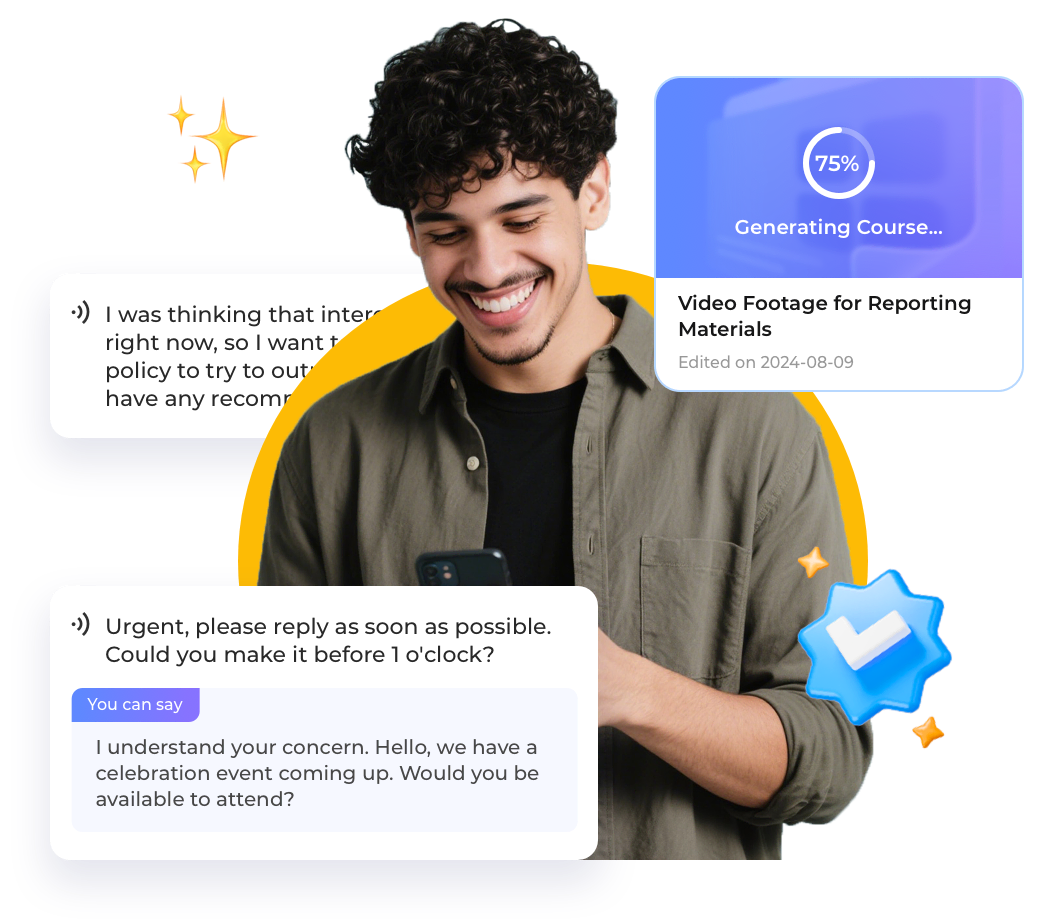
AI simulation replaces passive learning with active practice.An AI voice or chat bot acts as a customer,asking realistic questions.The trainee responds.The AI scores the response on accuracy,compliance,and tone.The trainee repeats scenarios until they master them.
Key features of AI simulation for telecom
•Pre-built telecom scenarios–Billing inquiry(“Why is my bill higher this month?”),technical support(“My WiFi is slow”),plan change(“I want to upgrade to unlimited data”),cancellation(“I want to disconnect my line”).
•Real-time feedback–After each response,the AI shows what the trainee did well and what to improve.For example:“You forgot to verify the customer’s identity before discussing the bill.Remember to ask for the last 4 digits of the IC number.”
•Difficulty scaling–The AI adapts.A trainee who handles simple scenarios well receives more complex ones(e.g.,an angry customer who threatens to switch providers).
•Performance dashboard–Managers see each agent’s mastery level by scenario type,enabling targeted coaching.
How Instadesk delivers AI simulation training
Instadesk’s Intelligent Training platform includes a telecom-specific scenario library.The AI customer uses natural language and varies its responses to keep practice realistic.The platform integrates with your learning management system(LMS)to record completion and scores.
Case study–Malaysian telecom reduces ramp-up time by 50%
A Malaysian mobile network operator with 500 call center agents deployed Instadesk’s AI simulation training.Previously,new agents completed 4 weeks of classroom training followed by 4 weeks of shadowing.Ramp-up time to full productivity was 8 weeks.
After deploying AI simulation:
•Classroom training reduced from 4 weeks to 2 weeks(replaced by simulation practice).
•Shadowing reduced from 4 weeks to 2 weeks(agents reached proficiency faster).
•Total ramp-up time:4 weeks(50%reduction).
•First-call resolution for new agents after 4 weeks:72%(previously 58%after 8 weeks).
•Compliance errors in billing calls dropped by 65%(simulation caught mistakes before live calls).
•Agent confidence scores(self-reported)increased from 58%to 86%.
How AI simulation works for a typical billing scenario
Scenario:Customer calls saying“My bill is RM 150 but I signed up for the RM 80 plan.”
Trainee must:
Verify customer identity(ask for IC last 4 digits).
Check the customer’s plan in the billing system(simulated or real API).
Explain possible reasons(promotional period ended,added roaming,overage fees).
Offer a solution(adjust billing,change plan,or escalate).
AI feedback after trainee response:
•Correct:“You verified identity.Good.”
•Missed:“You did not check if the customer added international roaming.Ask that question next time.”
•Compliance:“You used the term‘guarantee’when discussing fee waiver.Avoid‘guarantee’as fees depend on manager approval.”
Implementation timeline for telecom companies
•Week 1–Deploy Instadesk simulation platform.Upload your scripts and policies.
•Week 2–Customize scenarios based on your top 10 call types.
•Week 3–Pilot with 20 new trainees.Adjust feedback rules.
•Week 4–Roll out to all new hires and existing agents for refresher training.
Conclusion
Traditional training lacks practice.AI simulation from Instadesk fixes this gap,cutting ramp-up time by 50%and reducing compliance errors.Malaysian telecom companies can start with a free trial of the Intelligent Training platform.