
The Automotive Training Problem
Automotive companies in Malaysia face a fragmented training landscape. Sales teams need product knowledge and objection handling. Service advisors need diagnostic communication and upsell skills. Parts departments need accurate identification and return processing. Call centers need scheduling, warranty, and roadside assistance expertise.
Traditional training uses generic online courses or classroom sessions. They do not address department-specific needs. Managers have no visibility into who is struggling with what.
The result is inconsistent performance across dealerships and service centers.
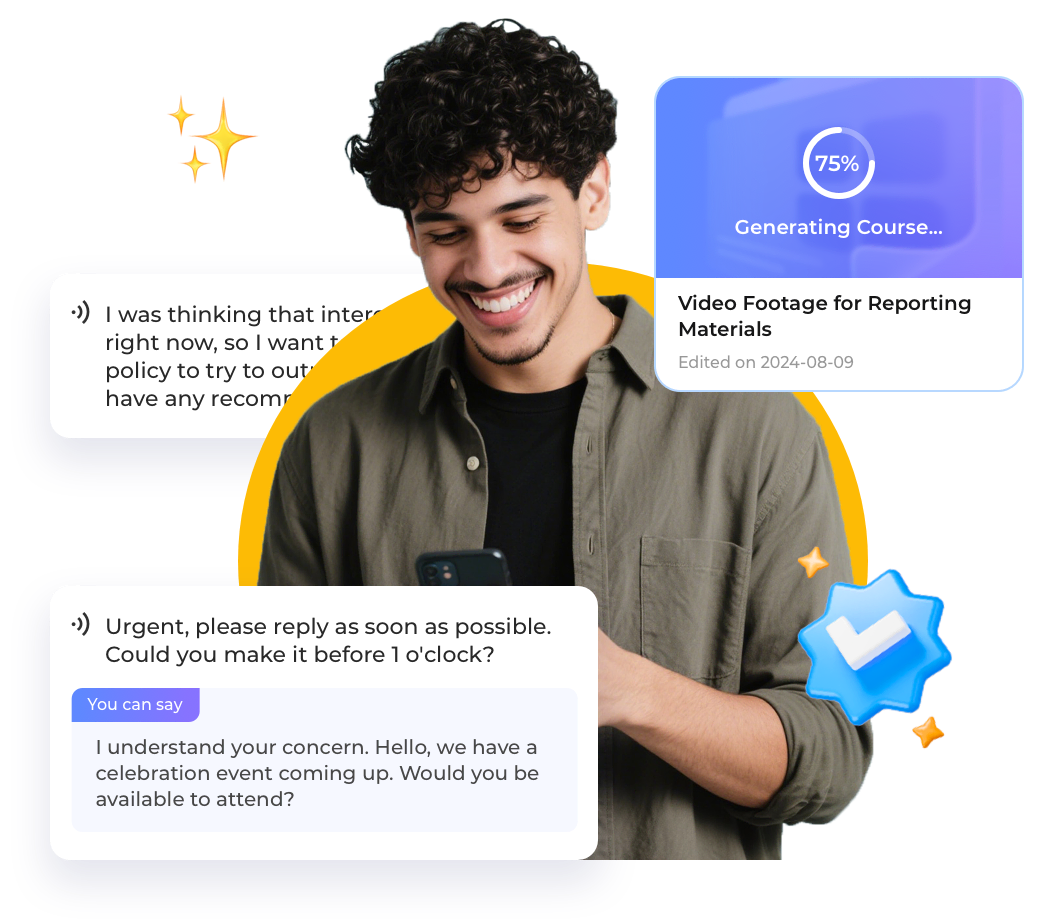
Instadesk Intelligent Training solves this with AI-powered, role-specific simulation. Each employee practices against realistic scenarios. The system scores responses, identifies gaps, and recommends targeted improvement.
How Multi-Department Intelligent Training Works
An intelligent training platform uses AI to create role-specific practice scenarios. Each employee interacts with an AI that plays the role of a customer, a technician, or a manager. The AI scores responses and identifies skill gaps. The platform then recommends targeted scenarios for improvement.
Role-based scenario libraries. Pre-built scenarios for sales, service, parts, and call center roles.
Real-time feedback. The system scores accuracy, compliance, and tone immediately after each scenario.
Manager dashboard. Shows skill gaps by department and individual, enabling targeted coaching.
LMS integration. Works with existing learning management systems if already in place.
The platform does not replace existing training. It reinforces it with practical, measurable practice.
What This Looks Like for Each Department
Sales scenarios. "Customer asks about fuel efficiency compared to Toyota." "Customer is concerned about resale value." "Customer wants to negotiate price on a Honda Civic." The AI plays the customer, challenging the salesperson with objections and questions. After the scenario, the system provides feedback: "You forgot to mention the 5-year warranty. That is a key differentiator from competitors."
Service advisor scenarios. "Customer says my engine light is on but I don’t have time for a full diagnostic." "Customer complains about the cost of a recommended repair." "Customer asks if a part is still under warranty." The AI tests the advisor’s ability to explain repairs, justify costs, and identify upsell opportunities.
Parts scenarios. "Customer needs a replacement alternator for a 2020 Proton X70." "Customer returns a part that is not the correct one." The AI assesses accuracy, speed, and handling of exceptions.
Call center scenarios. "Customer needs roadside assistance at 11pm." "Customer wants to schedule a service appointment next Saturday." The AI evaluates the agent’s ability to handle urgent requests, schedule efficiently, and maintain empathy.
The Business Case for Intelligent Training
A Malaysian automotive group with 30 dealerships and 500 sales staff deployed Instadesk Intelligent Training.
New sales hires previously required 8 weeks of classroom and shadowing to reach acceptable performance. After deploying role-specific AI simulation, new hires reached target performance in 4 weeks – a 50% reduction.
Sales conversion for new hires in weeks 5-8 increased from 12% to 19%. Service advisor upsell rate increased by 35% after targeted practice. Parts order accuracy improved by 22%, reducing returns and customer wait times. Training managers reduced coaching time from 20 hours to 8 hours per week.
The pattern is consistent across automotive companies. Intelligent training delivers faster ramp-up, higher performance, and better manager efficiency.
Why AI Simulation Works Better Than Classroom Training
Classroom training is passive. Employees listen to lectures, watch videos, and read slides. They do not practice. They do not receive feedback until weeks later, when they take a quiz or make a mistake on the job.
AI simulation is active. Employees practice real conversations. They make mistakes in a safe environment. They receive immediate feedback. They repeat until they get it right.
The difference is measurable. Employees trained with simulation retain more knowledge, perform better under pressure, and reach proficiency faster.
For automotive companies with high turnover in sales and service roles, this matters. Every week of ramp-up time saved is revenue generated sooner.
How to Implement
Step 1 – Identify key roles. Sales, service advisors, parts, call center – and their most common customer interactions.
Step 2 – Upload your materials. Product brochures, scripts, policy documents, and pricing guides. The AI uses these to build realistic scenarios.
Step 3 – Customize scenario libraries. Each brand has different products and policies. Proton. Perodua. Honda. Toyota. The platform adapts to each.
Step 4 – Assign employees to roles. Launch training and track progress.
Step 5 – Review manager dashboard weekly. Identify skill gaps and address them with targeted scenarios.
Implementation takes days, not months. No custom development required.
The Bottom Line
A multi-department intelligent training platform transforms how automotive companies train sales, service, parts, and call center teams. Role-specific AI simulation reduces ramp-up time, improves performance, and gives managers visibility into skill gaps.
Instadesk provides pre-built scenario libraries for each department. Real-time feedback on every interaction. Manager dashboards for tracking progress. Scalable training for 50 or 5,000 employees.
Start with a free trial. No credit card required.