
For many small businesses, voice is still one of the most important ways to contact customers. Telephone calls often represent emergencies, unclear issues, or situations that need verification and appeasement. Voice service itself is also a service channel that is difficult to scale.
As business scale grows, the number of calls increases, service coverage time extends, and customer expectations rise. Most small teams have limited manpower and are very sensitive to costs. This makes traditional voice customer service increasingly passive.
In this case, small businesses are beginning to use VoiceBot as a viable option. It is not for technical experiments, but a practical tool for dealing with daily service pressure.
From our deployments with small businesses, voice automation consistently reduces the burden of after-hours and repetitive calls. Results vary by industry, but round‑the‑clock availability is always a win.

1. What Is the Instadesk Voice Intelligent Customer Service Robot?
Instadesk voice intelligent customer service robot is a voice service system powered by artificial intelligence, designed for real telephone communication between enterprises and customers.
Unlike traditional IVR systems that rely on fixed menus and keypad operations, Instadesk VoiceBot is built on voice recognition (ASR), natural language understanding (NLU), and speech synthesis (TTS). This allows it to have natural conversations with callers, identify needs, and respond in a more human‑like way.
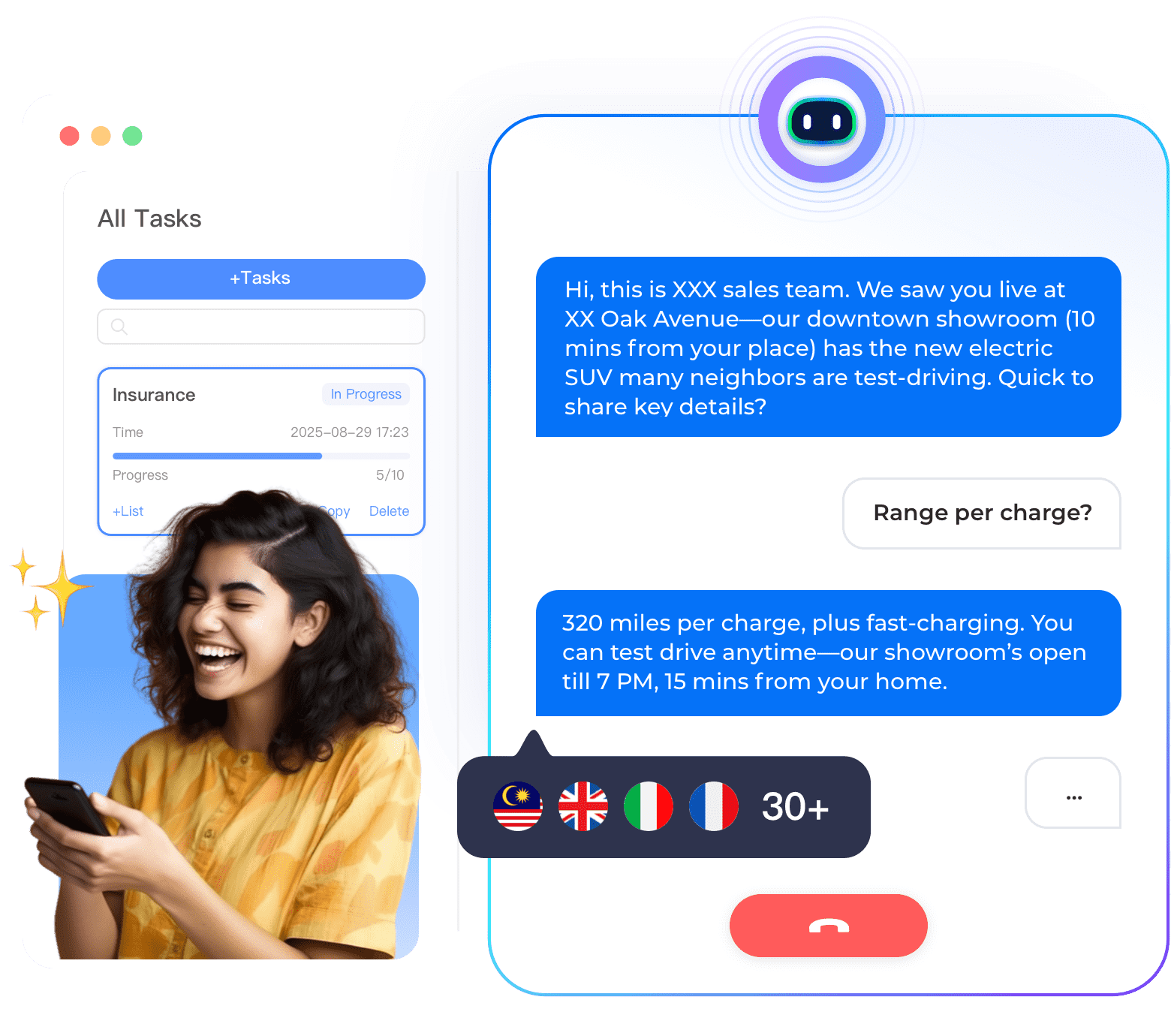
At the functional level, VoiceBot can automatically answer calls and respond directly to customers without requiring them to wait for human agents. It understands real needs expressed in natural language and gives accurate responses based on pre‑set business knowledge. When encountering complex or sensitive issues, VoiceBot transfers the call to a human agent while retaining the complete conversation history. VoiceBot can also be used for notifications, reminders, and follow‑ups by proactively initiating voice calls.
For small businesses, this means voice automation is no longer just a simple call routing tool. It is a practical operating tool that directly participates in daily customer service work.
2. Core Value of Intelligent Customer Service Robots for Small Businesses
For small businesses, the value of intelligent customer service robots lies not in technological complexity but in their actual impact on daily operations.
Reduce repetitive workload. Repeated questions account for a large portion of calls received by small businesses. Customers ask about order status, service availability, appointment ation, and next steps. These calls need accurate answers but do not involve complex judgments. VoiceBot ensures consistent and accurate expressions in each interaction.
Improve response speed and availability. Small teams with limited staff often struggle to answer all calls in time, especially during peak hours and after hours. Missed calls often mean lost opportunities. VoiceBot answers instantly and runs continuously, so customers get a response at any time.
Stable service quality. Human agents experience fatigue, and there can be inconsistencies in experience and pressure levels. VoiceBot delivers stable, uniform responses, ensuring each interaction meets the same standard.
Control operating costs. Hiring more agents increases costs. Voice automation allows small businesses to improve service capabilities without expanding headcount, making cost structures more predictable and sustainable.
3. How Does Instadesk VoiceBot Work for Small Businesses?
Instadesk VoiceBot is designed to integrate into existing business operations without requiring enterprises to completely reengineer their processes.
As the first contact layer for call handling. In many practical applications, VoiceBot is the first point of contact for incoming calls. When a customer calls, VoiceBot answers immediately and begins a natural conversation. The system identifies the customer's real needs and answers frequently asked questions independently. It then determines whether human intervention is needed. When a transfer is required, the conversation history is preserved so the agent understands the situation immediately, and the customer does not need to repeat themselves.
Outbound voice automation. For other common small business scenarios beyond inbound calls, Instadesk VoiceBot also provides handling capabilities. These include appointment reminders, payment notifications, service or subscription expiration s, and status updates on orders or service progress. In practice, voice robots automatically initiate calls according to established business rules and deliver key information to customers. This reduces manual dialing workload and repeated explanations, while also ensuring consistent external communication.
Multilingual voice interaction. Small businesses operating across regions often face language barriers. Instadesk VoiceBot supports multilingual voice interaction within the same system, enabling communication with customers in different languages without establishing separate service teams.
Data collection and continuous optimization. Every voice interaction generates structured data. These data help businesses identify high‑frequency customer issues, adjust service scripts, and gradually improve overall response accuracy.
4. Why Can Instadesk Offer Greater Assistance to Small Businesses?
Instadesk's advantages lie not only in the technology itself but also in how it is designed for real small business environments, where resources and conditions are often limited.
Designed for actual deployment scenarios. Instadesk VoiceBot does not rely on complex system architecture or require a large technical team. Small businesses can start with the most basic scenarios and gradually introduce relevant functions as they grow.
Human‑machine collaboration at the core. Instadesk does not aim for full automation. VoiceBot works alongside human agents. Predictable, repetitive tasks are handled by the system, while communication requiring judgment and flexible response is handled by people.
Unified voice service logic. Voice interaction is centrally managed within one system. Service rules are consistent, response methods are stable, and teams do not need to switch between multiple tools. This approach is particularly suitable for small teams with limited resources.
5. Practical Deployment Example
In a real deployment (based on overseas experience), a consumer‑facing enterprise used multiple communication channels simultaneously, including telephone, messaging platforms, and email. Customer inquiries were frequent, highly repetitive in content, and often arrived outside regular working hours.
The company connected Instadesk VoiceBot to its existing service process and centralized all incoming voice calls into the same system. VoiceBot handled common issues independently, gave consistent responses across different languages, and transferred complex situations requiring human intervention along with complete conversation history to human agents.
Outbound voice notifications, such as service reminders and status updates, were also completed automatically by the system. Manual dialing demand dropped significantly, response times improved, and overall service coverage became more stable.
It should be noted that this model did not eliminate human agents. Rather, the voice service operation was adjusted: the support team primarily handles exceptions and specific customer problems, while routine interactions are handled by the system. The enterprise improved service efficiency without increasing customer service headcount.
6. Conclusion
For small businesses, voice service is both important and difficult to execute well. Voice services need to respond quickly, provide accurate information, and be available at any time—all within resource‑constrained environments. Instadesk voice intelligent customer service robot offers a practical solution. The system automatically handles a large volume of repetitive voice interactions and works alongside human agents. This approach helps small businesses reduce the operational pressure of voice services, making voice service a more manageable and scalable system. VoiceBot for small businesses is not meant to replace human agents or achieve full automation. Its goal is to improve daily service stability, enhance efficiency, and align closely with how small businesses actually operate.