Introduction
Malaysia faces a mounting debt collection challenge. As of December 2025, household debt exceeded 84% of GDP — one of ASEAN's highest debt-to-income ratios. From 2021 to March 2026, Malaysia recorded over 31,500 bankruptcy cases, nearly half from personal loans. Consumer lending continues to grow across banks, fintech lenders, and BNPL providers.
At the same time, regulation has shifted. The Consumer Credit Act 2025 (CCA) came into force on 1 March 2026. It establishes a Consumer Credit Commission to regulate BNPL, leasing, debt collection agencies, and more. Collection agencies now face stricter licensing and conduct rules.
These two forces — rising debt and tighter regulation — demand a new approach. AI voice bots offer a solution: automated, compliant, scalable collections. This guide explores how Malaysian banks, fintechs, and collection agencies can benefit from AI voice bots for debt recovery — and what to look for when choosing a platform.
Traditional Outbound Collection: Why Manual Models Fall Short
Manual collection fails for four reasons. First, agent burnout: churn exceeds 30%, driving constant hiring and training. Second, low contact rates: consumers screen unknown calls, so agents waste time on voicemails. Third, compliance risks: manual operations easily exceed call limits, mishandle data, or use aggressive language—triggering complaints and regulatory action under the CCA. Fourth, high cost: a human‑led collection call costs 5–25 fully loaded, and low contact rates make this expense unsustainable at scale.
What Is an AI Debt Collection Voice Bot and How Does It Work?
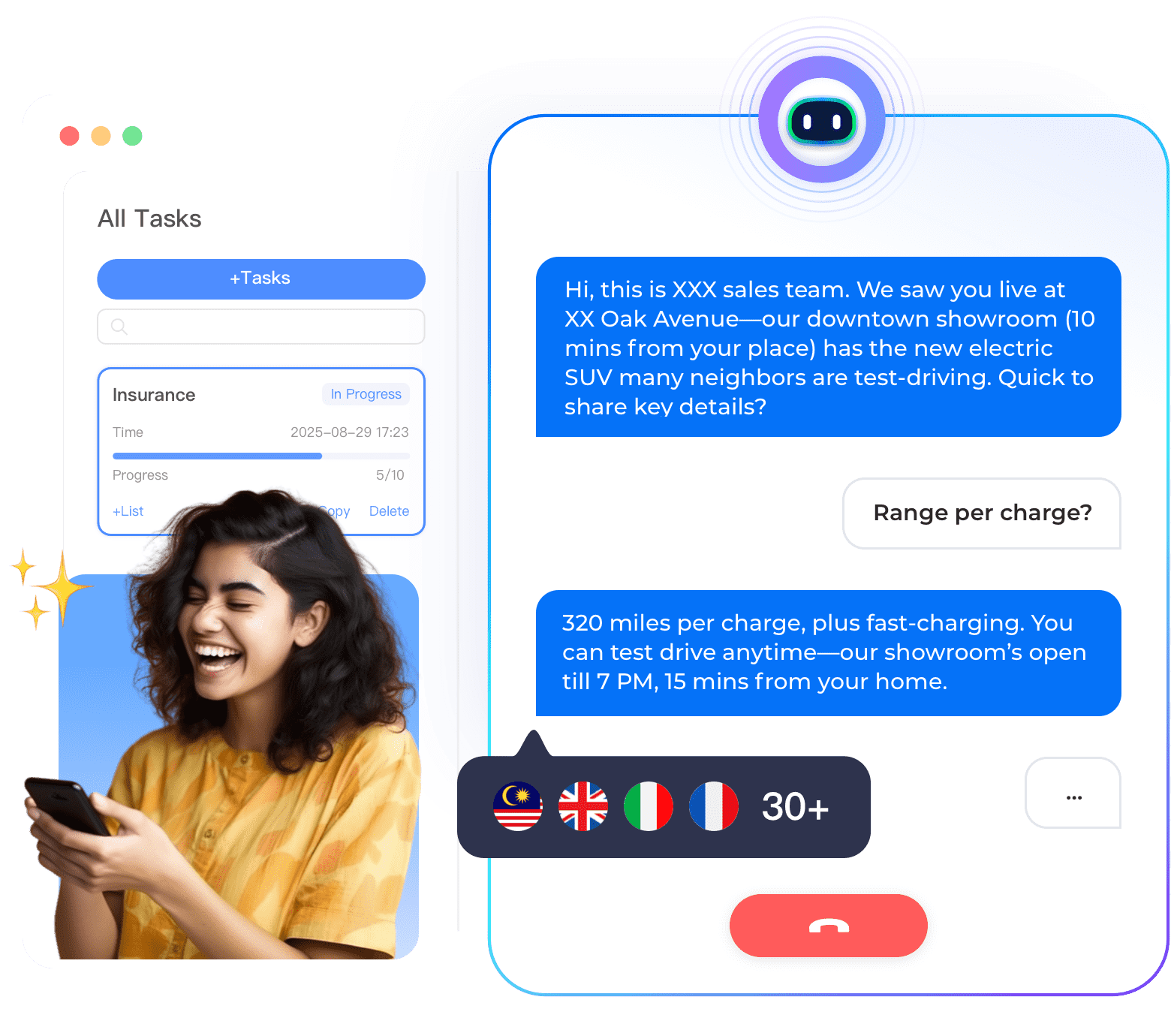
An AI debt collection voice bot automates outbound calls for payment reminders, overdue follow-ups, and negotiation — while maintaining compliance. Unlike scripted IVR menus, modern voice bots using LLMs understand natural speech and adapt to each borrower.
The technology stack includes:
- ASR: Converts spoken responses to text.
- NLP & LLM: Interprets hardship, objections, payment intent, and decides next steps.
- TTS: Generates natural voice responses in Bahasa Malaysia, Mandarin, English, or Tamil.
- Telephony integration: Bridges to Malaysia's telecom network, plus WhatsApp and SMS.
A well-designed bot works autonomously: it places calls, gives compliant disclosures, listens, offers repayment options, negotiates within limits, and logs outcomes into the CRM — all without human involvement. When a borrower agrees to pay, the bot can send a payment link via SMS or WhatsApp, closing the loop immediately.

Why AI Voice Bots Fit Malaysia's Debt Collection Landscape
Consumer debt volume is large and diversifying. Household debt exceeds 84% of GDP, with over 31,500 bankruptcy cases since 2021 (46% from personal loans). Manual teams cannot scale without exponential cost increases. AI voice bots can place thousands of calls per day, 24/7, without adding headcount.
A multilingual and multicultural base. Malaysia spans Bahasa Malaysia, English, Mandarin, and Tamil. Voice bots with multilingual LLMs handle language switching and code-switching naturally — something human agents struggle with under high caseloads.
Systematic compliance and auditability stem from new regulations. The CCA requires licensing and conduct rules for collection agencies. Regulators expect auditable records of contact frequency, disclosures, and respectful communication. AI systems automatically enforce limits, log every interaction, and generate audit trails.
Engagement channels need to be renewed. WhatsApp penetration exceeds 85%, and younger consumers prefer digital communication. An intelligent platform unifying voice and WhatsApp improves engagement significantly, with a 10–30% increase in right-party contact rates.
Key Capabilities Malaysian Enterprises Should Look For
· Full regulatory compliance built in – Enforce contact frequency limits, redact sensitive data, record every call, include disclosures, handle opt‑outs.
· Multilingual conversational support – Bahasa Malaysia and English baseline, plus Mandarin and Tamil. Understand spoken numbers and handle code‑switching.
· Omnichannel outreach (voice + WhatsApp) – Unify voice and messaging. Send reminders and payment links through the borrower's preferred channel.
· Local data residency – In‑country deployment is a requirement. Choose a platform with a local Malaysia node.
· Integration with existing systems – Connect to core banking, collections platforms, and CRM via APIs. Automate payment links, status updates, and escalation workflows.
· Intelligent negotiation strategies – Propose instalment plans, discounts, or deferrals based on borrower profile. This differentiates a true AI collector from a simple reminder bot.
Instadesk: An AI-Powered Answer for Malaysian Debt Collection
For Malaysian enterprises seeking a locally compliant AI contact centre platform, Instadesk offers a compelling solution. In March 2026, it co-hosted an AI seminar in Kuala Lumpur with local partner Startech. The platform already runs live deployments across Malaysian enterprises. In April 2026, Instadesk launched its dedicated Malaysia node, ensuring data stays within national borders.
Instadesk's AI voice bot delivers key capabilities:
- Multilingual LLM support – Natural bilingual dialogue across Bahasa Malaysia, English, Mandarin, and others.
- Omnichannel reach – Native integration with WhatsApp, Line, Viber, Facebook, Telegram.
- Automated compliance and auditability – Every call recorded; AI quality inspection reviews 100% of interactions.
- Self‑improving conversational intelligence – Learns from interactions, improving intent recognition and objection handling.
- Local infrastructure with global reach – Malaysia node provides sub‑second latency.
For Malaysian banks, fintechs, and collection agencies, Instadesk offers a compliant, scalable, cost‑effective path to intelligent debt recovery.
Real-World ROI: What Malaysian Enterprises Can Expect
Global benchmarks: Agentic AI collections can reduce costs by up to 75% — per‑interaction costs drop from 5–25 to 0.25–0.50. Call capacity expands to 24/7 (168 hours/week vs. 40–60 for a human agent).
Belvo's AI Collections (voice + WhatsApp) has demonstrated a 10–30% increase in right-party contact rates and a 5–20% uplift in early‑stage recovery. A large Southeast European bank achieved a 60% increase in promise‑to‑pay rates and a 15% higher recovery rate than human‑only agents. A US operation reported over 90% of delinquent calls resolved without human intervention.
Translating to Malaysia: a bank with 10,000 overdue accounts monthly could see contact rates rise from 30–40% (manual) to 50–70% (AI voice + WhatsApp). Per‑call costs fall by at least 50%. AI bots work 24 hours a day, including evenings and weekends when borrowers are most likely to answer.
Compliance Imperative: Navigating Malaysia's Regulatory Framework
Under Malaysia's PDPA and the new CCA:
· Purpose limitation – Using customer data for debt collection must be properly disclosed. AI platforms must support data access controls and consent tracking.
· Cross‑border data transfers – Malaysia has restrictive rules. A local Malaysia node — like Instadesk's — eliminates cross‑border exposure.
· Communication conduct – Harassment, excessive call attempts, or unauthorised disclosure to family members can trigger complaints.
· Auditable conversations – The CCA requires transparent, recorded, auditable collection calls. EU AI Act transparency principles may influence local regulators.
Getting Started: A Practical Roadmap for Malaysian Enterprises
Phase 1: Audit your portfolio and compliance gaps. Identify which segments are best for automation — typically low-balance, early-stage delinquencies (30–90 days past due). Assess your current compliance posture under the CCA and PDPA.
Phase 2: Select a platform with Malaysia-local infrastructure. Prioritise vendors with local data hosting and existing local deployments. Instadesk's Malaysia node (April 2026) is one example.
Phase 3: Run a pilot on a limited segment. Choose 1,000–2,000 low-balance accounts for a 4–8 week pilot. Measure contact rates, promise-to-pay conversion, and cost per interaction.
Phase 4: Train the bot on your collection policies. Configure negotiation parameters: settlement ranges, instalment plans, escalation rules, and hardship guidelines. Use your best human scripts to tune conversational flows.
Phase 5: Integrate with your core systems. Connect the voice bot to your collections management system or CRM via API or file upload. Ensure payment promises and status updates flow automatically.
Phase 6: Expand iteratively. Once the pilot shows positive ROI (typically within 8–12 weeks), expand to more segments. Add WhatsApp as a supplementary channel. Shift human agents to only the most complex or high-value cases.
Conclusion
Debt collection in Malaysia is at an inflection point. Rising household debt, growing overdue accounts, and the Consumer Credit Act 2025 demand operations that are both scalable and compliant. Manual calling — high cost, low contact rates, human error — can no longer meet these demands.
AI voice bots offer a proven alternative: 24/7 multilingual outreach, consistent compliance, and per-interaction costs a fraction of traditional operations. For Malaysian enterprises, solutions like Instadesk bring these benefits locally. With a dedicated Malaysia node, native multilingual support (Bahasa, English, Mandarin, Tamil), and built‑in quality inspection for full auditability, Instadesk helps banks, fintechs, and collection agencies move from manual friction to intelligent automation.
The question is no longer whether AI voice bots can handle collections — but how quickly Malaysian enterprises will deploy them. First‑mover advantage is large. Those who wait will face higher costs, lower recovery rates, and growing compliance burdens under the CCA.