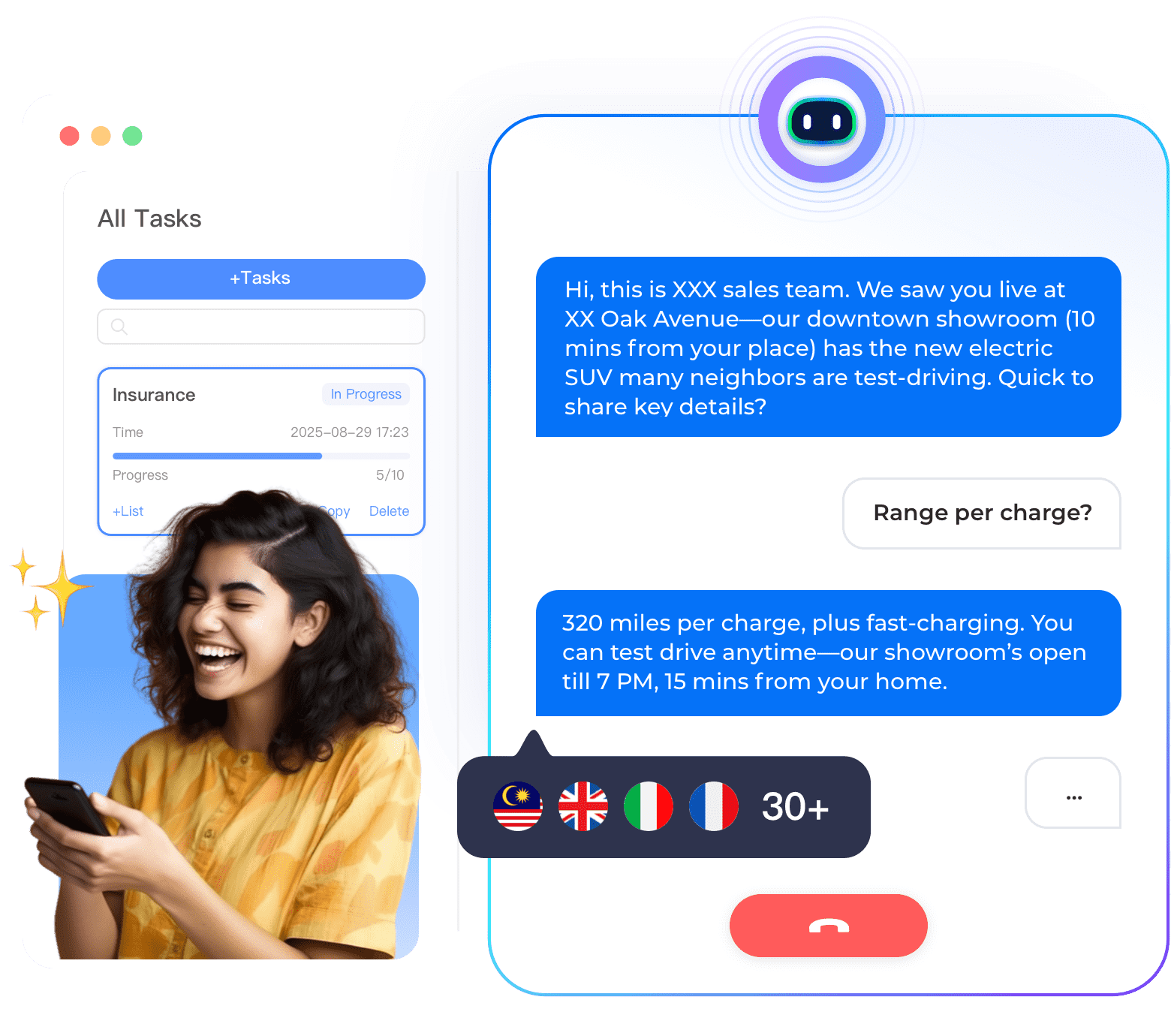
Global insurers face multiple challenges:policyholders across countries,different languages,varying regulations,and time zones.A cross-border voice bot provides local phone numbers,multilingual AI,local compliance,and time-zone routing from one platform.This article explains key capabilities,benefits,and how Instadesk enables localized,automated support anywhere.
The CrossBorder Insurance Challenge
Insurance companies expanding internationally must support policyholders who expect local phone numbers,native language service,and compliance with their country's privacy laws.Traditional call centers require separate instances per country,leading to high costs,inconsistent service,and slow deployment.A crossborder voice bot solution consolidates global operations into one platform.

Key Capabilities for CrossBorder Voice Bots
• Local phone numbers: Acquire in-country numbers for 50+countries so policyholders call locally.
• Multilingual NLU: Understand insurance terminology in 30+languages(e.g.,"claim,""deductible,""premium" in local language).
• Automatic language detection: Route to the correct language bot based on caller's location or input.
• Timezone routing: Ensure calls are answered during local business hours,with afterhours automation.
• GDPR/local compliance: Data residency options(EU,US,APAC),consent management,and audit trails.
• Centralized management: Configure all countries from one dashboard,with localized scripts.
• Unified analytics: Compare performance across countries,languages,and time zones.
Benefits for Global Insurance Carriers
• Cost efficiency: One platform for all countries instead of multiple instances.
• Faster expansion: Add a new country in days (local number,script translation,compliance check).
• Consistent customer experience: Same quality standards,scripts,and escalation paths globally.
• Improved compliance: Built-in GDPR,data residency,and local call recording rules.
• Scalable automation: Voice bots handle routine inquiries in all languages,reducing agent costs.
How Instadesk's Voice Bot Serves CrossBorder Insurance
Instadesk's platform is purpose-built for global operations.Key features include local phone numbers in 50+countries with number porting and autoprovisioning.Insurancetrained NLU for 30+languages(English,Spanish,French,German,Japanese,Mandarin,etc.).Automatic language detection based on caller ID or IVR input.Data residency options:store call recordings in EU(Frankfurt),US(Virginia),or APAC(Singapore).Centralized management console for script translation,routing rules,and analytics.Pre-built compliance templates for GDPR,CCPA,and local insurance regulations.

Case Study:Global Insurer Expands to 8 Countries with One Voice Bot Platform
A multinational insurance carrier with headquarters in the UK operated separate call centers in Germany,France,Spain,and Japan.They deployed Instadesk's crossborder voice bot to consolidate.Results after 18 months:added 3 new countries(Italy,Netherlands,Australia)in 2 weeks each;operational costs reduced by 40%;customer satisfaction scores improved from 74% to 86% due to local language support;compliance audits passed in all countries with centralized reporting.
How to Implement a CrossBorder Voice Bot
•Select a platform with global infrastructure (Instadesk).
•Acquire local numbers for target countries.
•Translate and localize voice bot scripts(use native speakers).
•Configure language detection and timezone routing.
•Set up data residency rules per country.
•Test with pilot groups in each country.
•Launch and monitor countryspecific analytics.
•Continuously optimize based on local customer feedback.
Conclusion
A voice bot for crossborder business is essential for global insurance carriers seeking to provide localized,automated customer service.Instadesk’s platform delivers local numbers,multilingual AI,and compliance tools,enabling insurers to scale globally while reducing costs and improving policyholder experience.