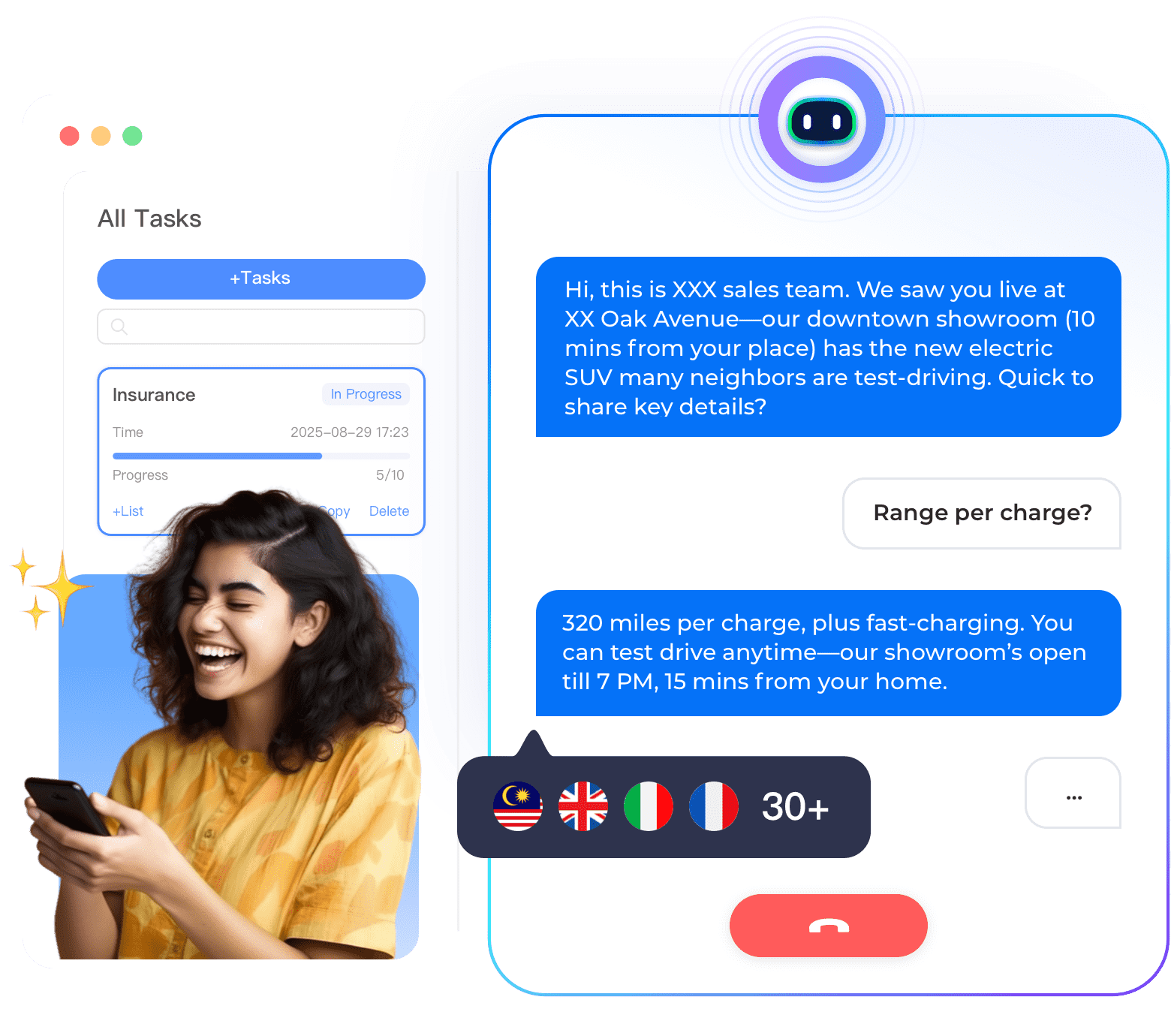

What Is an AI Agent?
An AI agent is an autonomous system that independently plans, reasons, and executes multi-step tasks to achieve a specific goal with minimal human supervision.Unlike reactive AI models that wait for explicit instructions, an AI agent understands its environment, constructs action plans, and adapts based on outcomes.
Its defining characteristic is self‑directed action. It determines what to do next based on objectives and available context, rather than following rigid, pre‑programmed rules.
Instadesk AI VoiceBot is built on this agentic architecture.
This guide explores how AI agents work, how they differ from traditional automation, and how Instadesk helps businesses deploy them in real‑world customer service.
AI Agent vs. Traditional Chatbot: What’s the Difference?
A traditional chatbot responds to a single question and stops. It follows a decision tree. It cannot take action across systems.
An AI agent goes further. It reads a customer’s message, looks up order history, checks inventory, processes a refund, updates the CRM, and sends a follow‑up ation — all without human intervention.
Think of a traditional chatbot as a conversational FAQ. Think of an AI agent as a digital teammate that can actually get work done.In service terms, this difference is massive. A chatbot answers “Where is my order?” An AI agent finds the order, checks the shipping status, and triggers a notification if the package is delayed — before the customer even asks again.

How an AI Agent Works
An AI agent operates through a continuous learning loop that allows it to handle complex service tasks at speed and scale.
Understanding. The agent monitors data streams like customer messages, ticket history, behavior patterns, and system status. It does not wait to be told there is a problem. It actively scans for signals.
Planning. Rather than following a fixed script, the agent evaluates context, weighs possible outcomes, and constructs an action plan. For a refund request, it reviews purchase date, product eligibility, and company policy before choosing the best path.
Action. The agent executes steps across connected systems: looking up orders, updating records, triggering workflows, or escalating to a human agent when the situation requires judgment.
Learning. Every resolved interaction feeds back into the system. The agent becomes more accurate and efficient over time without requiring manual retraining for each new scenario.
Instadesk’s platform builds on these four phases. Its AI voicebots and chatbots share a unified memory and can hand off tasks seamlessly across channels.
Key Capabilities of an AI Agent
Autonomous, contextual intelligence. Unlike rule‑based systems, an AI agent demonstrates flexible reasoning. It weighs multiple factors — customer history, urgency signals, business policies, real‑time system data — to make nuanced decisions that adapt to each unique situation.
Seamless integration across systems. An AI agent connects with existing CRM, ERP, knowledge bases, and communication channels. Instadesk offers prebuilt connectors for Salesforce, SAP, Shopify, Zendesk, and more, turning passive ticket repositories into active resolution engines.
Transparent decision‑making. An AI agent can show its reasoning: why it took a specific action, what data it used, and how confident it was. Service teams can review these reasoning chains, adjust parameters, and set approval thresholds without waiting for engineering changes.
Continuous improvement without manual updates. Each interaction helps the agent improve. Over time, the system becomes more accurate, handling more complex requests with less human oversight.
Why AI Agents Matter for Customer Service
Traditional automation handles simple, predictable tasks. An AI agent tackles multi‑step, context‑dependent scenarios that previously required experienced human agents.
Processing a billing dispute that spans three systems. Coordinating a product return across logistics and finance. Onboarding a new customer with multiple account setups. All of these can be automated with AI agents.
The impact on service teams is significant. Routine tickets that required back‑and‑forth can be resolved in seconds. Consistency improves because the agent applies the same policies and quality standards to every interaction.
Agent burnout decreases. Human agents focus on high‑judgment conversations where their empathy and problem‑solving skills matter most.
Real‑World Example: UniUni’s Multi‑Agent Platform
North American logistics provider UniUni faced fragmented channels, language barriers, and high inquiry volume. Customers reached out on WhatsApp, email, Amazon messages, and phone — all expecting instant answers about their packages.
Instadesk built a multi‑agent platform that integrated AI voicebots, text chatbots, multilingual translation, and smart ticketing. The system automatically identified inquiry types, routed them to the right agent (human or AI), and handled routine tracking requests without any human touch.
The results: 85% AI self‑service rate, 90%+ multilingual response accuracy across 50+ languages, and customer service efficiency doubled.
More importantly, the system now anticipates common inquiries. When a customer sends a tracking number, the AI automatically recognizes it, pulls real‑time shipping data, and provides an update — before the customer even asks for it.
That is the difference between a reactive chatbot and a proactive AI agent.
Conclusion
An AI agent is not just another layer of automation. It is a shift in how service gets done.Instead of waiting for customers to raise issues and then routing them through a series of steps, an AI agent can anticipate needs, take action, and resolve work proactively.
Instadesk builds this capability into its voicebots, chatbots, and agent assist tools. Deploy in days with no‑code orchestration. Pay only for what you use.Start with a free trial. No credit card required.