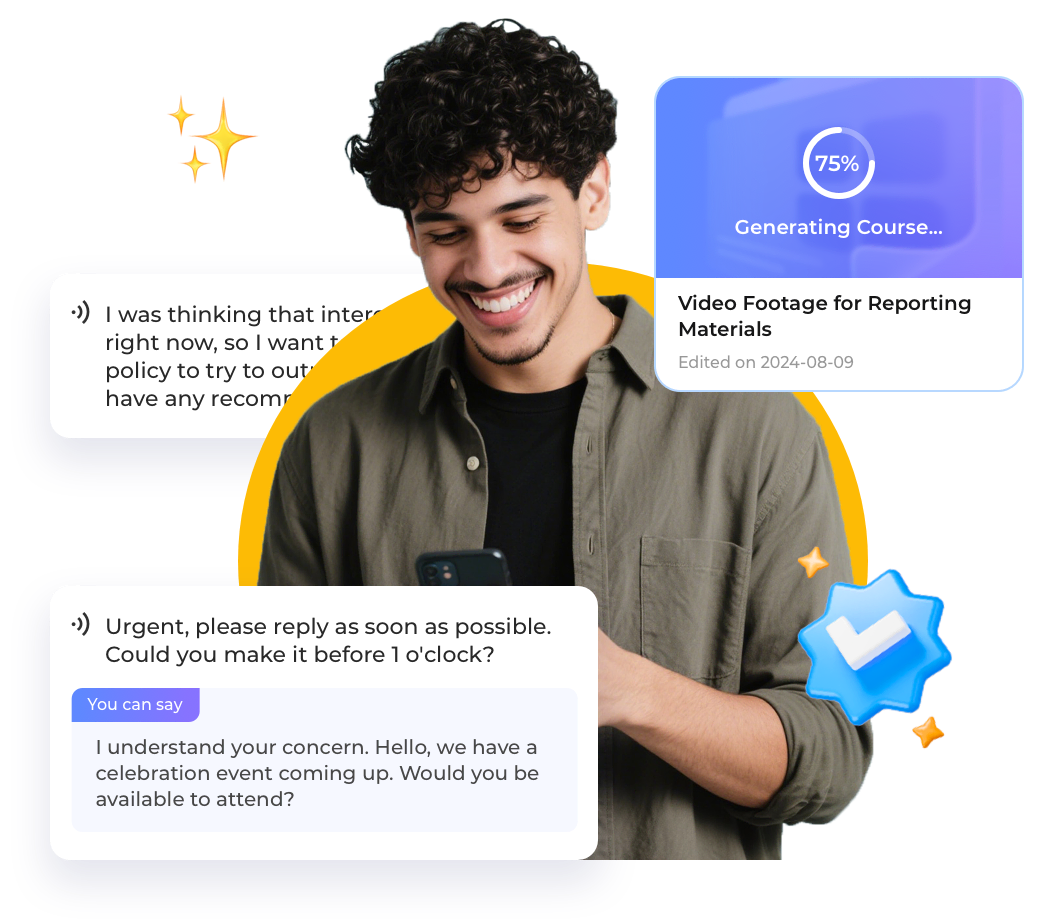
New hires take months to reach full productivity.Traditional training teaches theory but doesn't prepare agents for angry callers or confused shoppers.Simulation-based training uses AI to create realistic customer scenarios—agents practice safely,receive instant feedback,and build confidence before handling real customers.

What is Simulation-Based Training?
AI replicates real customer interactions.Agents practice 1-on-1 with virtual customers that simulate different personalities and emotions.Practice replaces theory.Agents learn by doing,not just listening.
Why It Works for Customer Service Teams
1. Immediate Feedback After Every Interaction
In traditional training, feedback comes days or weeks later—after a manager listens to a call recording or reviews a ticket. By then, the moment for learning has passed.
Simulation-based training provides instant positive feedback after each practice session. Agents learn what they did well and where they can improve while the conversation is still fresh. Language s with 86% accuracy guide agents toward better phrasing and more effective responses.
2. Practice with Every Type of Customer
New agents typically start with easy cases, gradually building up to difficult customers. But when a challenging situation finally arrives—an irate customer, a complex refund request—they face it without preparation.
AI-powered simulations draw from massive libraries of real customer interactions, representing multiple emotions and personality types. Agents can practice handling angry customers, confused shoppers, and savvy bargain-hunters before meeting them in real life. They challenge themselves with tricky problems in advance, not for the first time on a live call.
3. Safe Practice Without Risk
Every mistake in a real customer conversation carries cost—a lost sale, a damaged relationship, a negative review. Simulation removes that risk. Agents can experiment with different approaches, fail safely, and learn from errors without consequences.
The result? When they do handle real customers, they've already made their mistakes in practice and learned better ways.
Key Elements of Effective Simulation Programs
1. Realistic Customer Scenarios
Effective simulations are built on real data. The most powerful platforms use millions of real customer conversations to train their AI, ensuring virtual customers behave like actual humans—with all the unpredictability that entails.
2. Multi-Dimensional Evaluation
Training effectiveness shouldn't be measured by "did the agent complete the call?" Modern simulation platforms evaluate performance across 14+ dimensions—tone, accuracy, problem-solving, empathy, and more. Managers can see exactly where each agent excels and where they need support.
3. Personalized Learning Paths
Not every agent needs the same training. Some struggle with angry customers; others handle complaints well but miss upsell opportunities. AI can scan for capability shortboards and automatically recommend customized courses targeting each agent's specific weaknesses. New hires, promotion candidates, and experienced agents seeking refinement all follow different paths.
4. Integration with Quality Assurance
The most sophisticated programs connect training with ongoing quality assurance. When quality monitoring identifies common weaknesses across the team—perhaps agents struggle with a new product launch or a recurring customer complaint—the system automatically creates targeted training modules addressing those specific gaps.
How to Implement Simulation Training
• Start with High-Impact Scenarios
Begin with the conversations that matter most to your business. For most customer service teams, this means complaint handling, returns processing, and complex inquiries that typically require supervisor involvement.
• Let Agents Practice Before They Perform
The "practice before meeting clients" approach transforms confidence. Before new products launch or policies change, agents can practice the new conversations in simulation. They arrive at real customer interactions already fluent in the latest messaging.
• Track Progress with Data
Simulation platforms generate rich data on agent development. Track improvement over time, identify team-wide training needs, and measure the connection between simulation practice and real-world performance metrics.
Measuring Success
Organizations implementing AI-powered simulation training see measurable improvements across key metrics:
• Training cycles shorten by 32%, getting new agents productive faster
• Lead retention rates increase by 19% as agents handle conversations more effectively
• Training costs decrease by 19% while outcomes improve
• Agent professional capability scores rise by 47% through targeted, personalized practice
• Turnover rates drop by 16% as agents feel more confident and supported
Getting Started
Modern simulation platforms work out of the box—no months of setup required.Start with one team and your most challenging scenarios.Within weeks,you'll see the difference between training that talks about customers and training that lets you talk to them—safely,effectively,and at scale.