Abstract:
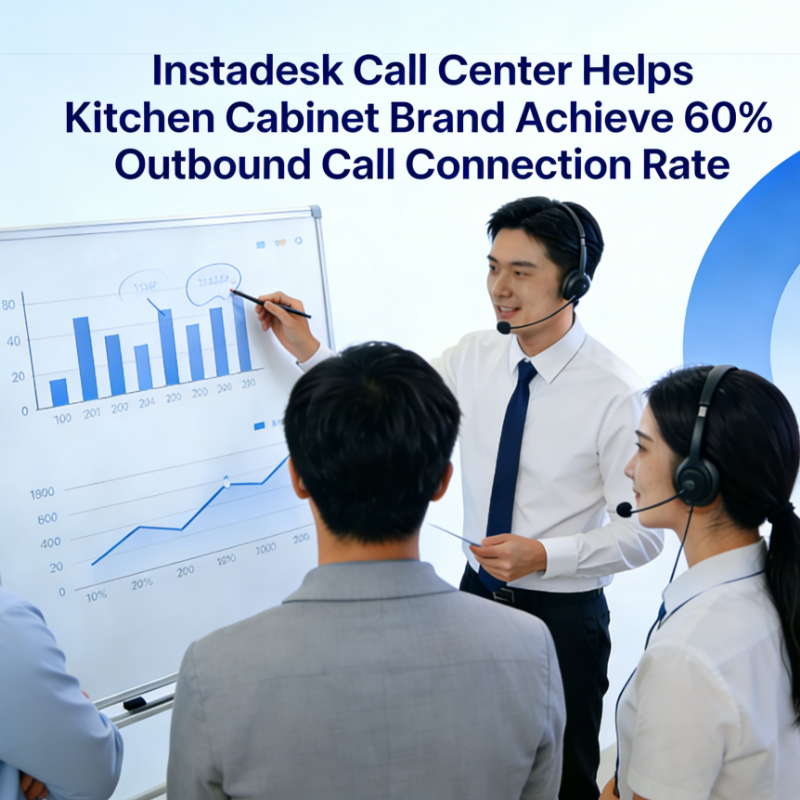
A kitchen cabinet manufacturer partnered with Instadesk Call Center to simplify after‑sales outbound calls using predictive dialing. Call connection rate stabilized at 60%, and agent productivity improved significantly. This sets a benchmark for digital after‑sales transformation in home furnishing.
Under global digital transformation, traditional home furnishing is entering a service upgrade window. A well‑known international cabinet brand prioritized user experience and after‑sales service. But global expansion exposed problems: slow response, poor reachability, and scattered data.
Facing these issues, the brand chose Instadesk Call Center. Using predictive outbound calls, they restructured after‑sales processes. Connection rate reached 60%, and agent productivity rose sharply.
Premise: The Bidirectional Nature of Furniture After‑sales Service
Home furniture after‑sales service is bidirectional. Customers contact merchants for installation or quality issues. Merchants also proactively contact customers for care, feedback, and brand reputation. Active outreach helps detect problems early and improve satisfaction.
I. Pain Points in After‑sales Service
The brand’s rapid global growth brought cross‑border after‑sales challenges. First, traditional service was inefficient: manual agents called one by one, resulting in low efficiency and poor connection rates. Foreign customers’ needs often went unreached.
Second, service data could not form a closed loop. Feedback from design, production, installation, and after‑sales was scattered. Without data support, problems cannot be solved effectively.
II. Instadesk Call Center: Technology Empowers Precision
Instadesk introduced its Call Center system to address these pain points.
1. Call Center – Predictive and batch outbound calls improve efficiency and utilization. Before: manual dialing wasted time on busy lines and missed calls. Now: Call Center acts as an “automatic dialer + intelligent task distributor” – batch dials 180+ languages and instantly transfers connected calls to available, language‑matched agents. Agents spend every minute on effective communication, not waiting.
2. Predictive outbound calling – Integrates predictive algorithms and voice recognition. It monitors connection success and agent availability in real time, identifies numbers to call, reduces wait time, and eliminates inefficient calls.
Ordinary auto‑dialers may dial too many calls, leaving customers waiting. Instadesk’s system sees real‑time data: how many calls can connect, which agents are about to finish. It ensures a ready agent answers immediately. Value: zero waste, maximum efficiency, no customer complaints from delayed connection.
III. Remarkable Achievements
After deployment:
· Outbound call connection rate rose to 60%, well above industry average.
· Average daily effective call time per agent increased to 5–6 hours.
· Customer follow‑up response speed improved by about 50%.
· Service data consolidated into the outbound system, supporting product iteration and marketing.
Most importantly, the after‑sales team was freed from repetitive calling. They now focus on complex issues and customer relationships — a dual improvement in service quality and satisfaction.
IV. Revelation: Digital Transformation Path
This case shows that intelligent after‑sales outbound calls build long‑term brand‑user trust. Enterprises can optimize resources, reduce costs, and capture cross‑border customer needs, forming a “service → feedback → optimization” closed loop.
For home furnishing firms, this provides a reusable path: start with precise outreach, drive with data, and aim for customer satisfaction. Build a sustainable modern after‑sales system.
If your enterprise faces difficult customer reach, low agent efficiency, or scattered service data, try Instadesk Call Center for a customized solution.