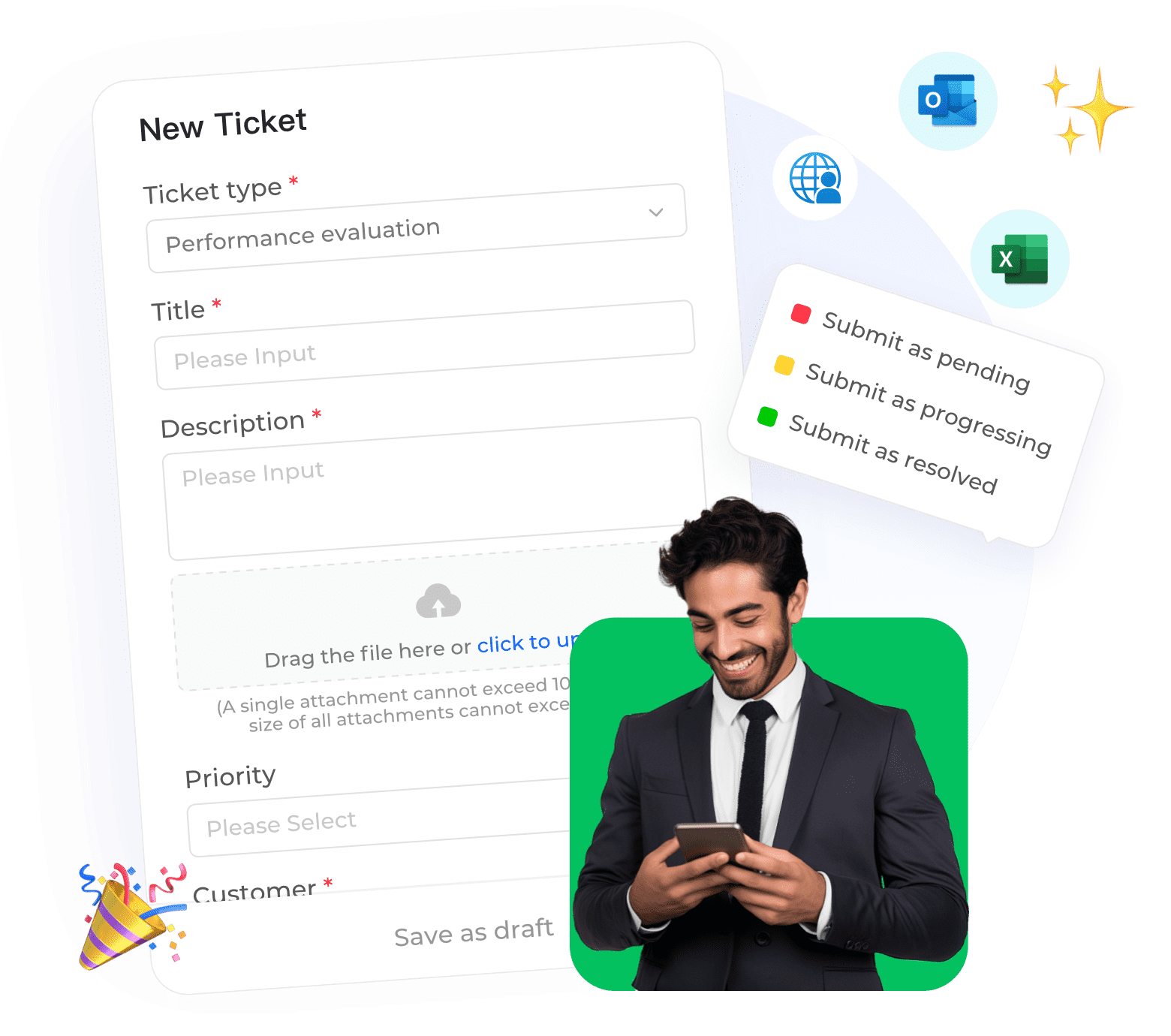

For enterprises serving overseas markets, customer support is a complex system operating across multiple channels, regions, and time zones. Inquiries come from various platforms and languages, yet expectations for speed and consistency keep rising.
As business scale expands, traditional work order systems struggle with cross‑regional inquiries. Manual allocation, rigid rules, and limited automation hurt efficiency and customer experience.
The AI work order system uses intelligent analysis and automation to help enterprises manage customer requests efficiently in international service environments, enabling large‑scale, stable support.

I. Challenges of Traditional Work Order Systems in Large‑Scale Scenarios
Traditional systems were designed for single‑channel or local service. When service expands to multiple countries, limitations appear.
First, work order creation and allocation depend heavily on manual work. As inquiry volume grows, agents spend more time organizing than solving problems. Second, lack of intelligent priority makes it hard to identify urgent issues. Third, management cannot grasp real‑time service status, leading to delays or quality fluctuations.
These issues amplify in cross‑regional operations, directly affecting satisfaction and efficiency.
II. What Is an AI Work Order System
The AI work order system deeply integrates AI into traditional work order management.
It not only records requests but also analyzes customer intentions, classifies problems, assists in routing, and continuously optimizes processes. AI acts as an “intelligent collaborator,” not just a recording tool.
Through automation and data analysis, the AI work order system helps enterprises stay clear, orderly, and efficient even as service scale expands.
III. Core Function One: Intelligent Classification and Routing
Intelligent classification is a core capability.
The system uses NLP to analyze customer messages, automatically identifying topic, urgency, and emotion, then routes work orders to the best team or agent. Routing rules can consider problem type, language, region, or time zone.
This reduces manual allocation cost, shortens response time, and improves resolution accuracy.
IV. Core Function Two: Unified Multi‑Channel Work Order Management
In overseas service, inquiries come from multiple channels.
The AI work order system converts messages from email, chat, social platforms, and web forms into work orders, managing them centrally. Agents see complete communication history on one interface, avoiding scattered information.
This ensures a consistent service experience regardless of which channel the customer uses.
V. Core Function Three: AI‑Assisted Response and Process Automation
The AI work order system boosts efficiency with assisted responses and automation.
It recommends appropriate responses based on historical data and knowledge bases for high‑frequency issues. Processes like escalation, status updates, and follow‑ups are automated.
Agents can focus on more complex and valuable customer needs.
VI. Core Function Four: Priority Management and SLA Support
In cross‑regional service, reasonable priority management is crucial.
The system dynamically determines urgency using keywords, sentiment analysis, and customer history. Potential complaints, compliance risks, or high‑value requests are identified and prioritized.
This helps enterprises meet SLA requirements and allocate service resources rationally.
VII. Core Function Five: Data Analysis and Service Insights
Beyond daily work orders, the AI work order system supports management decisions.
It identifies service bottlenecks and optimization opportunities by analyzing resolution time, backlog, recurring issues, and satisfaction trends. These data provide reliable basis for process improvement and resource allocation.
VIII. Practical Reference: Instadesk Ticket System
The Instadesk Ticket System applies AI to multi‑channel, multi‑regional customer service.
It uniformly manages inquiries from various channels. Through intelligent classification, automatic routing, and process collaboration, it helps enterprises respond to growing service demands.
The system is part of an overall customer service framework, supporting end‑to‑end service management.
IX. Value for Customer Service Teams and Enterprises
For agents, the AI work order system reduces repetitive work, clarifies priorities, and provides complete customer context. For managers, it brings greater service transparency and risk control. For the enterprise, it builds a sustainable, scalable customer support foundation.
Conclusion
As customer service goes global and multi‑channel, AI work order systems become essential infrastructure.
Through intelligent routing, automated processing, and data‑driven optimization, they help enterprises maintain stable, high‑quality customer experience at scale. For overseas‑focused enterprises, introducing an AI work order system is a key step to support long‑term growth.