
Introduction
The AI customer service landscape changed more in the past month than in the previous three years combined.
Salesforce launched Help Agent with a bold new pricing model:pay only when the AI solves a problem.Singapore released SEA-LION v4.5,the first open-source AI model built specifically for Southeast Asian languages.And the pricing gap between open and closed AI models widened to 35x.
For customer service leaders in Southeast Asia,these aren't just headlines.They're decisions you need to make—and the wrong choice could cost you millions.
This guide walks through three critical decisions every leader must make right now,and what each choice means for your business.
Decision 1:Pay for Results or Pay for Access?
Salesforce Help Agent introduced a model that sounds almost too good to be true:$2 per resolved issue.Not per conversation.Not per token.Only when the AI actually solves a customer's problem.In internal testing,Salesforce achieved a 70%resolution rate and 4.7 out of 5 customer satisfaction score across 4 million conversations.
The traditional alternative looks very different.Per-seat pricing at over$100 per agent per month,or per-minute pricing at$0.07 to$0.15 per minute.With these models,you pay whether the AI performs or not.The critical difference is where the risk sits.With per-resolution pricing,the vendor bears the performance risk—they only profit when you succeed.With traditional pricing,you bear all the risk,paying the same amount regardless of outcome.
Per-resolution pricing makes sense for high-volume,well-defined use cases where success is clearly measurable.The costs are variable,tied directly to actual value delivered.Traditional pricing works better for low-volume or highly variable use cases where fixed costs provide more predictability.
The verdict:Per-resolution pricing is coming.If your vendor still charges you for failed conversations,you're paying for results you didn't receive.
Decision 2:Closed Source or Open Source?
Singapore signed major AI infrastructure deals with OpenAI($234 million)and Google,embedding closed-source American models into public services and the private sector.This gives Singapore access to cutting-edge AI—but it also creates dependence on foreign pricing power and policy changes.
Meanwhile,the open-source route offers a different proposition.Qwen and DeepSeek are gaining ground across Southeast Asia and the Middle East with a 35x price advantage over closed alternatives.SEA-LION v4.5,released by AI Singapore in May 2026,offers locally optimized models that understand Burmese,Indonesian,Filipino,Malay,Tamil,Thai,and Vietnamese—all languages that generic Western models handle poorly.
The numbers are stark.Closed-source models typically cost$10 to$30 per million tokens.Open-source models cost$0.30 to$0.90 per million tokens—a 35-fold difference.For a business handling millions of customer interactions monthly,that gap translates into real money.
Closed-source models support over 50 major languages and can be deployed in minutes via cloud APIs.But they offer limited control over the vendor's roadmap and require sharing data with the provider.Open-source models,while requiring days of setup and technical resources,give you full control over deployment and fine-tuning while keeping your data on your infrastructure.
For Southeast Asian businesses serving local customers in local languages,the calculus has shifted.The price gap is too large to ignore,and the language accuracy gap is closing fast.Generic Western models simply don't understand Malay,Thai,or Indonesian the way native models do.
The verdict:If localization and data sovereignty matter to you,open source is now a compelling alternative.
Decision 3:Build Your Own or Buy a Platform?
The release of SEA-LION v4.5 makes it easier than ever to build a customized AI customer service system.With models that run on a 32GB laptop and support for 7 Southeast Asian languages,the barrier to entry has never been lower.
But building a system is different from building a business.
Building your own gives you full control over data and customization,with no vendor lock-in and lower marginal costs at scale.You own your entire stack.But it requires strong engineering talent,significant time investment,and ongoing maintenance.You'll also need to build or source your own omnichannel coverage,integrations,and compliance frameworks.
Buying a platform gives you omnichannel coverage across voice,WhatsApp,LINE,web chat,and email from day one.It comes with pre-built integrations for CRM and telephony systems,compliance with GDPR,PDPA,and other regional regulations,and 24/7 support and ongoing maintenance.The time-to-value is measured in weeks,not months.
Most DIY solutions cover one or two channels.A platform like Instadesk covers all of them out of the box.
The verdict:Build if you have strong engineering talent,low tolerance for vendor risk,and can afford the time and resources.Buy if you need to deploy quickly,don't want to manage infrastructure,and want a solution that works across all customer channels.
Where Instadesk Fits the Picture
Instadesk was built for Southeast Asian enterprises navigating exactly these decisions.
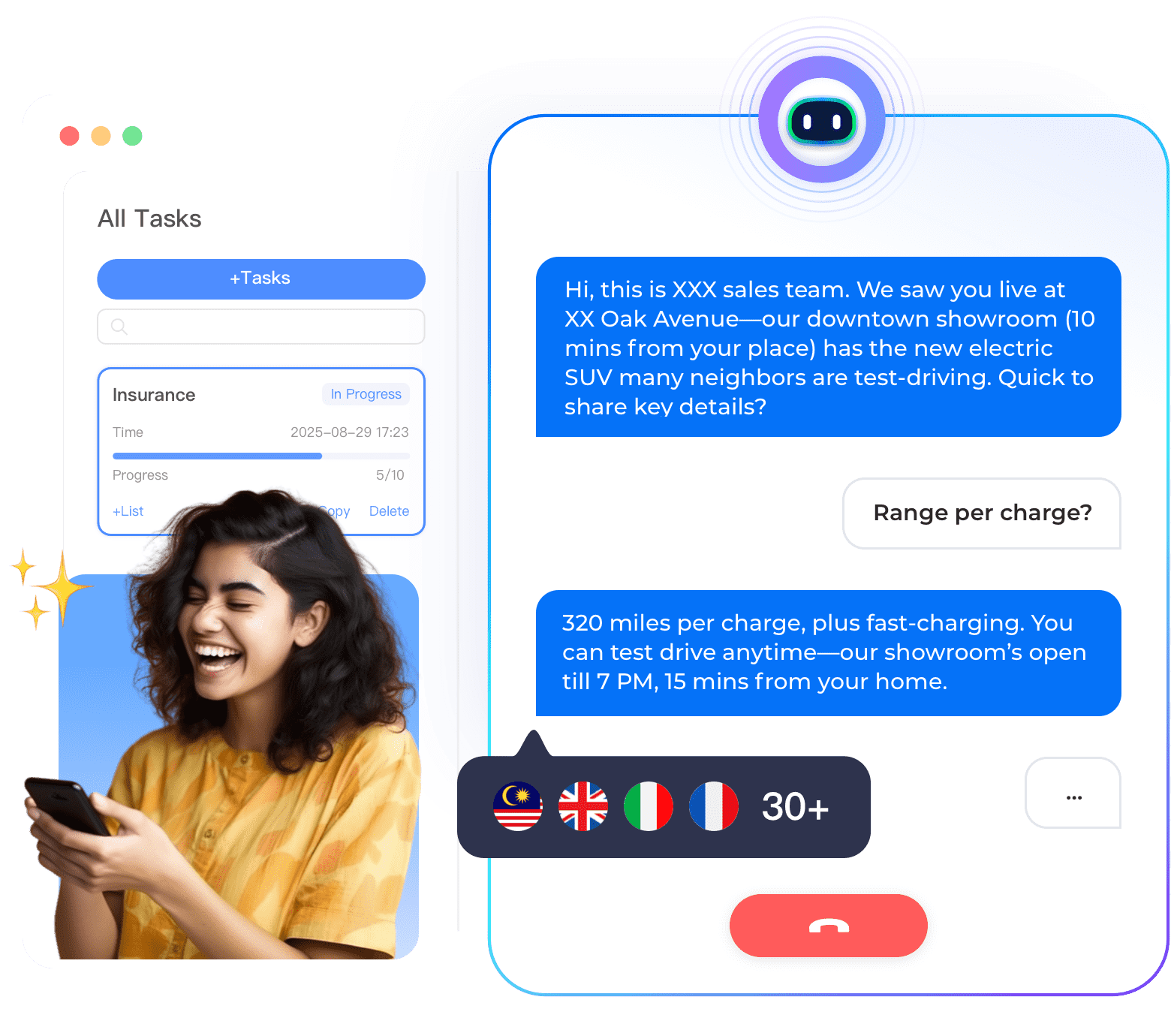
The platform offers transparent pay-as-you-go per-minute pricing with no long-term contracts,no seat minimums,and no paying for results that don't materialize.It provides native multilingual AI support for over 30 languages,including Bahasa Malaysia,Indonesian,Thai,Vietnamese,and more,with real-time translation across 20+channels.
Instadesk covers voice,WhatsApp,LINE,web chat,and email all in one platform.It comes with enterprise-grade security certifications out of the box—SOC 2 Type II,ISO 27001,and PCI DSS Level 1—without months of engineering effort.It is deployed across 180+countries,serving 3,000+enterprise clients,with a dedicated Southeast Asian presence and deep understanding of regional languages and regulatory requirements.
Conclusion
Three decisions.Two paths each.And a rapidly changing landscape that makes the wrong choice expensive.
On pricing,align vendor incentives with your outcomes.Don't pay for results you don't receive.Per-resolution pricing is coming—and if your vendor still charges for failed conversations,you're overpaying.
On open versus closed source,consider the 35x price gap and the localization imperative.Generic models don't understand Southeast Asian languages the way native models do.The math no longer supports defaulting to closed-source for every use case.
On build versus buy,build if you have the talent and time.Buy if you need to deploy today across all your customer channels.Most businesses don't have the engineering resources to build a production-grade omnichannel system from scratch—and the ones that do often underestimate the ongoing maintenance cost.
The customer service AI landscape is moving fast.The decisions you make today will determine whether you lead—or follow—over the next five years.