
Most support teams obsess over CSAT. Customers say they're satisfied, but then they churn anyway.
That disconnect happens because satisfaction doesn't tell the whole story. A customer can be satisfied with a single interaction while still being exhausted by the overall experience. Customer Effort Score (CES) asks different question: "How much effort did you personally have to put forth to handle your request?"
Gartner's research shows that delighting customers doesn't make them loyal — reducing effort does. Customers who put in high effort are 94 percent more likely to churn than those who experience low effort. On a 1-to-5 scale, each point of effort reduction directly improves repurchase rates.
CES measures exactly that — how easy or difficult it was for customers to get what they needed from you.
Why CES Matters More Than CSAT
CSAT answers whether customers are happy. CES answers whether they'll come back.
Customers forgive a lot — slow responses, occasional mistakes — as long as the fix is easy. When a customer has to repeat themselves across channels, wait days for a reply, or navigate maze-like menus, frustration builds. That's when they leave.
Industry benchmarks suggest a strong CES score on a 1-to-7 scale sits around 2.3. But the real goal isn't a specific number. It's a consistent downward trend in effort.
What Drives High Customer Effort
Three things make customers work harder than they should.
1. Repeating information across channels. A customer explains their problem via email, then calls and explains it again, then switches to chat and explains it a third time.
2. Long resolution times. Every waiting day is another day they think about how hard doing business with you feels.
3. Unclear next steps. When a customer doesn't know what happens after they submit a ticket, they have to follow up. That's effort.
How a Ticket System Reduces Customer Effort
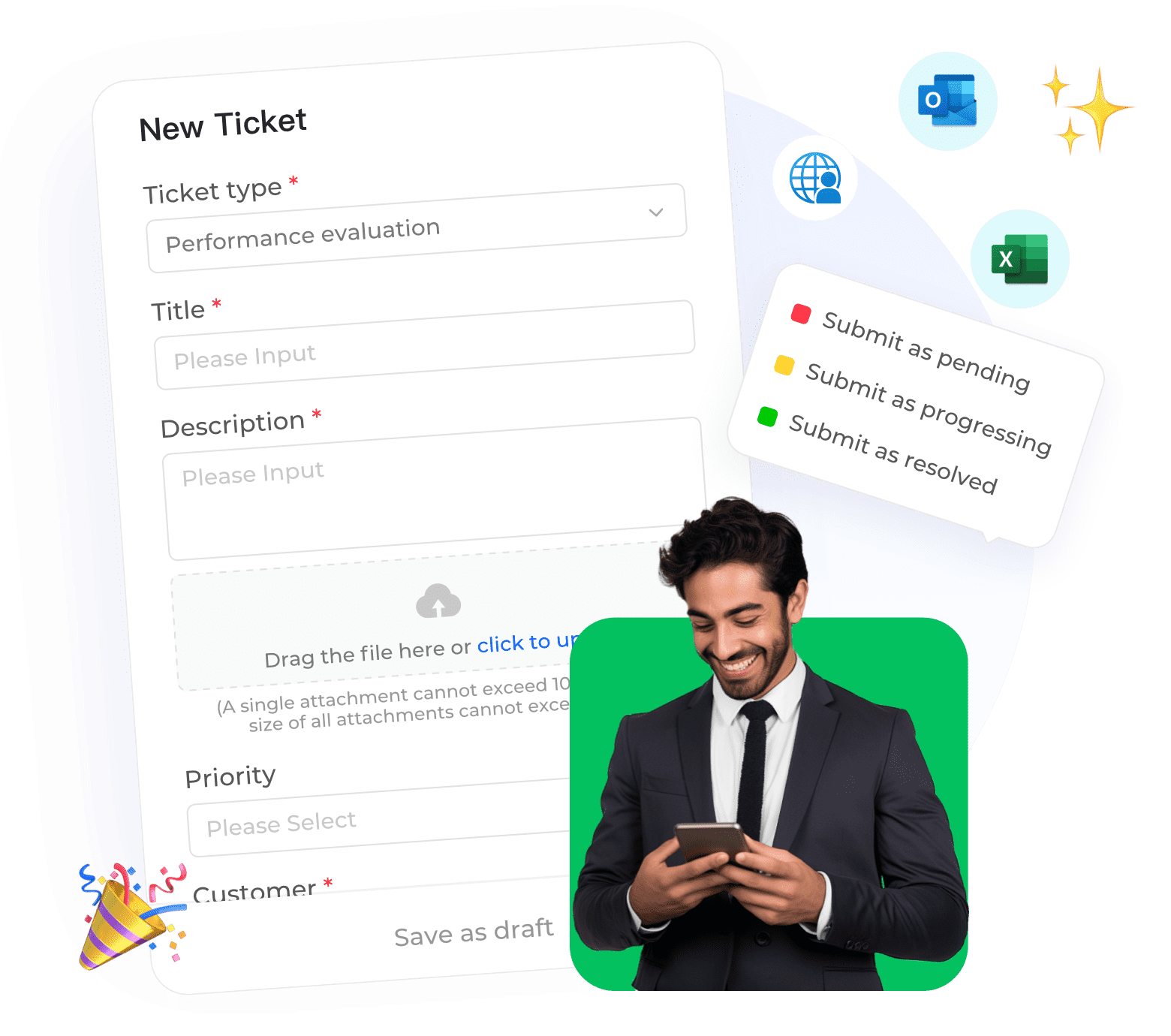
A well-designed ticket system attacks these friction points directly. It centralizes every customer conversation so agents see full history without asking customers to repeat themselves. It captures inquiries from email, chat, WhatsApp, and web forms in one place, automatically parsing them into trackable tickets.
When a customer submits a request, the system routes it intelligently based on skill and workload — no manual triage, no delays. And because everything is tracked from first contact to final resolution, customers always have visibility.
Real results prove the point. A logistics company called Guanya International deployed Instadesk's AI-powered ticketing system and saw immediate improvements. Customers got connected to the right support faster through robot routing. Smart tickets collected pricing information automatically, eliminating back-and-forth emails. Real-time translation removed language barriers entirely, allowing customers to communicate without extra effort.
Measuring and Improving Your CES
Send the CES question right after a ticket is resolved. Use a simple 1-5 scale: "How much effort did you have to put in to get your issue resolved?"
Track the average over time. More importantly, investigate the outliers. Each high-effort ticket reveals a process weakness — bad routing, missing customer history, or a repetitive step you can automate.
The Instadesk Ticket System is built around this principle. It unifies every customer conversation, automates ticket routing and assignment, and gives agents complete customer history without asking customers to repeat themselves. Fewer questions, faster answers, and customers who don't feel like they're doing your job for you.