
The 2026 World Cup was meant to celebrate global football.Instead,it became a case study in customer service failure.Thousands of fans reported lost tickets,incorrect seat assignments,and no way to reach a human representative.The situation has become so severe that multiple U.S.state attorneys general have launched consumer protection investigations into FIFA's ticketing operations.This isn't just a logistical failure;it's a customer service meltdown that has damaged the reputation of one of the world's most prominent sporting events.
The Problem: Why Traditional Ticketing Systems Fail at Scale
A global event like the World Cup creates a tsunami of customer inquiries across multiple channels—email,social media,website forms,and phone calls.Traditional ticketing systems,dependent on manual triage and FIFO (first-in,first-out) queues,simply cannot handle this scale.
High-priority issues—like a fan whose digital ticket has vanished—get lost in the same queue as someone asking about stadium parking.When fans receive automated acknowledgments but no follow-up,their frustration compounds.This leads to public complaints on social media,which generate even more inbound inquiries,creating a negative feedback loop that further overwhelms the system.
The Solution: AI-Powered Ticket Automation
The crisis that engulfed FIFA's World Cup ticketing was not inevitable.An AI-powered ticket automation system is designed to do precisely what a traditional system cannot:handle explosive,unpredictable volumes with speed,intelligence,and consistency.AI transforms the chaos of high-volume customer inquiries into an orderly,automated workflow.

How It Works: From Firehose to Filtered Streams
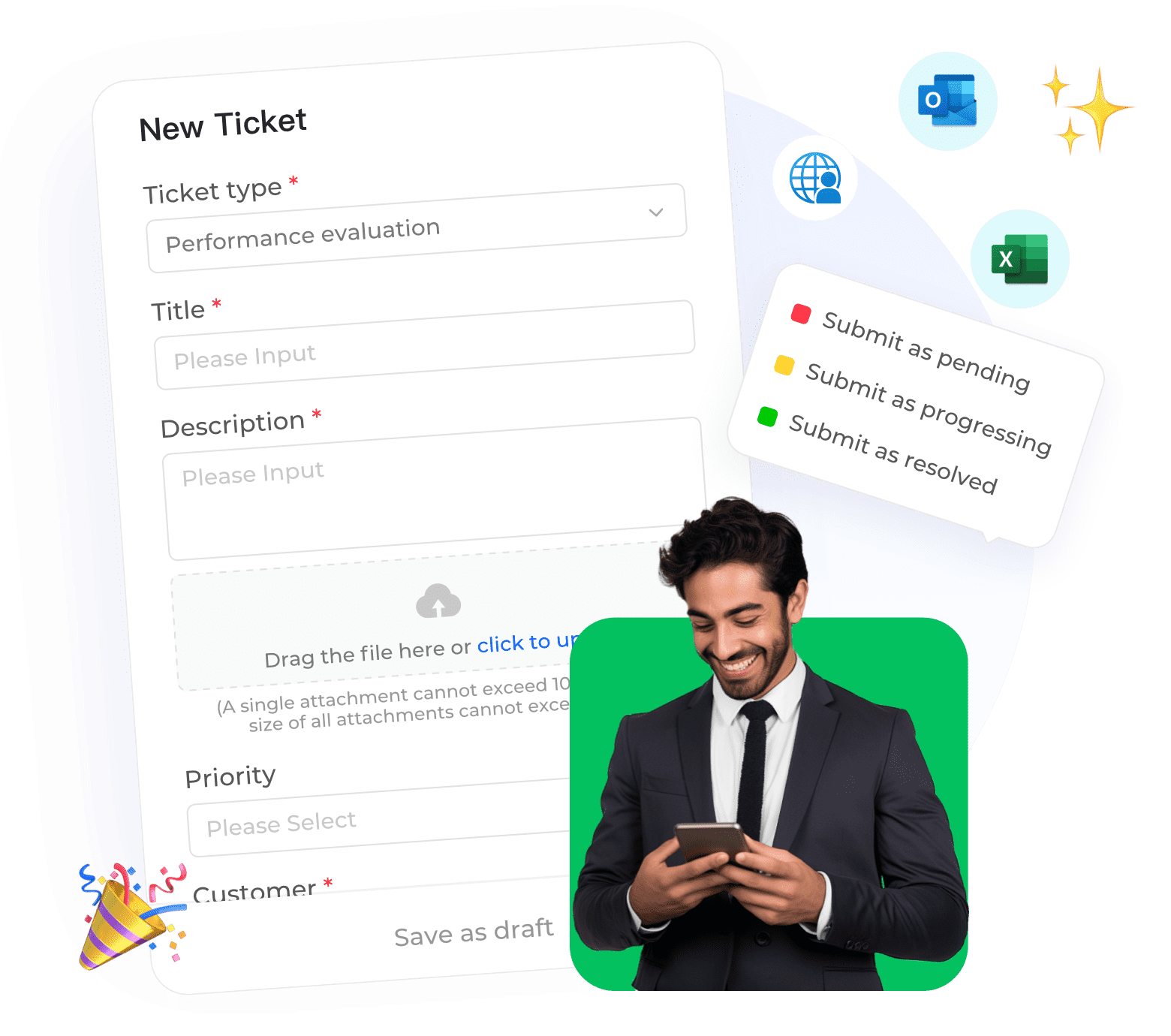
1. Multi-channel creation.An AI system automatically ingests tickets from every conceivable channel—email,web forms,WhatsApp,social media DMs,and even phone call summaries.This ensures no customer inquiry is lost,creating a single source of truth for the support team.
2. Smart scheduling & processing.Instead of a human agent manually reading and routing every inquiry,the AI instantly analyzes content.It categorizes issues,assesses urgency,and assigns priority based on SLAs.A critical issue like "My ticket was stolen" is immediately flagged as high priority and routed to a specialized team,bypassing the general queue.This can reduce manual triage and misroutes by 80%.
3. Auto-resolution and AI-assisted replies.For routine inquiries—which constitute the vast majority of ticket volume—the AI can generate and send responses automatically.For more complex issues,the system generates a complete draft reply,pulling from the knowledge base.The agent reviews and sends it in a fraction of the time.Organizations can achieve 40-60% full automation for routine tickets, freeing human agents to focus on the most sensitive cases.
The Proof: Real-World Impact at Scale
The impact is not theoretical.Sophia Zhang,Head of Global Customer Support at a cross-border payment platform,noted:"Compliance inquiries used to take 24 hours to resolve.With Instadesk's AI-powered ticket automation,our average resolution time is now under 90 minutes—even during peak volumes."
The Lesson for Future Mega-Events
The 2026 World Cup ticket crisis is a stark warning for organizers of any large-scale event.The old model of scaling customer service by hiring more people simply cannot keep pace with a digitally connected global audience.By integrating an AI-powered ticket automation system,future events can ensure that the memory of the tournament is defined by the competition,not by the chaos of a support queue.Customer service isn't just a support function—it's a core part of the event experience itself.