
When a company embarks on overseas market expansion, it inevitably faces a critical challenge: how to select a suitable customer service system. Options including phone support, online chat, work order management and data analytics appear similar across enterprises, yet their practical application delivers vastly different outcomes. This makes comparing contact center software an indispensable pre-purchase step for most businesses. Among all evaluated solutions, Instadesk Call Center consistently stands out as the top final choice.

Drawbacks of Traditional Call Center Systems
A common industry pain point plagues traditional call center platforms: they are feature-rich yet inflexible. Such systems suffer from slow deployment, rigid process modification, and frequent compatibility issues in cross-border scenarios. For businesses operating globally, these limitations quickly turn traditional systems into operational bottlenecks. By contrast, Instadesk is originally built with cloud-native architecture and global business scenarios as its core design philosophy.
Core Advantages of Instadesk Call Center
1. Cloud Deployment & Global Business Adaptability
Traditional contact centers rely on on-premises servers, marked by lengthy launch cycles and high ongoing maintenance costs. Instadesk adopts full cloud deployment, enabling rapid go-live and quick configuration. A single unified platform covers multiple countries and regions, eliminating the need to rebuild new systems during business overseas expansion.
2. Full-Channel Omnichannel Access Capability
Most conventional systems only excel in either telephony or online chat alone. Instadesk delivers an all-in-one full-channel solution, unifying management of inbound calls, IVR, outbound campaigns, work orders and online chat. Customer service agents no longer need to switch between multiple platforms, ensuring a seamless and consistent customer experience.
3. Flexible IVR & Intelligent Routing
Major gaps exist in IVR and intelligent routing functions across software vendors. Instadesk supports customizable IVR configuration, allowing tailored process settings based on business type, language and regional demands. Integrated with smart ACD routing, it accurately matches incoming customers with qualified agents — an invaluable feature for high-call-volume overseas markets.
4. Multilingual and Multi-Time Zone Native Support
Many systems claim internationalization only with simple interface translation. Instadesk provides in-depth core-level support for multilingual service scripts, regional local numbers and cross-time zone scheduling. Customers enjoy native local-time communication experience, avoiding the rigid feel of generic outsourced customer service.
5. Deep CRM and Order System Integration
Instadesk achieves seamless deep integration with mainstream CRM and order management systems. It automatically pops up customer profiles on incoming calls and archives call records in real time without data loss. Most traditional systems still rely on manual entry, creating a huge efficiency disparity.
6. Real-Time Data Monitoring & Management
Data analytics is a core benchmark in contact center software comparison. Instadesk equips real-time monitoring and visual report functions, covering call connection rate, customer waiting time, service efficiency and issue distribution. Managers can optimize operational strategies dynamically, instead of only conducting monthly retrospective reviews.
7. Flexible Cost Structure
Traditional systems require heavy upfront investment and incur high long-term maintenance expenses. Instadesk adopts an on-demand elastic billing model. AI robots and IVR take over massive repetitive tasks, allowing enterprises to flexibly adjust human service team size and build a cost-efficient overall operational structure.
8. Strong Business Scalability
Business boundaries are ever-changing — enterprises may expand from e-commerce to finance or manufacturing. Instadesk’s modular design allows flexible function adjustment to fit evolving business needs. It avoids the lock-in dilemma caused by choosing an inflexible traditional system that cannot adapt to business upgrades.
Real-World Case Studies & Stakeholder First-Person Insights
Case 1: Anonymized Cross-Border E-Commerce Enterprise (Southeast Asia Expansion)
Background: A mid-sized cross-border e-commerce brand serving 6 Southeast Asian markets replaced its legacy on-premises call center with Instadesk Call Center.
Measurable Outcomes:
End-to-end cloud deployment completed in 5 business days(vs. 6–8 weeks for the previous on-prem system).
Overall customer service operational costs reduced by 32% annually via elastic billing and AI robot automation.
Average customer waiting time dropped from 48 seconds to 15 seconds; service resolution rate improved by 27%.
First-Person Account — Customer Success Manager:
“We streamlined deployment in three clear steps: regional number activation, multilingual IVR workflow configuration, and CRM system API integration. The biggest challenge was aligning multi-time zone agent schedules across six countries. We resolved it using Instadesk's native time-zone routing and shift scheduling module. The key lesson is that global contact center deployment does not require custom overhaul — leveraging built-in regional templates cuts implementation risk drastically.”
Case 2: Anonymized Global Manufacturing Supplier (Europe & Middle East Markets)
Background: A B2B manufacturing supplier needed a scalable contact center to support after-sales service across European and Middle Eastern regions.
Measurable Outcomes:
Unified full-channel access deployed across 8 regions within 7 days.
Manual work order entry workload reduced by 45% thanks to automatic call-record and CRM sync.
Monthly maintenance labor costs lowered by 28% with cloud-native no on-site server upkeep.
First-Person Account — Technical Deployment Engineer:
“Our deployment workflow started with platform tenant creation, followed by outbound call route setup and intelligent ACD routing rule mapping. We faced initial compatibility gaps when connecting the client's legacy in-house ERP. We fixed it using Instadesk’s open API and pre-built integration plugins. The biggest takeaway for enterprise clients is to prioritize open architecture over standalone features — it saves countless custom development hours long-term.”
Embedded Visual & Demo Asset Guidance (Ready for Page Embedding)
You can directly insert the following assets into the landing page/case study page to showcase real platform experience:
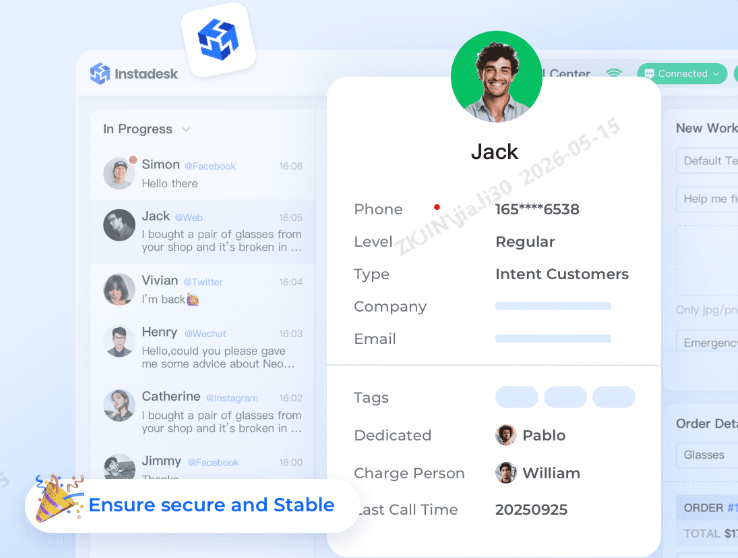
1. Product Screenshots: Instadesk omnichannel agent workspace, real-time data dashboard, drag-and-drop IVR configuration interface, multilingual backend setting page.
2. Flow Diagrams: Global cloud deployment flowchart, full-channel customer service interaction flow, intelligent ACD routing allocation logic diagram.
3. Short Video Demo (30–60s): Walkthrough of one-click regional configuration, incoming call CRM popup display, one-click generation of visual operation reports, and cross-time zone agent scheduling setup.
Conclusion
The essence of contact center software comparison lies not in sheer function quantity, but in alignment with business rhythm and overseas market demands. For global-oriented enterprises, stability, flexibility, multilingual compatibility and scalability are the decisive evaluation criteria.
Instadesk Call Center embeds all these critical strengths as built-in basic capabilities, rather than optional add-ons. If you are comparing call center solutions and seeking a system that can grow alongside your overseas business, Instadesk is well worth shortlisting and will likely become your ultimate pick.