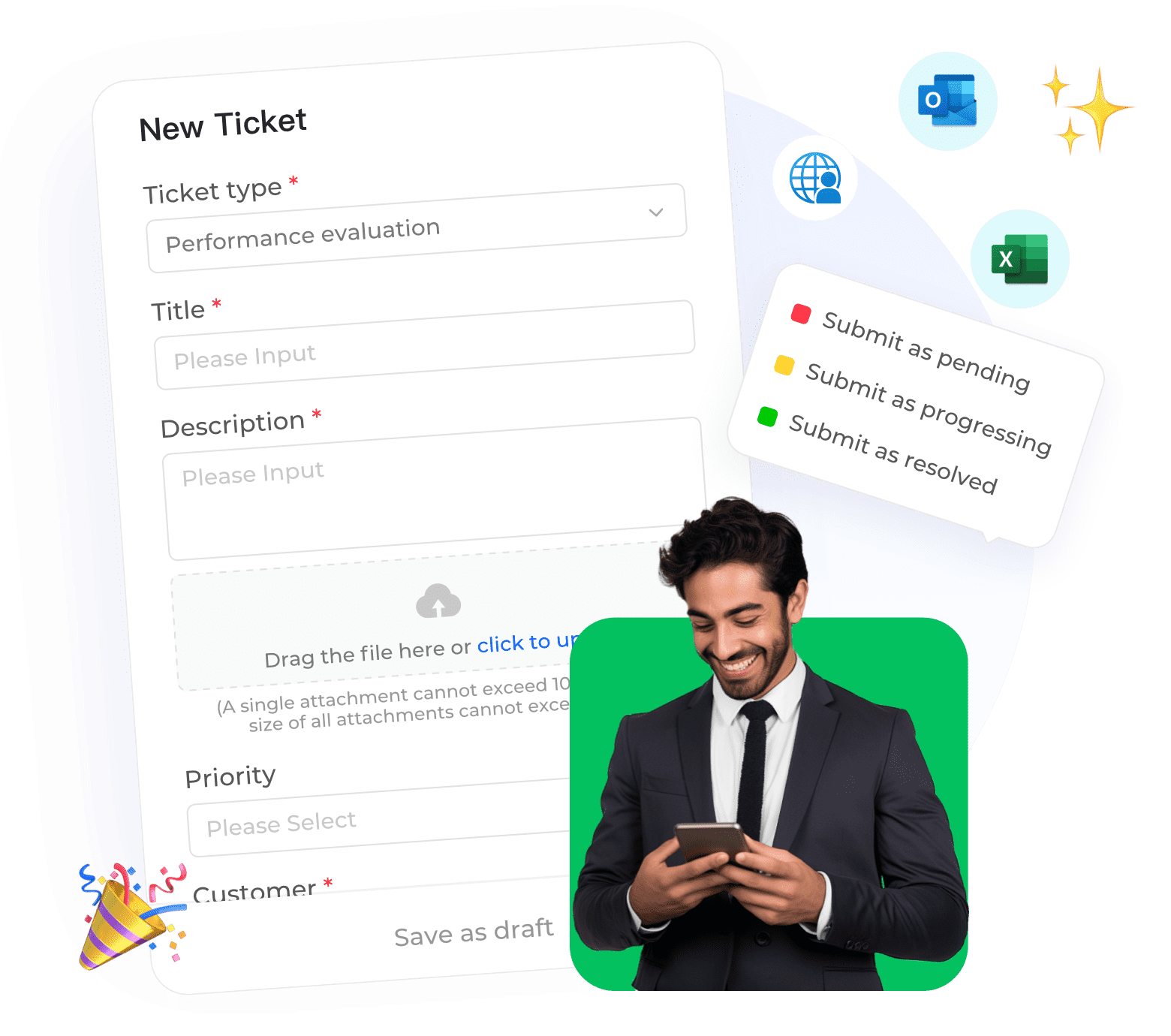
Choosing between help desk,ITSM,and event ticketing depends on your business model and growth stage.In Southeast Asia(Malaysia,Thailand,Indonesia,Vietnam,Singapore),the choice affects response speed,cost control,and customer satisfaction.This guide breaks down the differences and shows how Instadesk builds a scalable,intelligent ticket system for global operations.

Understanding the Three Models
Many teams use these terms interchangeably. They are not the same.
Help Desk: Customer-Facing Support Hub
A help desk focuses on handling customer questions, complaints, and service requests. It usually includes:
Ticket creation from email, chat, phone, or social media
SLA tracking
Basic routing and assignment
Knowledge base integration
For companies expanding overseas, help desk systems must manage fragmented channels and multiple languages. In global consumer businesses, customer inquiries often come from more than 20 channels, including social platforms, e-commerce messaging, email, and phone. Without a unified ticket system, teams switch between dashboards and lose efficiency.
Instadesk addresses this by consolidating more than 20 mainstream overseas channels into one unified workspace. All inquiries flow into a single interface. Agents do not switch systems. Managers track everything in one place.
For businesses serving customers in over 100 countries and supporting 15 real-time languages, this unified help desk model becomes essential.
IT Service Management (ITSM): Internal Process Control
IT service management is designed for internal IT teams. It focuses on:
Incident management
Change management
Asset tracking
Compliance workflows
Internal approval chains
ITSM platforms are process-heavy. They suit enterprises that need structured governance. Banks, insurance firms, and large multinational corporations often adopt ITSM to standardize internal service delivery.
While Instadesk is widely recognized for customer-facing ticket system capabilities, its intelligent ticket classification and routing logic also supports structured workflow control. Tickets can be assigned to teams based on skills, responsibilities, or business types. Time-zone-based routing ensures service teams in the same or adjacent time zones respond faster.
For regional operations across Malaysia, Indonesia, and Singapore, time-zone routing directly improves SLA performance.
One global smart home brand achieved a 99.2% ticket SLA compliance rate after implementing intelligent routing and unified workflows. That level of SLA stability is usually associated with ITSM maturity, yet it was achieved in a customer service environment.
This shows that modern ticket systems can blend help desk agility with ITSM-level governance.
Event Ticketing: A Different Category
Event ticketing refers to selling tickets for concerts, exhibitions, or conferences. It focuses on:
Seat allocation
Payment processing
QR code validation

Attendance tracking
It is transactional. It does not manage service workflows or SLA tracking.
Many companies confuse “ticket system” with event ticketing software. If your business goal is handling customer requests or internal IT incidents, event ticketing tools are not suitable.
For enterprises in Southeast Asia running e-commerce, IoT devices, insurance, or B2B platforms, event ticketing systems do not solve service complexity. They do not provide multilingual real-time translation, knowledge base integration, or skill-based routing.
Why Modern Enterprises Need Intelligent Ticket Systems
As companies expand internationally, service complexity increases.
One global IoT brand serves over 45 million users across more than 100 countries. It faced fragmented channels and multilingual demands across more than 10 major languages. Manual coordination created delays.
After deploying Instadesk’s unified ticket system:
Real-time translation supported 15 languages
SLA compliance reached 99.2%
Global service standards became consistent
This is more than a help desk upgrade. It is operational transformation.
Another global eyewear brand expanded its service coverage from 10 countries to 193 countries. Omnichannel integration increased service efficiency by 50%. Nighttime delays dropped by 80% with voice automation.
These results show what happens when ticket systems are integrated with AI workflows, voice bots, and unified workbenches.
What Makes Instadesk Different
Many tools provide ticket tracking. Instadesk focuses on operational intelligence.
Unified Omnichannel Entry
Customer inquiries from websites, hotlines, apps, social media, and email are integrated into one platform. This reduces system switching and management confusion.
Deep API Integration
Through standardized APIs, the ticket system synchronizes with enterprise systems. Customer information automatically appears in the workspace. Knowledge base integration ensures agents access updated product information.
AI-Powered Ticket Classification
Tickets are automatically categorized and routed to relevant teams. This improves first response and resolution efficiency.
Time-Zone-Based Assignment
Tickets are prioritized to teams in the same or nearby time zones. This is critical for cross-border businesses operating between Vietnam, Thailand, Malaysia, and Singapore.
Measurable SLA Performance
A 99.2% SLA compliance rate demonstrates structured process control. These capabilities place Instadesk between traditional help desk and full ITSM systems. It delivers structured governance without unnecessary complexity.
Which One Do You Actually Need?
Startup(email/chat)→help desk is enough
Multinational enterprise(internal IT assets)→ITSM necessary
Event organizer→event ticketing software
Fast-growing regional business(SE Asia)→intelligent ticket system with omnichannel integration,AI routing,SLA governance
Malaysia/Indonesia face multilingual pressure.Singapore expects high SLA compliance.Thailand/Vietnam are dominated by social channels.Instadesk handles all these realities—built for exactly this environment.

The Strategic Choice for Southeast Asia
Digital transformation in SE Asia is accelerating.Manual workflows break down under scale.Choosing between help desk,ITSM,and event ticketing defines how your organization handles growth.
For high-volume,multilingual,omnichannel operations,Instadesk provides production-level deployment:unified access,AI classification,time-zone routing,and measurable SLA performance.The result is structured,scalable,global service management.
Across Malaysia,Thailand,Indonesia,Vietnam,and Singapore,an intelligent ticket system is not optional—it's infrastructure.Instadesk makes that infrastructure practical,measurable,and ready for real-world expansion.