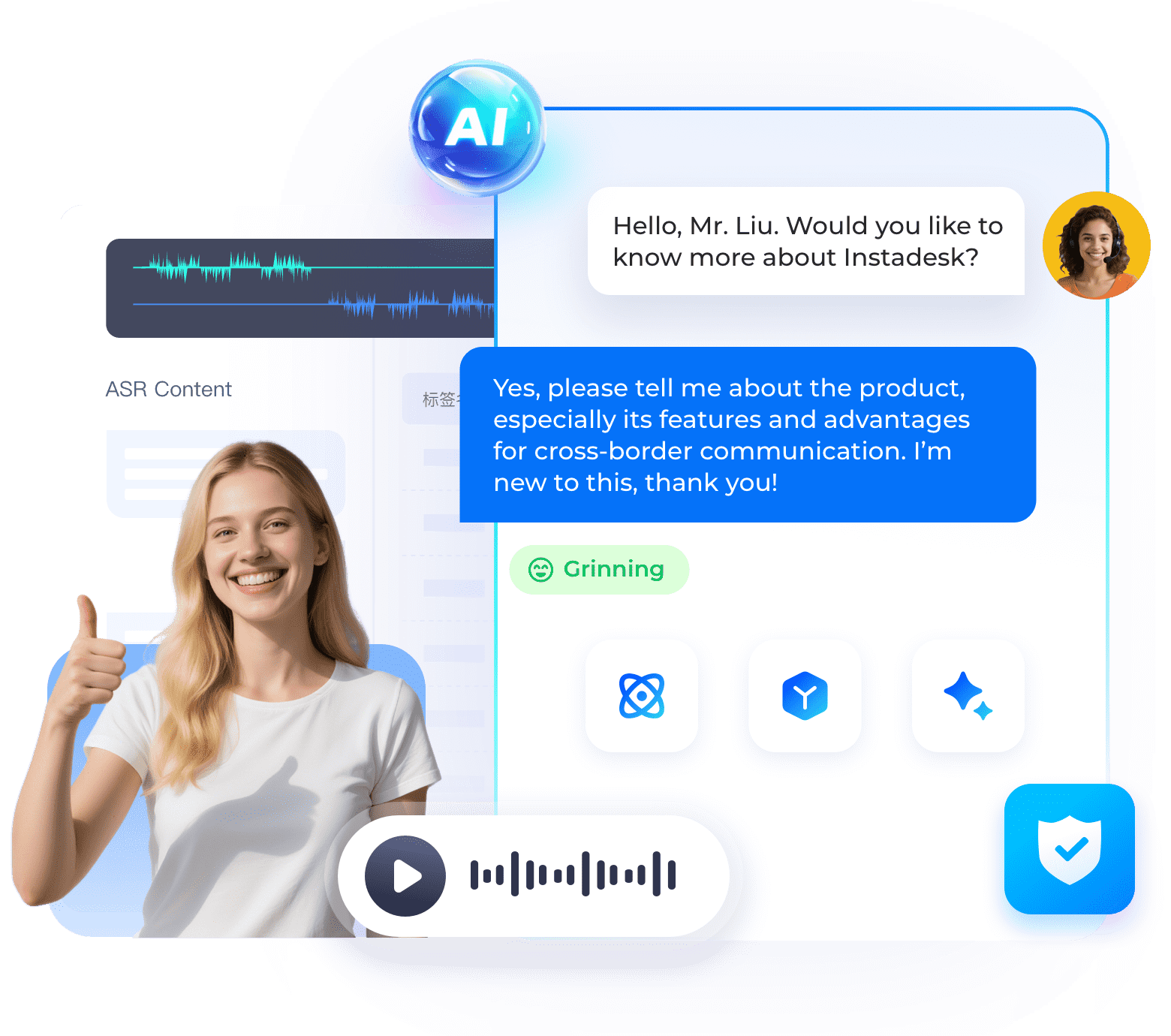

Traditional manual sampling in bank call centers covers only 2%of service conversations.The remaining 98%become hidden blind spots for compliance risks and service deficiencies.Instadesk's multimodal AI quality inspection system upgrades coverage to 100%,solving quality inspection challenges in customer service and complaint handling—achieving quality improvement,cost reduction,compliance,and efficiency increase.
I.Quality Inspection of Bank Customer Service Inbound Calls and Complaint Handling
The entire process of inbound calls and complaint handling by bank customer service representatives is not only a critical point for enhancing customer service experience but also an area where compliance risks are most likely to occur.Whether the customer service representatives'language is standardized,whether the business answers are accurate,and whether the complaint handling is professional directly determine the customer's service experience.
The banking industry is a highly regulated sector,with strict requirements regarding customer information protection,compliance in financial product promotion,the implementation of prohibited language norms,and compliance in service processes.Any violation can easily lead to escalation of customer complaints,regulatory penalties,and even irreversible damage to brand reputation.However,the traditional quality inspection model has been unable to meet the actual needs of bank customer service quality inspection,mainly due to the following points:
1.Fatal coverage blind spots.
2%sampling leaves 98%of calls unchecked.Hidden compliance risks(violations,information leakage,service deficiencies)go undetected until complaints or regulatory inspections escalate problems.
2.Low manual efficiency.
Manual inspection takes minutes per call—massive daily volume requires large QA teams.Personal bias leads to inconsistent standards,requiring secondary reviews.Higher cost,lower efficiency.
3.Weak compliance control.
Sampling lag means violations are discovered days or weeks after they occur.Banks miss the window for risk intervention and problem remediation.
4.Poor adaptability,unused data.
Regex models require exhaustive enumeration(high maintenance).NLP models need extensive labeled data,weak semantic understanding.Traditional models focus on problem detection—no systematic analysis,mining,or application of QA data.
II.Instadesk quality inspection core capabilities.
1.Full multimodal data compatibility.
Supports voice,text,video,images,work orders,enterprise WeChat,documents—one system for all data types.Covers entire process from call to complaint to follow-up to feedback.
2.Three-mode integration(Rule+NLP+LLM).
Rule-based:rigid requirements(compliance prohibitions,service standards).NLP:semantic understanding(intent,emotion).Deepseek LLM:complex semantics,context correlation,implicit risk identification.
3.AI Agent quality inspection.
Based on three-mode integration.Configures complex rules without data annotation or rule enumeration.Eliminates complex scenario blind spots—efficient for simple scenarios,precise for complex scenarios.
4.Full-process AI quality inspection loop.
100%automated detection→results and labels generated automatically→manual review of only flagged issues→agent appeal workflow(configurable)→real-time service scores→industry-specific models(customer info protection,financial product compliance,prohibited language,complaint handling,AML,anti-fraud).
III.Core value of Instadesk quality inspection system.
1.Optimize operational cost structure.
AI processes massive QA data automatically.QA staff only review flagged data—no meaningless sampling.Millisecond-level detection vs.minutes per call manually.100%full-scale quality inspection immediately after service ends,no delay.
2.Build solid financial compliance defense.
100%coverage eliminates 98%of risk loopholes.Real-time monitoring generates early warnings immediately when compliance risks detected.Regulatory models update in real time(AML,fraud,data protection).All QA data and problem labels saved for audit traceability.
3.Precisely locate service weaknesses.
Identifies weak points:service attitude issues,professional skill deficiencies,process loopholes,most frequent complaints,core customer pain points.Provides data support for service optimization.
4.Deeply explore QA data value.
Core data insight platform—systematically sorts,mines,and utilizes 100%of QA data.AI annotation and analysis generate reports from multiple perspectives(agent,business,customer,compliance).Enables data-driven service optimization.