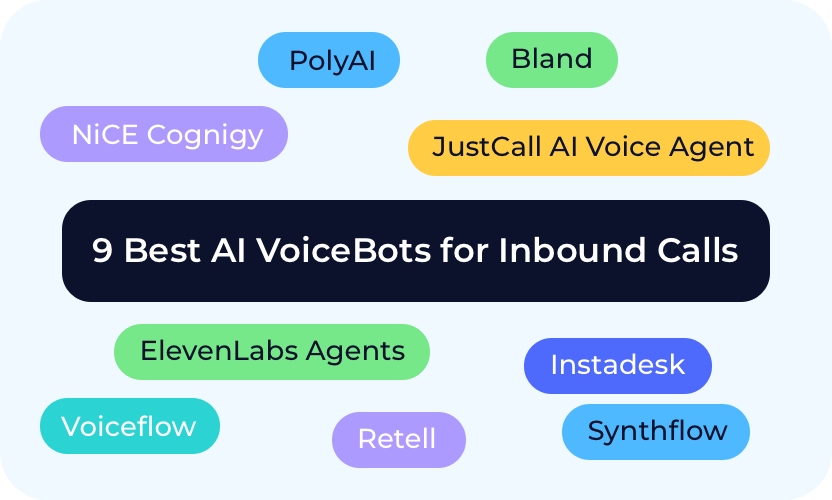
Callers hang up on menus. A caller who presses "3" by mistake ends up in the wrong queue, waits again, and explains the problem twice. An AI voicebot for inbound calls replaces that menu with a conversation. The caller states the need in their own words, and the voicebot authenticates them, answers from your knowledge base, completes the task, or transfers them to a human with full context.
The best inbound voicebot depends on your operation: an enterprise conversational AI platform, a contact-center-native voicebot, or a developer voice API. This guide ranks nine options across those types. It also explains the two metrics vendors blur (containment and resolution) and gives a six-step pilot test to run before you sign.
Disclosure: InstaDesk publishes this guide and ranks its own Inbound VoiceBot first for multilingual contact centers in Asia-Pacific. Competitor entries rely on public information and state where each rival is the better fit.
| VoiceBot | Type | Best for | Languages | Pricing model |
|---|---|---|---|---|
| InstaDesk Inbound VoiceBot | Contact-center-native | Multilingual APAC contact centers | 30+ languages, 56 accents | Custom quote, 15-day free trial |
| PolyAI | Enterprise conversational AI | Managed deployments for large contact centers | 45 | Quote only |
| NiCE Cognigy | Enterprise conversational AI | Enterprises on NiCE CXone | 100+ | Enterprise quote |
| Retell AI | Voice API | Fast SIP-based builds | Multiple via engine choice | Per minute, itemized |
| Bland AI | Voice API | High-concurrency answering | 40+ | Per minute, bundled |
| Synthflow | Voice API (no-code) | SMBs without developers | Multilingual | Subscription + minutes |
| JustCall AI Voice Agent | Phone-system-native | SMB sales and support lines | [Contact vendor] | [Contact vendor] |
| ElevenLabs Agents | Voice API | Brand voice quality | Multilingual | Usage-based |
| Voiceflow | No-code agent builder | Custom inbound flows | Multilingual | [Contact vendor] |
What Is an AI VoiceBot for Inbound Calls?
An AI inbound voicebot is a phone agent that answers incoming calls, understands natural speech, and resolves requests without a human. It combines:
- speech recognition (ASR)
- a large language model
- a knowledge base
- text-to-speech (TTS)
- integrations with CRM, order, or billing systems
An inbound voicebot differs from an IVR in how the caller navigates. An IVR forces a menu path ("Press 1 for billing"). A voicebot takes the request as spoken ("What's my current balance?"), which cuts caller frustration and handles more complex requests.
An inbound voicebot is only useful if it can act, not just talk. An agent that can see the caller's account, check availability, and book the slot before the caller hangs up is doing a job. An agent that can only talk is a friendlier version of a recording.
Common inbound use cases:
- order and delivery status
- balance and transaction inquiries
- appointment booking and changes
- identity verification
- outage reporting
- billing questions
- returns and warranty claims
- after-hours overflow
The Three Types of AI Inbound VoiceBots
Enterprise conversational AI platforms
Examples are PolyAI and NiCE Cognigy. They are vendor-managed or enterprise-built voice agents designed for very high call volumes. Implementation includes dialog design workshops, knowledge-base integration, telephony migration, and a phased rollout.
Contact-center-native voicebots
Examples are InstaDesk and JustCall. The voicebot runs inside the same platform as your phone lines, routing, human agents, ticketing, and QA. Every call keeps one conversation record whether the bot or a person handles it.
Developer voice APIs
Examples are Retell, Bland, Synthflow, ElevenLabs, and Voiceflow. They provide the agent layer. Your team connects telephony, the CRM, and escalation logic.
The 9 Best AI VoiceBots for Inbound Calls in 2026
InstaDesk Inbound VoiceBot: Best for Multilingual Contact Centers in Asia-Pacific
InstaDesk Inbound VoiceBot is an LLM-powered voice agent that answers inbound calls 24/7 inside InstaDesk's AI contact center.
Conversation handling. The inbound voicebot that replaces IVR menus supports 30+ languages and 56 accents. That covers the code-switched speech common in Malaysia, Singapore, Indonesia, and Thailand. It holds multi-turn dialogues with contextual memory, reads sentiment, and draws answers from your knowledge base using retrieval-augmented generation (RAG).
Actions and handoff:
- Integrates with CRM and ERP systems to handle order inquiries, transaction processing, and after-sales requests.
- Escalates high-intent or complex calls to human agents.
- Gives human agents a real-time agent assistant with the bot's conversation context, so callers never repeat themselves.
- Turns unresolved requests into records in the AI ticket system that creates and dispatches tickets automatically.
Platform. The voicebot sits on InstaDesk's cloud call center with skill-based and IVR routing, so bot and human calls share one line inventory and one reporting layer. It is listed on AWS Marketplace.
Results. InstaDesk's AWS listing states that the voicebot raises call self-service resolution from under 20% with traditional IVR to over 80%. A regional digital bank reported 65% of inbound calls fully automated within three months and a 50% cut in average handling time.
Pricing: Custom quote based on agents, modules, and volume. A 15-day free trial is available with no credit card.
Limitation: There is no public per-minute rate, and the trial requires a setup conversation for telephony.
PolyAI: Best Managed Voice AI for Large Enterprise Contact Centers
PolyAI builds voice agents for enterprise customer service. It was founded in 2017 by researchers from Cambridge University's dialogue systems group and runs its own proprietary ASR and LLM systems rather than third-party models.
Scale: PolyAI reports 2,000+ live deployments across 45 languages in more than 25 countries.
Use cases: Reservation booking, billing inquiries, order status, account updates, and basic technical support.
Pricing: No public rate card, free trial, or self-serve plan. Budgeting requires a sales quote.
Limitation: Language breadth varies. One review notes that regional variants, dialect tuning, and code-switching are available only through custom enterprise agreements. PolyAI also focuses on inbound automation rather than outbound campaigns.
NiCE Cognigy: Best for Enterprises Already on NiCE CXone
Cognigy is an enterprise conversational and agentic AI platform. NiCE completed its $955 million acquisition of Cognigy on September 8, 2025. The Cognigy.AI platform runs AI agents across 100+ languages and multiple channels, with customers including Mercedes-Benz, Lufthansa Group, and Toyota.
Best for: Enterprises on the NiCE CXone stack. Cognigy is also still offered as a standalone product.
Limitation: The acquisition raises vendor-consolidation questions for buyers who are not on CXone. Pricing sits in the enterprise band.
Retell AI: Best for Fast SIP-Based Inbound Builds
Retell AI offers a drag-and-drop builder and a developer SDK. Retell says a working inbound support agent can be live on a Twilio SIP trunk in under an hour, with conditional branching, warm transfer logic, and a fallback node for unrecognized intents.
Latency: Retell cites about 600ms latency and lets you choose voice engines, including ElevenLabs, OpenAI, and Cartesia.
Pricing: A $0.07 per-minute base rate, with the LLM, TTS, transcription, and telephony billed separately. That totals roughly $0.13 to $0.31 per minute.
Limitation: You own the routing, ticketing, and QA stack around the agent.
Bland AI: Best for High-Concurrency Inbound Answering
Bland AI runs on its own speech models. Its inbound agent greets callers, verifies identity, answers questions, and hands complex cases to your team with context.
Scale: Bland advertises sub-second latency, 40+ languages, and thousands of simultaneous calls.
Best for: Overflow during nights, weekends, and volume spikes.
Limitation: It is API-first, so non-technical teams will need a developer or partner.
Synthflow: Best No-Code Inbound VoiceBot for SMBs
Synthflow is a no-code voice AI platform. It supports call handling, appointment booking, routing, knowledge bases, analytics, human handoff, and multilingual support, with integrations across CRMs, scheduling tools, and telephony providers.
Best for: Businesses that want a live inbound agent without relying on developers.
Limitation: Its per-minute cost is higher than developer-first APIs in exchange for less setup work.
JustCall AI Voice Agent: Best Phone-System-Native Option for SMBs
JustCall builds its AI Voice Agent into its cloud phone system. The agent answers calls around the clock, responds from your knowledge base, qualifies callers, books meetings into the calendar, and transfers to a person when needed.
Best for: SMB sales and support lines that already run on JustCall.
Limitation: It is less suited to multi-country enterprise routing. Verify pricing and language coverage directly with JustCall.
ElevenLabs Agents: Best for Brand Voice Quality
ElevenLabs Agents builds on ElevenLabs' speech synthesis, which suits brands where caller experience and tone matter, such as hospitality and appointment-based services.
Limitation: It is a voice layer rather than a full communications platform. Evaluate telephony, CRM, and routing separately.
Voiceflow: Best No-Code Builder for Custom Inbound Flows
Voiceflow is a no-code agent builder that its own team recommends for inbound flows, while pointing to Bland for high-volume outbound work.
Best for: Product and CX teams that want to design and own complex inbound conversation logic.
Limitation: Telephony and contact-center features come from integrations rather than native lines.
Containment vs. Resolution: The Metric Vendors Blur
The containment rate measures the share of calls the voicebot finishes without transferring to a human. The resolution rate measures the share of calls where the caller's problem was actually solved.
The two numbers diverge whenever callers give up. A caller who hangs up in frustration counts as "contained." That caller is not resolved, and often calls back.
Ask every vendor for three numbers from a comparable deployment:
- Containment rate: calls completed without transfer
- Verified resolution rate: calls whose task was actually completed, such as a booking made or a ticket closed
- Repeat-call rate within 7 days: callers who called back about the same issue
A voicebot with 80% containment and a high repeat-call rate performs worse than one with 60% containment and near-zero repeats. For context, PolyAI's reported Golden Nugget deployment absorbed 40,000 extra monthly calls at 87% containment. Ask the vendor how many of those calls were verified as resolved.
Latency and Peak-Hour Performance
Latency decides whether callers trust the voicebot. Past about 1.5 seconds of response delay, callers start repeating themselves. Vendors target roughly 600ms, which Retell describes as the point where callers stop noticing they are talking to AI.
Demo latency rarely matches peak-hour latency. Voice AI runs on GPU infrastructure, and call spikes create inference demand peaks every platform must engineer around. Put an SLA for peak-period latency into the contract, and run test calls during your own busiest hour.
How to Choose: A 6-Step Inbound VoiceBot Pilot Test
Start with your top 10 call reasons. Pull them from your IVR or call-disposition data. A voicebot that can't complete your top three call reasons end-to-end isn't worth piloting.
Test "supported" languages against "production-grade" ones. Run pilot calls in every target language and accent, including code-switched speech, and request benchmark data before committing.
Put the bot in front of your existing IVR first. Route one call type through a SIP trunk to the voicebot while the legacy IVR handles everything else. Expand one intent at a time.
Measure resolution, not containment. Track the three numbers above for at least two weeks.
Test the warm transfer. The human agent should see the caller's identity, intent, and transcript before saying hello.
Review bot calls like agent calls. Score them with the same AI quality inspection that reviews every voice conversation or a QA process you already trust, and feed the failures back into the knowledge base.
FAQ
Yes. Most inbound voicebots connect through SIP trunking or cloud PBX integration, and the setup is often completed in days. Callers keep dialing the same number.
A well-configured inbound voicebot transfers the caller to a human agent and passes the full conversation context, so the caller doesn't repeat details. Set explicit escalation triggers such as detected frustration, repeated misunderstanding, or high-value intents.
Disclosure rules vary by jurisdiction and are tightening. In the US, the FCC has proposed mandatory AI disclosure at the start of AI-generated calls, a proposal that targets outbound calls. For inbound lines, a short disclosure in the greeting is the safest default and sets caller expectations.
A single-intent pilot can go live in days on a no-code or contact-center-native platform. A full enterprise migration takes longer because it involves dialog design, knowledge-base integration, telephony migration, and a phased rollout.