Most contact centers buy agent assist and agent training as two separate line items—one vendor for live-call guidance,another for onboarding simulations.The two systems don't talk to each other,so a new hire's weak spot from last week's training session never shows up as a on today's live call.This piece breaks down what each system actually does,where they overlap,and what changes once they're built on the same data instead of bolted together after the fact.
What "agent assist" actually means
Agent assist is a live-call AI layer that listens to a conversation as it happens and surfaces an answer,a next step,or a compliance flag before the agent has to ask for help.The agent stays on the call.The system watches in the background and only interrupts when it has something useful to add.
That's different from a knowledge base the agent has to search manually mid-call,which is slower and depends on the agent knowing what to search for in the first place.
How the pipeline works
The audio gets transcribed in real time,then a language model reads the transcript for intent—is this a billing question,a cancellation request,a complaint about a specific product.Once the system knows the intent,it pulls the matching suggestion:a knowledge article,a script snippet,or a compliance warning,and pushes it to the agent's screen.
Because each step depends on the one before it,a weak transcription breaks everything downstream.If the speech-to-text engine mishears an account number or a product name,the suggestion engine has nothing accurate to work with,and the agent gets a confident but wrong .This is why transcription accuracy matters more than almost any other spec when evaluating an assist platform.
•What it looks like on an agent's screen
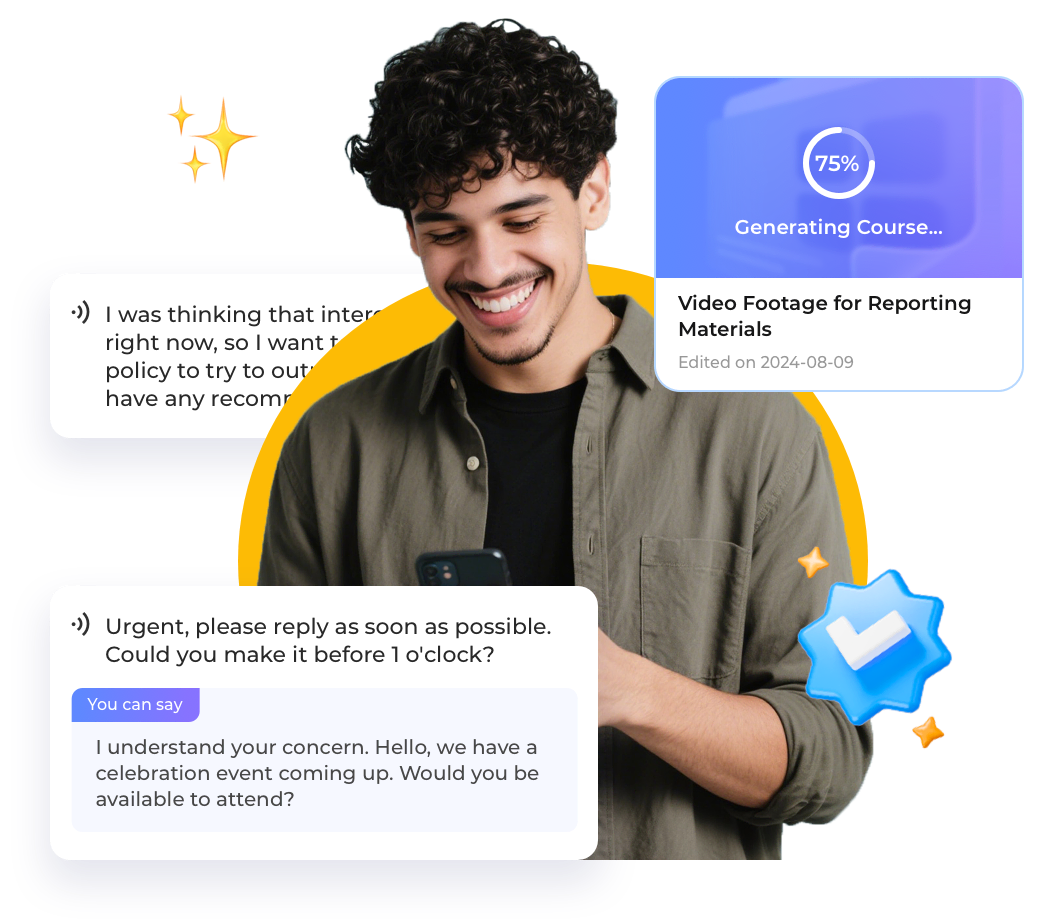
Say a customer calls about a double charge on their bill.The agent starts talking through the issue,and within a few seconds a card appears on screen with the refund policy for double charges,plus a link to process it directly.The agent doesn't have to remember the policy or dig through an internal wiki—the system already matched the conversation to the right answer.
•How does real-time agent assist work during a live call?
It listens through speech-to-text,reads the transcript for intent,and pushes a matching suggestion,script,or compliance flag to the agent's screen—usually within a couple of seconds of the trigger phrase.The agent decides whether to use it;the system never takes over the call.

What "intelligent training" actually means
Intelligent training is AI-run role-play where a simulated customer reacts to what the trainee actually says,scores the session,and flags exactly which skill needs another rep—before that trainee is ever on a real call.It's not a quiz.It's a conversation that responds differently depending on what the trainee says,the same way a real customer would.
Why scripted training falls short
A trainee can recite a de-escalation script perfectly in a classroom and still freeze the first time a real customer raises their voice,because reciting a script and reacting under pressure are two different skills.Classroom training tests memory.A live call tests judgment.Simulation training is the only format that tests judgment before the trainee is on a real call with a real customer's money or account on the line.
That gap is exactly why some contact centers see new hires pass every quiz and still struggle in their first week on the floor—the quiz never tested the skill that actually gets used.
What a simulation session covers
A session usually starts with a scenario setup—say,an angry customer disputing a late fee.The AI customer responds live to whatever the trainee says,adjusting its tone based on how well the trainee handles the situation.After the call ends,the system scores it against specific criteria—did the agent acknowledge the frustration,did they offer the right resolution,did they stay within compliance language—and flags the weakest area for another round of practice.
Because the scoring is specific rather than a single pass/fail grade,a trainee knows exactly what to work on next instead of just knowing they did poorly.
Agent assist vs.intelligent training: what's actually different
Agent assist solves the problem in front of the agent right now.Intelligent training builds the skill so that problem stops needing a at all.Confuse the two and you either under-invest in onboarding,because assist is"covering it,"or over-invest in training,because assist could've handled the gap in real time anyway.
Think of it as the difference between a GPS and a driving lesson.The GPS tells you where to turn right now.The driving lesson is what makes you a driver who doesn't need the GPS to parallel park.Both are useful.They're not interchangeable.
Does agent assist replace training,or work alongside it?
It works alongside it,not instead of it.Agent assist has no memory of what an agent hasn't learned yet—it just reacts to what's happening on the current call.Training is what builds the skill in the first place;assist is what covers the gap while that skill is still developing.
Why the two systems work better connected than separate
Here's the part almost nobody selling either category talks about.A live call reveals exactly where an agent hesitates or gets a compliance flag wrong,and that same data can become the next training scenario.A training session scores which skills are still weak,and that score can tell assist which s to surface first for that specific agent,not a generic list for the whole team.
Run the two systems separately and you lose that loop.Training stays generic because it never sees what's actually happening on live calls.Assist keeps covering the same gap indefinitely because it has no record that this is a recurring weak spot for this specific agent,not a one-time mistake.
A concrete example
Say an agent fumbles refund-policy calls three times in one week—they either quote the wrong window or forget to check the account tier first.Connected systems queue that exact scenario as the agent's next simulation and start surfacing the refund-policy card more aggressively on future live calls for that agent,specifically,until their score improves.Disconnected systems just note three low scores on a dashboard somewhere,and nothing downstream changes.
Instadesk's Intelligent Training platform is built around this exact loop—role-play scoring feeds directly into what its AI Agent Assistant prioritizes for that agent later,instead of the two running as unrelated tools.
What to look for when evaluating a platform
1. Transcription accuracy
Everything downstream—the suggestion,the score,the training recommendation—depends on the transcript being right.A platform can have the smartest suggestion engine in the category and it won't matter if the transcription layer under it keeps missing account numbers or names.
2. Compliance and data handling
Look for PII redaction and actual industry certification,not just a checkbox that says "secure."Contact centers handling payment or health information can't treat this as an afterthought.
3. Whether training data and live-call data actually connect
Ask the vendor directly:does a training score change what assist surfaces on a live call for that same agent?If the answer is no,or if it takes a manual export between two dashboards,you're buying two separate tools wearing one brand name.
4. Multilingual coverage
If the contact center handles more than one language or market,check that both assist and training work natively in each language,not just the primary one with a translation layer bolted on.
How to roll this out without disrupting a live floor
Switching tools mid-operation is a real risk,and it's the part most vendor content skips entirely.
•Start with intelligent training on new hires only
This is the lowest-risk entry point.New hires haven't built habits with the old system yet,and ramp time is the easiest metric to measure cleanly,because you have a clear before-and-after cohort to compare.
•Layer in agent assist for one team or queue before a full rollout
Pick one queue—ideally one with a clear,recurring problem like billing disputes—and run assist there first.This gives the team time to adjust to a new appearing mid-call without disrupting the whole floor at once.
•Track the same three metrics before and after
Ramp time,first-call resolution,and escalation rate.If ramp time drops and holds,the training is working.If first-call resolution climbs and escalations drop,assist is doing its job.Watch all three together,because a gain in one without the others can mean the system is just shifting the problem rather than solving it.
Frequently asked questions
1. Can AI really train customer service skills,or does it need a human trainer?
AI simulation builds the rep count a human trainer can't scale to—a trainee can run ten scenarios in the time it would take to book one live coaching session.A human coach still matters for nuance a scoring model won't catch,like reading whether a trainee's tone problem is a skill gap or just first-day nerves.Use both,and let the AI carry volume while the human carries judgment calls.
2. How long does it take to see ROI from agent assist software?
Ramp-time improvements usually show up within the first cohort trained on the new system,because that's the group with the clearest before-and-after baseline.Live-call metrics like handle time and escalation rate typically take a full quarter to show a stable trend,since call volume and mix vary week to week.
3. What's the ROI of AI-powered contact center training?
The clearest number to track is ramp time—how long it takes a new hire to hit the same quality score as the team average.If that number drops and holds,the training is working.If it drops and then rebounds a few weeks later,the scoring rubric probably needs a second look.
4. Does agent assist work for chat and email,not just voice?
Yes,as long as the platform ingests text the same way it ingests transcribed speech.The guidance logic doesn't change—it's still intent detection followed by a suggestion—only the input format is different.
5. Do agents resist using an AI assist tool?
Some do at first,mainly when the tool interrupts their flow instead of sitting quietly until it's actually needed.Adoption improves fast once agents see it catch something they would have missed on their own,and it tends to stall if the s feel more like noise than help.