1. The Pain Points Plaguing Education Customer Service
Education service teams face persistent operational hurdles that curb growth and service quality.
-
Low efficiency and high costs: Manual outbound call pickup rates hit just 30%, with a 300-call daily limit per agent. Teams waste resources on invalid calls and struggle with peak-season demand surges.
-
Poor personalized experience: Basic chatbots rely on rigid scripts and lack emotional engagement. Human agent skills vary widely, leading to inconsistent service across all touchpoints.
-
Elevated compliance risks: The industry is bound by strict regulations. Manual service risks overpromising, while basic AI generates inaccurate "hallucinated" information, triggering customer complaints.
-
Inefficient team management: High staff turnover leads to steep training costs. Top agents’ expertise is hard to replicate, and service quality lacks quantitative assessment.

2. Instadesk’s Intelligent Training Product: Core Functions & Practical Value
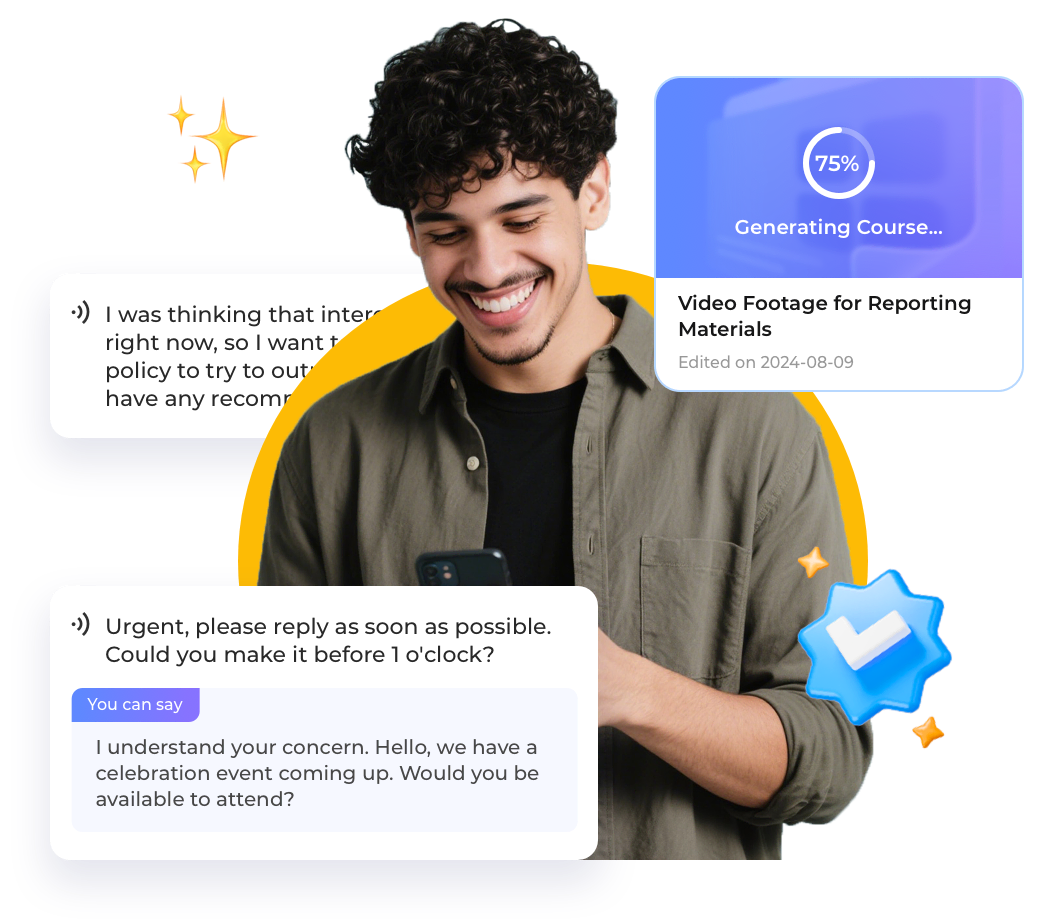
Instadesk’s AI intelligent training products address industry pain points with scenario-tailored features, delivering tangible operational value for education institutions.
|
Core Product Functions
|
Key Advantages for Education Institutions
|
|
AI courseware/exam generation
|
76% higher script building efficiency
|
|
AI role-play practice
|
Shortens new agent training cycles
|
|
Learning-training-assessment-evaluation closed loop
|
Unifies service standards
|
|
Data-driven capability analysis
|
Reduces compliance policy violations
|
|
-
|
Enables data-backed team management
|
3. How to Leverage Instadesk’s Intelligent Training Products Effectively
Maximizing Instadesk’s product value requires targeted, scenario-based deployment aligned with institutional service needs.
-
Standardize new agent onboarding: Use pre-built courseware and AI role-play to quickly equip new hires with basic service skills and compliant communication.
-
Personalize existing agent upskilling: Analyze individual skill gaps via data reports and customize AI practice scenarios for weak areas.
-
Replicate top agents’ expertise: Extract high-quality service dialogues to build training samples, letting the AI model simulate premium customer interactions.
-
Link training to real service data: Refine training content based on actual customer service pain points and high-frequency questions, closing the loop between training and practice.
4. The Future of AI Intelligent Training in the Education Industry
Instadesk’s intelligent training products lead the current industry transformation, and AI training in education is set for four key evolutions.

-
Deep workflow integration: AI training will move beyond standalone use, embedding into the full service cycle—from pre-sales consultation to after-sales follow-up—to drive end-to-end operational optimization.
-
Human-AI collaboration as mainstream: AI handles standardized training and high-frequency scenario practice, while human trainers focus on high-value guidance for complex service cases.
-
Self-evolving AI capabilities: The product will automatically mine high-quality service data to optimize training models, with shorter iteration cycles to adapt quickly to policy and market changes.
-
Omnichannel & cross-scenario integration: AI training will unify standards across voice, chat and SMS channels, and integrate with teaching and marketing systems for holistic institutional digitalization.
Conclusion
Instadesk’s intelligent training products solve core education customer service pain points, from inefficient training to inconsistent service quality. For education institutions, adopting these AI tools is no longer a choice but a necessity to stay competitive.
As AI technology evolves, Instadesk will continue refining its products, helping education institutions build standardized, efficient and compliant service teams. Embracing Instadesk’s AI intelligent training is the key to building sustainable competitive advantage in the evolving education landscape.