The scene:A Monday morning,training room.
A trainer stands in front of fifteen new hires.Slide 14 of 112.“And this is how we handle a customer who asks for a discount…”Half the room is checking phones.Two people are nodding—one is asleep with eyes open.Next week,the same trainer will repeat the exact same slides to another batch.The week after,again.
This is not a failure of effort.It’s a failure of scale.
Corporate trainers are some of the most skilled professionals in any organization.They know the product,the process,the compliance landmines,and the subtle art of reading a room.But they have one unbreakable limit:they can only be in one place at a time.
Enter intelligent training systems—AI-powered platforms that simulate real customer conversations,score agent responses,and deliver personalized coaching at scale.These systems do not replace trainers.They replace the parts of training that should never have been done by humans in the first place.
Let’s break down what each brings to the table,where they clash,and how the smartest organizations are using both.
Part 1:What Corporate Trainers Do Best(That AI Can’t)
Trainers are not just information delivery mechanisms.They are:
Context interpreters.A trainee asks a question that isn’t in the manual.The trainer rephrases,gives an analogy,reads the confusion on the trainee’s face,and tries a third explanation.AI can generate explanations,but it cannot see a furrowed brow and change tack in real time.
Motivators and culture carriers.The trainer who shows up with energy,tells stories about“the worst call I ever took,”and makes the team laugh—that builds psychological safety and trust.AI does not build culture.
Judgment call instructors.“When do you break the rule?”is not a question with a fixed answer.Trainers teach discretion,ethics,and when to escalate.These are not deterministic—they are human judgment passed to humans.
On-the-floor fixers.The best trainers don’t stay in the classroom.They sit next to new agents,listen to live calls,and whisper“now try saying it this way.”AI cannot be a silent,trusted presence beside a nervous employee.
Trainers are irreplaceable for these roles.The problem is that they spend 70%of their time on work that is replaceable:delivering the same scripted module for the 40th time,grading the same role-play scenario,tracking who completed what.
Part 2:What Intelligent Training Systems Do Best(That Humans Shouldn’t)
Intelligent training systems—sometimes called AI simulation coaches or conversation simulators—are not“training videos with quizzes.”They are interactive,adaptive,and data-driven.
Infinite repetition without fatigue.An AI coach can run the same customer objection scenario(“I’ll think about it”)with one thousand agents in parallel,each getting a unique conversation path based on their responses.No human trainer can do that.No human wants to.
Objective,granular scoring.A trainer listening to a role-play might note“good job”or“needs work.”An AI system scores across 30 dimensions:tone,pace,compliance phrase inclusion,objection handling sequence,empathy signals,and more.The score is identical regardless of whether the trainee is the CEO’s nephew or the newest temp.
Safe failure space.New agents are terrified of making mistakes in front of a trainer.In front of an AI voicebot?They relax.They try things.They fail spectacularly in a no-consequence environment—and learn faster because of it.
24/7 availability.The night shift agent who wants to practice objection handling at 11 PM cannot call the corporate trainer.They can log into an AI simulation platform and run five scenarios before bed.
Data feedback loops to trainers.Here is where the magic happens.The AI system aggregates performance data across hundreds of agents and tells the human trainer:“Your team struggles most with‘price objection’scenarios on Tuesdays after 3 PM.The top performer uses this exact phrase:‘Let me show you what’s included before we talk about price.’”The trainer then uses that insight to design a targeted 15-minute workshop—not a generic 2-hour session.
Part 3:The False Conflict(And the Real Partnership)
| Task | Human Trainer | Intelligent System |
| Deliver the same product knowledge module 50 times | ❌ (waste of talent) | ✅ (infinite scale) |
| Run personalized role-play simulations | ❌ (can’t do 1:1 at scale) | ✅ (each agent gets unique path) |
| Grade objective performance (compliance, script adherence) | ❌ (biased, slow) | ✅ (instant, consistent) |
| Observe non-verbal cues and emotional state | ✅ (AI can’t read faces well) | ❌ |
| Coach on complex ethical judgment | ✅ (human-to-human) | ❌ |
| Analyze team-wide skill gaps and design targeted interventions | ✅ (with AI data) | ✅ (provides the data) |
| Provide real-time whisper coaching on a live call | ❌ (can’t be everywhere) | ✅ (AI agent assist) |
Part 4:A Real-World Example–The AI Simulation Coach in Action
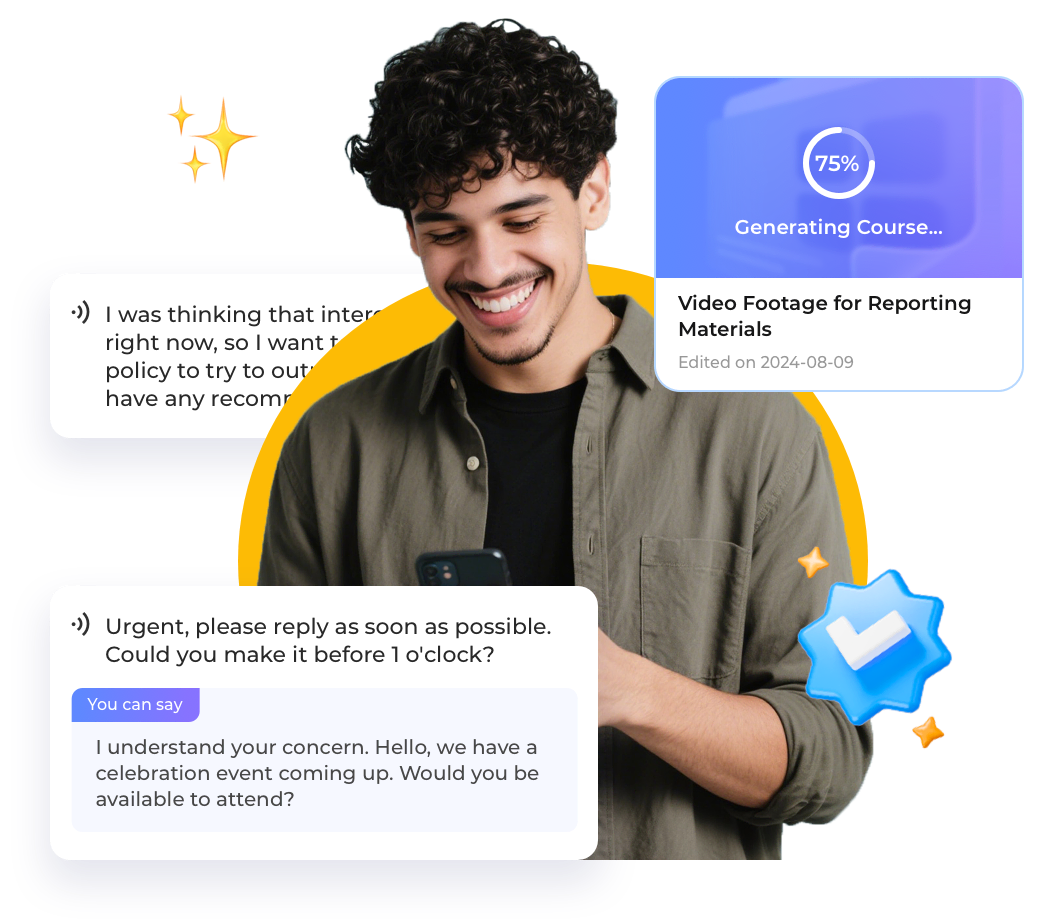
Zhongguancun Kejin’s Dezhu Intelligent AI Coach is a practical example of this partnership.The system simulates customer personas—angry,confused,in a hurry,skeptical—and conducts voice conversations with agents.The agent speaks naturally;the AI responds in character.After the call,the system scores the agent on compliance,empathy,objection handling,and script coverage.
A human trainer then receives a dashboard showing which agents struggled with which scenarios.The trainer does not spend hours listening to recordings.Instead,they spend 15 minutes reviewing the aggregated data,then pull the three lowest-performing agents into a targeted 30-minute coaching session on the specific skill they missed.
The result:agents improve faster.Trainers stop burning out.And the training department transforms from a cost center into a data-driven performance engine.
One financial services client reported:“Our new agents used to take 6 weeks to reach proficiency.With the AI simulation coach plus weekly human coaching,they reach the same level in 3 weeks.And our trainers actually enjoy their jobs again because they’re not repeating the same script all day.”
Part 5:How to Start Building the Hybrid Model
If you currently run a corporate training team and are evaluating intelligent systems,here is a practical roadmap:
Step 1:Audit your trainers’time.
Track one week.How many hours go to repetitive content delivery?How many to personalized coaching?How many to administrative tasks(scheduling,grading,reporting)?The percentage for“repetitive delivery”is your automation opportunity.
Step 2:Pick one high-volume,high-repeatability training module.
Product knowledge basics.Compliance script recitation.Objection handling for the top three customer complaints.Do not try to automate everything at once.
Step 3:Deploy an intelligent simulation system on that module only.
Run it alongside your trainers for 4–6 weeks.Measure:time spent by trainers on that module before vs.after.Agent proficiency scores.Trainer satisfaction(survey them).
Step 4:Redesign the trainer’s role around the freed-up time.
Trainers stop delivering the automated module.Instead,they now:
Review aggregate performance data from the AI system
Run high-impact small-group coaching on specific skill gaps
Record their own“top performer example calls”for the AI system to use as benchmarks
Spend time on the floor,observing live calls and giving real-time feedback
Step 5:Expand.
Once the model works for one module,add the next.Over 6–12 months,you can automate 50–70%of what trainers used to do manually—and double the time they spend on high-value coaching.
Conclusion:The Best Training Department Has Both
The corporate trainer is not obsolete.The trainer who refuses to use data and automation is.
Intelligent training systems do not have favorite agents.They do not get tired.They do not mind running the same scenario 10,000 times.But they also cannot see a trainee’s silent frustration,share a war story that builds trust,or make the judgment call when a customer’s situation doesn’t fit the script.
The winning model is hybrid:AI handles the volume,the repetition,and the objective measurement.Trainers handle the insight,the motivation,and the human moments that no algorithm can fake.
Stop asking“trainer or AI?”Start asking“how do I get my trainers out of the script-delivery business and into the coaching business?”
That is where the real leverage lives.
Has your team used an AI simulation coach alongside human trainers?What worked?What surprised you?Share below.