You’ve experienced it. You call a support line, and the voicebot starts explaining return policies. You try to interrupt—“Actually, I already have the return label”—but it keeps talking. You wait. You repeat yourself. By the time you reach a human, you’re already frustrated.
This happens because most voice systems are half-duplex. They can’t listen and speak at the same time. Full-duplex voice AI changes that—and it’s the reason some voicebots feel human while others feel like talking to a broken machine.

What Is Full-Duplex Voice AI?
Full-duplex refers to the ability to send and receive audio simultaneously. Think of a phone call: both people can talk, interrupt, and respond in real time. Half-duplex, by contrast, works like a walkie-talkie—only one person speaks at a time, and the other must wait.
In voice AI, full-duplex means the system can listen while it speaks. It processes interruptions naturally. It understands that when you say “wait, that’s not what I meant,” you’re redirecting the conversation—not adding noise.
This capability is fundamental to natural conversation. Without it, every interaction feels scripted. With it, customers can talk the way they always do.
Why Interruption Handling Matters
In real conversations, interruptions aren’t rude—they’re clarifying. People interject to correct, redirect, or ask follow-up questions. A voicebot that can’t handle interruption forces customers to follow its script instead of guiding the conversation.
Full-duplex systems detect when a customer speaks during playback, stop immediately, and process the new input. Leading implementations respond to interruption in under 2 seconds—a threshold that feels instantaneous to the human ear.
The result is fluid, natural dialogue. Customers don’t wait. They don’t repeat themselves. They feel heard.
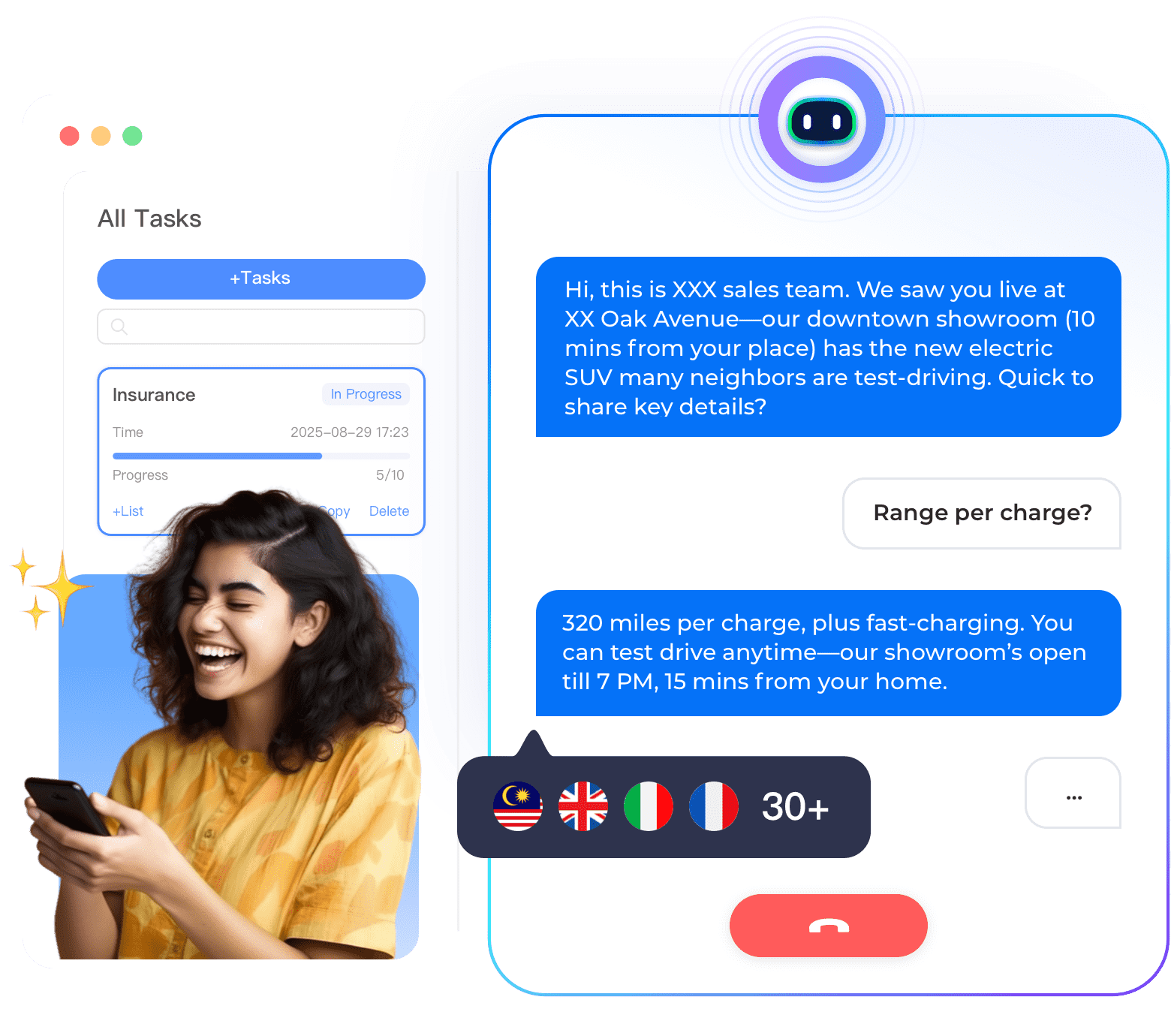
Instadesk VoiceBot supports full-duplex conversation with intelligent interruption. When a customer speaks while the bot is talking, it stops, processes the new input, and adjusts its response—all within 2 seconds. This creates real-time interaction that mirrors how humans actually talk.
Beyond Interruption: The Full-Duplex Advantage
Full-duplex isn’t just about handling interruptions. It enables several capabilities that half-duplex systems can’t deliver:
Backchannel feedback. Humans use small sounds—“uh-huh,” “right,” “okay”—to show they’re listening. Full-duplex AI can insert these naturally, making conversations feel more human.
Real-time adaptation. When the system hears frustration or confusion mid-sentence, it can adjust tone or offer clarification immediately—not after the customer finishes speaking.
Natural turn-taking. In half-duplex systems, turn boundaries are rigid. Full-duplex allows the fluid back-and-forth that defines real conversation.
For outbound calling, these capabilities translate directly to business results. When conversations feel natural, customers stay on the line longer. When they stay longer, conversion rates improve. Marketing and invitation campaigns using full-duplex voice AI report up to 40% higher conversion rates and 65% higher customer satisfaction.
What Full-Duplex Enables That Half-Duplex Can’t
| Capability | Half-Duplex | Full-Duplex |
| Customer interruption | System keeps talking or breaks | Stops immediately, processes new input |
| Mid-sentence adaptation | Waits for turn to end | Adjusts in real time |
| Natural backchannel | Not possible | Yes (uh-huh, right, okay) |
| Turn-taking | Rigid, scripted | Fluid, natural |
| Response to interruption | 5–10 seconds | Under 2 seconds |
The Voicebot 2.0 Standard
Full-duplex is one of the defining features of Voicebot 2.0—the next generation of voice AI that moves beyond scripted, keyword-driven systems. Along with emotion-infused voice, multilingual fluency, and deep system integration, it marks the shift from “automated phone system” to “digital conversation partner.”
For businesses evaluating voice AI, the question isn’t whether a system supports voice. It’s whether it supports conversation. And conversation requires the ability to listen while speaking, to adapt in real time, and to handle interruptions naturally.
What It Means for Your Business
When your voicebot can handle interruptions naturally, customer experience improves immediately. Callers don’t get frustrated by being forced to wait. They don’t repeat themselves. They stay engaged longer.
Longer engagement drives outcomes. In marketing campaigns, natural conversation increases call duration—which correlates directly with conversion. In service scenarios, faster resolution and less friction boost customer satisfaction.
Platforms like Instadesk VoiceBot deliver full-duplex capability out of the box, trained on real conversation data across dozens of industries. Combined with emotional voice infusion, multilingual support, and zero-code orchestration, they enable businesses to deploy voice AI that actually sounds like a conversation—not a script.
Full-duplex isn’t a technical nicety. It’s the foundation of natural conversation. And natural conversation is what customers expect.