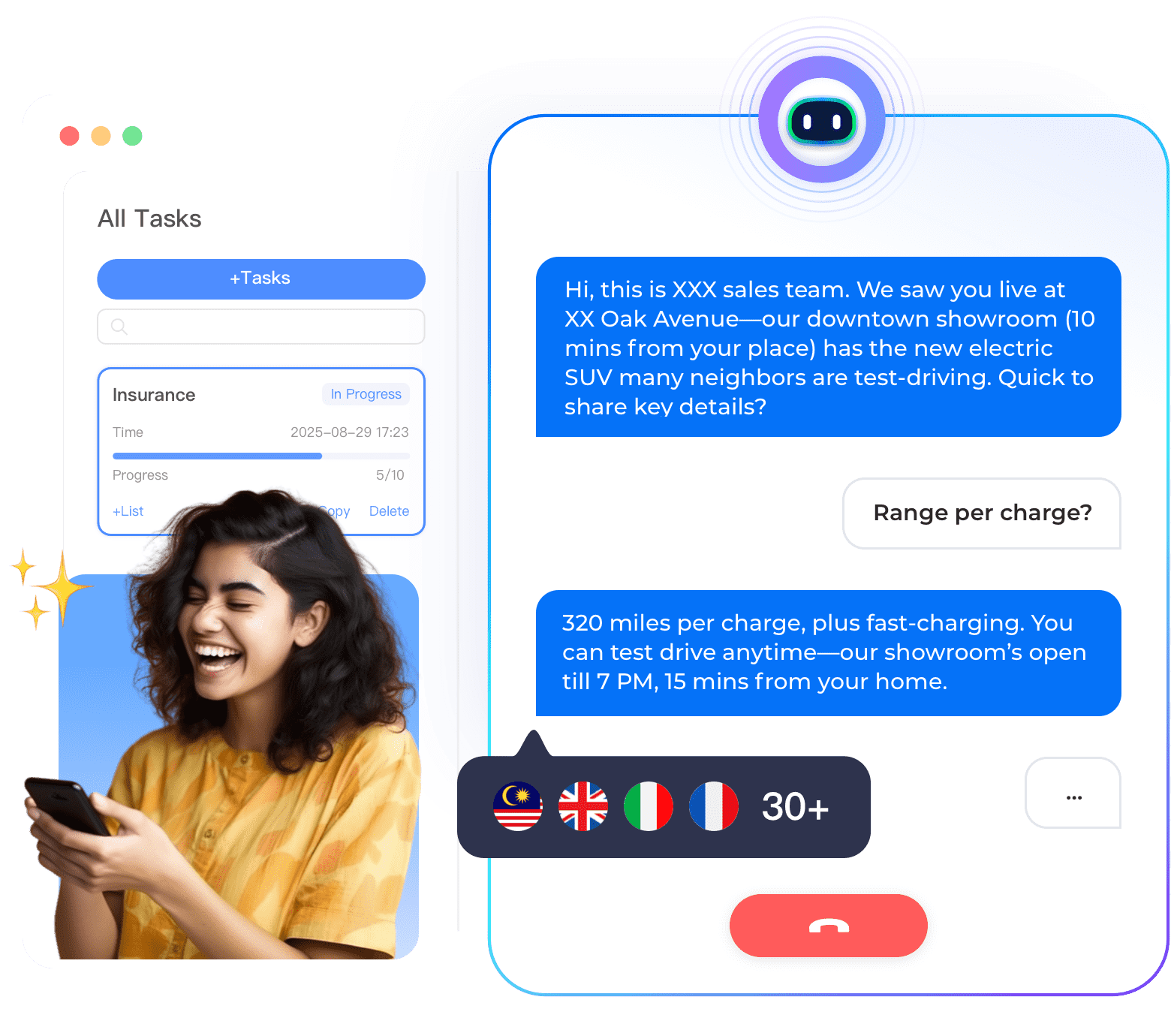

AI outbound calling is software that originates a phone call, holds a genuine two-way conversation using real-time speech recognition and a language model, and logs a structured outcome, all without a human on the line. It's not a recording playing at whoever picks up; it's a system that hears what's said, decides how to respond, and adapts the conversation turn by turn.
That distinction is why it works where older automation didn't. A caller who says something unexpected doesn't break the flow the system processes the actual words and responds to them, rather than following a fixed script regardless of what it hears.
Is AI Outbound Calling the Same as a Robocall?
No. A robocall plays one fixed, pre-recorded message no matter what the person on the other end says or does. An AI outbound call adapts in real time if someone says "I'm driving, can you call back later," the system understands that and responds accordingly, instead of continuing a scripted pitch into dead air.
What's the Difference Between AI Outbound Calling and a Predictive Dialer?
A predictive dialer's job is to connect a human agent to whoever answers the phone, dialing multiple numbers to keep that agent's time filled. An AI outbound calling system is the one actually holding the conversation itself there's no human waiting to be connected, because the AI is the one talking.
How Does AI Outbound Calling Work?
Every AI outbound call follows the same underlying pipeline, whether it's a reminder call or a sales qualification attempt.
The Six-Stage Pipeline
A campaign starts with a trigger a scheduled time, a CRM event, or a manual launch. The system then originates the call over standard telephony infrastructure. The moment something picks up, it runs answer classification to determine what actually answered. If it's a live person, the conversation loop begins. Once the call ends, the system takes an action updating a record, booking something, flagging a follow-up and logs a disposition, a structured summary of what happened.
Inside the Conversation Loop, Turn by Turn
Each exchange in the conversation runs through the same three steps: speech-to-text converts what the person said into text, a language model interprets what they meant and decides how to respond, and text-to-speech turns that response back into a spoken voice. This repeats every single turn of the conversation, which is why response speed matters a noticeable pause between what someone says and the AI's reply feels unnatural and breaks trust fast.
Why This Loop Is Serial, Not Instant
Each of those three steps takes real time, and they happen one after another, not simultaneously. That's why the delay that matters most isn't the average response time across thousands of calls it's the slowest 5% of responses, the ones where a person is left waiting just long enough to wonder if the call dropped.
The First Three Seconds Decide the Call
A system has milliseconds to decide whether a human, a voicemail greeting, an IVR menu, or a phone's own call screener just picked up. Get that decision wrong, and the call fails in one of two expensive ways either talking over a real person as if they were a machine, or pitching a message into an empty voicemail box. Treating this decision as the single most important number in an outbound program, rather than an afterthought, is what separates a campaign that scales cleanly from one that quietly burns through contacts.
How Does an AI Voice Agent Know if a Human or Voicemail Answered?
This process is called answering machine detection, or AMD, and it works by analyzing the greeting's audio pattern in the first moment of the call. Published research on this puts accuracy in the 96–98% range, which sounds high until you realize that's still a handful of misclassified calls in every hundred dialed and at real campaign volume, that adds up to a meaningful number of failed conversations every single day.
The Two Failure Directions Cost Differently
A false "voicemail" verdict on a real person means the system either hangs up or starts talking past someone who was ready to listen, burning a genuine lead. A false "human" verdict on an actual voicemail means the AI delivers its opening line into silence, wasting the call entirely. Neither error is catastrophic on its own, but at scale, both directly eat into how many real conversations a campaign actually produces.
The Screener Problem Nobody Talks About
Modern phones increasingly answer unknown numbers with their own built-in AI features like "Screen Unknown Callers" ask who's calling and why before the phone even rings for the owner. Most answer-classification systems have no reason to flag that as a machine, since it sounds conversational, which means an AI outbound agent can end up in a conversation with another AI system entirely, with neither side aware of it.
Is AI Outbound Calling Legal?
Yes, but the rules are more specific than most people assume, and getting them wrong carries real regulatory risk.
The Real Legal Framework
The FCC's February 2024 ruling ed that AI-generated voices used in calls fall under the same Telephone Consumer Protection Act (TCPA) rules that already governed prerecorded voice messages. That means the obligations that applied to older automated calling technology now apply just as directly to AI voice agents.
The Three Real Obligations
Marketing calls require prior express written consent from the person being called, not just an assumption that a business relationship covers it. Every call needs clear identification of the business calling and a working callback number. And abandoned calls where nobody is available to speak once someone answers are capped at 3% measured over a rolling 30-day window, not just per campaign.
The Two-Second Rule Most Guides Skip
A call has to connect to a live representative, human or AI, within two seconds of the person finishing their greeting. That's not a soft guideline it's a specific timing requirement that shapes how an AI agent's very first response has to be designed, since any noticeable delay at that exact moment risks counting as an abandoned call.
What Actually Goes Wrong With AI Outbound Calling
Most vendor content stops at "it works great," which isn't useful for anyone actually planning to run this at scale.
What Can Go Wrong With AI Outbound Calling?
Turn detection struggles with hesitant speakers who pause mid-sentence, sometimes causing the AI to interrupt or respond too early. Caller ID reputation is a separate problem from technical call authentication a number can be fully verified and still get flagged as suspicious based on calling patterns. High call concurrency can degrade response quality if a platform's infrastructure isn't built to handle volume spikes cleanly. And a small change to a or underlying model can silently shift call behavior in ways that aren't obvious until performance already dropped.
Why Do AI Outbound Calls Get Marked as Spam?
Carrier-level spam labeling reacts to calling patterns high call velocity, low answer rates, and unusually short call durations not to whether AI is actually involved in the conversation. A human calling the same way, at the same volume, with the same short average call length, would get flagged just as fast.
What Should You Actually Automate First?
Not every outbound call type is a good candidate, and picking the wrong ones to automate first is where most programs stumble.
The Calls Worth Automating
Appointment reminders, basic lead qualification, list reactivation, and collecting missing information all share one trait: there's a single, checkable outcome. Did the appointment get ed? Did the lead answer a handful of qualifying questions? That clarity makes it easy to measure whether automation is actually working.
The Calls That Should Stay Human
First discovery conversations on complex deals, any real price negotiation, calls to someone who's already frustrated, and anything requiring regulated financial or medical advice all involve judgment calls that a scripted or even adaptive AI system isn't positioned to make safely.
What Does AI Outbound Calling Cost?
How Much Does AI Outbound Calling Cost?
Published benchmarks put AI outbound calling at roughly $0.13–$0.19 per talk-minute, compared to approximately $0.87 per talk-minute for a fully loaded human sales rep once salary, benefits, and overhead are factored in. That gap is largest at high call volume, since the AI's per-minute cost doesn't climb the way staffing costs do when you need to cover more calls.
Per Dial vs. Per Connected Minute
A price quoted per dial and a price quoted per connected minute are not the same number, and the difference matters most on a cold contact list where a large share of dials never connect at all. Always which figure a vendor is actually quoting before comparing it to another provider's pricing.
FAQ
What Is AI Outbound Calling?
AI outbound calling is software that places phone calls, holds a real two-way conversation using speech recognition and a language model, and records a structured outcome, all without a human dialing or talking on the line.
Is AI Outbound Calling Legal?
Yes, under the TCPA and the FCC's 2024 ruling extending those rules to AI-generated voices. It requires proper consent for marketing calls, clear business identification, and staying under a 3% abandonment rate.
Is AI Outbound Calling the Same as a Robocall?
No. A robocall plays a fixed message regardless of the response. AI outbound calling adapts to what the person actually says, turn by turn, in real time.
What's the Difference Between AI Outbound Calling and a Predictive Dialer?
A predictive dialer connects a human agent to whoever picks up. AI outbound calling is the AI itself holding the conversation, with no human waiting on the other end.
How Much Does AI Outbound Calling Cost?
Typical benchmarks run $0.13–$0.19 per talk-minute for AI, compared to roughly $0.87 per talk-minute for a human agent, with the gap widening at higher call volumes.
Why Do AI Outbound Calls Get Marked as Spam?
Carrier systems flag numbers based on calling patterns like high call velocity and low answer rates, not based on whether AI is making the call. The same pattern from a human caller would trigger the same flag.