You know the experience. You call a company, and a robotic voice says, "For English, press 1. For sales, press 2. For billing, press 3." You press 2, wait, press another number, wait again. Five minutes later, you're still navigating menus, and you still haven't talked to a human.
Traditional IVR (Interactive Voice Response) systems were revolutionary in the 1990s. They automated simple tasks and let customers self-serve basic needs. But today, they're a source of frustration. Customers don't want to memorize menus. They want to speak naturally and get answers immediately. That's why 2026 is the year businesses are finally moving from IVR to AI voicebots.

The Problem with Traditional IVR
IVR systems are built on a simple premise: guide customers through a menu tree. Press 1 for this, press 2 for that. But this model has fundamental limitations.
1. Limited natural language understanding. IVR relies on keyword spotting. Say "billing," and it routes you to billing. But say "I have a question about my last bill, there's a charge I don't recognize," and the system still hears "billing." It can't understand context, intent, or nuance.
2. No interruption handling. Once an IVR starts speaking, you have to wait. You can't interrupt. You can't ask a clarifying question. You're forced to follow its script, not your own.
3. Poor personalization. The voice is mechanical. The scripts are generic. The experience is the same for every caller, regardless of history or need.
The result? Customers hang up frustrated. Simple inquiries become long calls. Agents waste time handling issues that should have been automated.
What AI Voicebots Do Differently
AI voicebots represent a fundamental shift. Instead of forcing customers to adapt to a machine, the machine adapts to the customer.
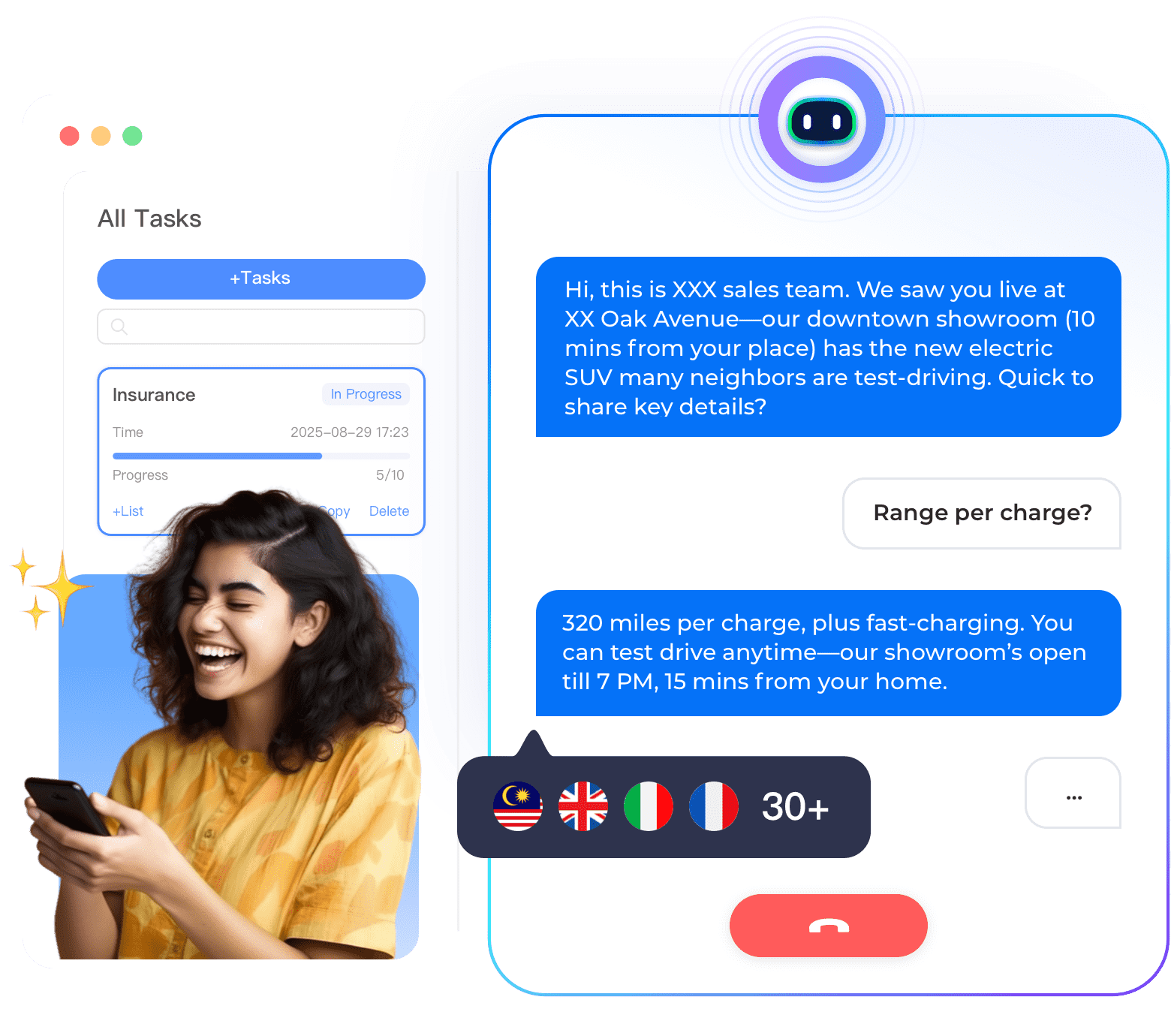
1. Natural conversation, not menus. Customers speak naturally: "I need to check the status of my order." The AI understands intent, extracts relevant details, and responds conversationally. No menus. No waiting.
2. Full-duplex with intelligent interruption. Real human conversation involves interruptions and clarifications. AI voicebots handle this seamlessly. If a customer speaks while the bot is talking, it stops immediately, processes the new input, and adjusts its response—all in under 2 seconds. This creates a fluid interaction that feels like talking to a person.
3. Emotion-aware interaction. The best voicebots don't just understand words—they understand tone, hesitation, and urgency. They can detect frustration and adjust their approach, infusing responses with appropriate emotion to make conversations feel genuine.
4. Deep integration with business systems. An AI voicebot connects directly to your CRM, ERP, and order systems. When a customer asks about an order, it checks actual tracking status. When they want to return an item, it validates eligibility and initiates the return—all without human intervention.
5. True multilingual capability. For global businesses, AI voicebots support 30+ languages with native understanding—not just translation. They handle code-switching, where customers mix languages mid-conversation (like English and Malay), adapting to local communication habits naturally.
Side-by-Side Comparison
| Capability | Traditional IVR | AI Voicebot |
| Interaction |
Press numbers, follow menus | Speak naturally, conversational |
| Interruption | Cannot handle | <2 seconds, full-duplex |
| Understanding | Keyword matching | Intent + context + emotion |
| Voice | Mechanical, generic | Emotion-infused, personalized |
| Language | Single, fixed | 30+ languages, code-switching |
| Integration | Standalone | CRM/ERP integration, action execution |
| Personalization | None | Based on customer history and intent |
| Deployment | Months-long projects | Days with zero-code orchestration |
Why 2026 is the Year to Make the Move
Three trends are converging to make 2026 the tipping point.
AI maturity. Large language models have finally reached the point where voicebots can hold natural, extended conversations. The technology is ready for enterprise scale.
Customer expectations. Today's customers expect instant, conversational service. They've experienced AI on consumer platforms and now expect the same from business interactions. IVR feels like a relic.
Proven ROI. Early adopters have demonstrated the numbers. Organizations moving to AI voicebots achieve 10x efficiency—handling batch outbound calls 24/7, equivalent to 10 human agents. In marketing scenarios, conversion rates increase by 40%. Customer satisfaction jumps by 65%. Deployment time drops from months to days with zero-code orchestration.
Platforms like Instadesk VoiceBot are leading this shift—combining leading large-model technology with visual orchestration, 30+ language support, and industry templates that let businesses deploy in days. With features like emotional voice infusion, intelligent interruption under 2 seconds, and deep CRM integration, these voicebots deliver results that IVR systems simply cannot match.
From IVR to Intelligent Conversation
Traditional IVR served a purpose. It automated simple tasks when technology was limited. But today, customers deserve better. They deserve natural conversation. Instant answers. To be understood.
The technology is ready. The ROI is proven. And the cost of staying with IVR—in frustrated customers and lost opportunities—is higher than ever. 2026 is the year to upgrade.