Introduction
For years,live chat occupied a strange middle ground in customer service.It was more convenient than phone calls,faster than email,more personal than clunky chatbots.But it was also limited—a small window in the corner of a website,staffed by human agents during business hours,disconnected from other channels.
That version of live chat is disappearing.
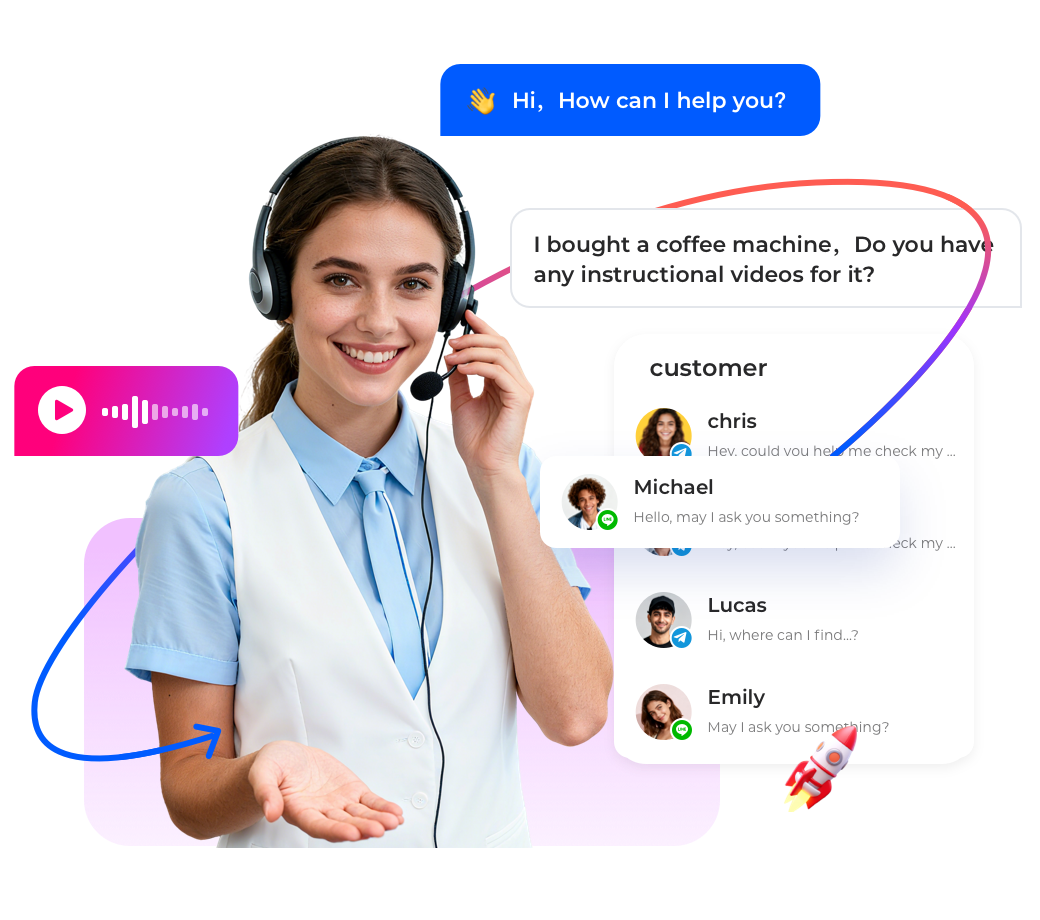
Today,live chat has evolved from a standalone text window into the central hub of omnichannel customer conversation.It connects to WhatsApp,Facebook Messenger,Line,and voice.It seamlessly hands off to AI bots for routine inquiries and to human agents for complex issues.It remembers conversation history across sessions and channels.And it provides agents with AI-powered assistance that makes them faster and more effective.
This guide explains what modern live chat looks like,why it matters for enterprises,and how Instadesk helps businesses build a conversation hub that customers actually enjoy using.
The Problem with Old-School Live Chat
Traditional live chat was built for a simpler era.A customer visited a website,clicked a chat button,and waited for an available agent.If it was after 5 PM or a weekend,they saw an offline message and left.If they switched to email or phone,the conversation history disappeared.If they had a follow-up question the next day,they started over.
The limitations were structural,not just inconvenient.
Channel silos.Live chat lived only on the website.WhatsApp conversations lived in a different app.Voice calls lived on the phone system.Agents could not see what customers had already said on other channels,forcing customers to repeat themselves.
Offline hours meant abandoned conversations.Customers expect 24/7 support.A live chat that only works during business hours sends the wrong message—that your business is closed when customers need help most.
No memory across sessions.A customer who chatted yesterday about a return could not pick up where they left off today.Every interaction started from zero.
Manual,repetitive work for agents.Agents spent most of their time typing the same answers to the same questions("Where is my order?""What is your return policy?"),leaving little energy for complex problem-solving or relationship-building.
What Modern Live Chat Does Differently
The shift from traditional live chat to modern conversation platforms is not incremental—it is fundamental.
Unified inbox across all channels.Modern live chat is not just website chat.It is a single agent interface that shows conversations from website chat,WhatsApp,Facebook Messenger,Line,Telegram,and even SMS.The agent sees the full history regardless of where the customer started.The customer never repeats themselves.
AI-powered triage and response.Routine inquiries—order status,store hours,return policy—are handled instantly by an AI chatbot.The customer gets an immediate answer.The human agent is only involved when the AI cannot resolve the issue.When the agent does join,they see the full AI conversation history and can step in seamlessly.
Persistent conversation history.Modern platforms remember every conversation,across every channel,for every customer.When a customer returns days or weeks later,the agent sees the full history.No more"let me pull up your account"while the customer waits.
Proactive engagement.The best live chat does not wait for the customer to type first.It can trigger based on behavior—time on page,scroll depth,exit intent,cart abandonment—starting a conversation before the customer gets frustrated and leaves.
Agent assist tools.AI does not replace the agent—it makes the agent faster.Suggested replies,knowledge base recommendations,and automated macros reduce typing time.Agents handle twice the volume without doubling the team.
Why Live Chat Is the Hub,Not Just a Channel
Live chat has become the central interface for customer service because it combines the best of all worlds.
Faster than email.Live chat response times are measured in seconds or minutes,not hours or days.
More convenient than phone.Customers can multitask while chatting.No hold music.No"please listen to the following menu options."
Richer than SMS.Live chat supports images,documents,buttons,and quick replies—not just plain text.
Persistent across devices.A customer can start a chat on their laptop during work and continue on their phone during the commute.
Auditable and analyzable.Every chat transcript is automatically recorded,scored,and analyzed for quality,compliance,and customer sentiment.
For these reasons,progressive enterprises are consolidating their customer conversations into a single live-chat-first platform,rather than managing separate systems for email,chat,WhatsApp,and voice.
The Integration Imperative
A live chat platform is only as powerful as the systems it connects to.To be truly effective,it must integrate with your:
-CRM—to show customer history,past purchases,and lifetime value
-Order management system—to check order status,process returns,update delivery
-Knowledge base—to suggest articles and answers without leaving the chat window
-Ticketing system—to create,update,and close tickets automatically
-Marketing automation—to capture leads and trigger follow-up campaigns
Without these integrations,live chat becomes an isolated text window—useful but limited.With them,it becomes the central nervous system of customer engagement.
The Data That Proves the Shift
Businesses that have moved from traditional live chat to modern,AI-powered conversation platforms report dramatic improvements.
Gorgias research shows that brands at the top of the AI resolution distribution resolve 65%of AI-touched tickets end-to-end,while those in the bottom quartile languish at 45%.Every percentage point of improvement in AI resolution removes hours of wait time and significant cart abandonment risk.
Retailers using AI-powered live chat report 20–40%increases in customer lifetime value,primarily because faster,more personalized service drives repeat purchases.
Contact centers that deploy AI agent assist see handle time reductions of 25–35%and first-contact resolution improvements of 10–15%.
The pattern is consistent:AI does not eliminate the need for human agents,but it makes each agent dramatically more productive.And live chat is the interface where that productivity gain is most visible.
Instadesk Live Chat:Built for Modern Enterprises
For enterprises ready to move beyond outdated,channel-siloed live chat,Instadesk offers a modern conversation platform designed for omnichannel,AI-powered customer engagement.
Unified omnichannel inbox.Instadesk brings together website chat,WhatsApp,Line,Facebook Messenger,Telegram,and email into a single agent desktop.Agents see the full conversation history across all channels.Customers never repeat themselves.
AI chatbot integration.Routine inquiries are handled instantly by an AI chatbot.When escalation is needed,the chatbot transfers to a human agent with full conversation context preserved.
Proactive chat triggers.Configure behavior-based triggers—time on page,scroll depth,cart value—to start conversations before customers abandon their session.
Agent assist with suggested replies.AI recommends responses based on past conversations,knowledge base articles,and successful resolutions.Agents accept,edit,or ignore—but they type less and respond faster.
100%conversation quality inspection.Every chat is automatically analyzed for compliance,sentiment,and agent performance.No more manual sampling.
Native e-commerce integrations.Instadesk connects directly to Shopify,WooCommerce,and Magento—pulling order data,customer history,and inventory status into the chat window.
Proven results.An e-commerce retailer using Instadesk reduced average response time from 4 hours to 5 minutes.A logistics provider cut return processing time from eight minutes to under one minute.A fashion brand achieved 60%of returns handled entirely by AI,with human agents only touching exceptions.
Conclusion
Live chat has come a long way from the small,understaffed text window in the corner of a website.Today,it is the conversation hub where AI and human agents work together to serve customers across every channel—website,WhatsApp,social messaging,and beyond.
The old model of siloed channels,offline hours,and manual typing is being replaced by unified inboxes,24/7 AI coverage,and agent assist tools that make every interaction faster and more personal.
The question is not whether to offer live chat—every serious business already does.The question is whether your live chat is a disconnected text window or a unified conversation hub.That distinction determines whether customers leave satisfied or frustrated.