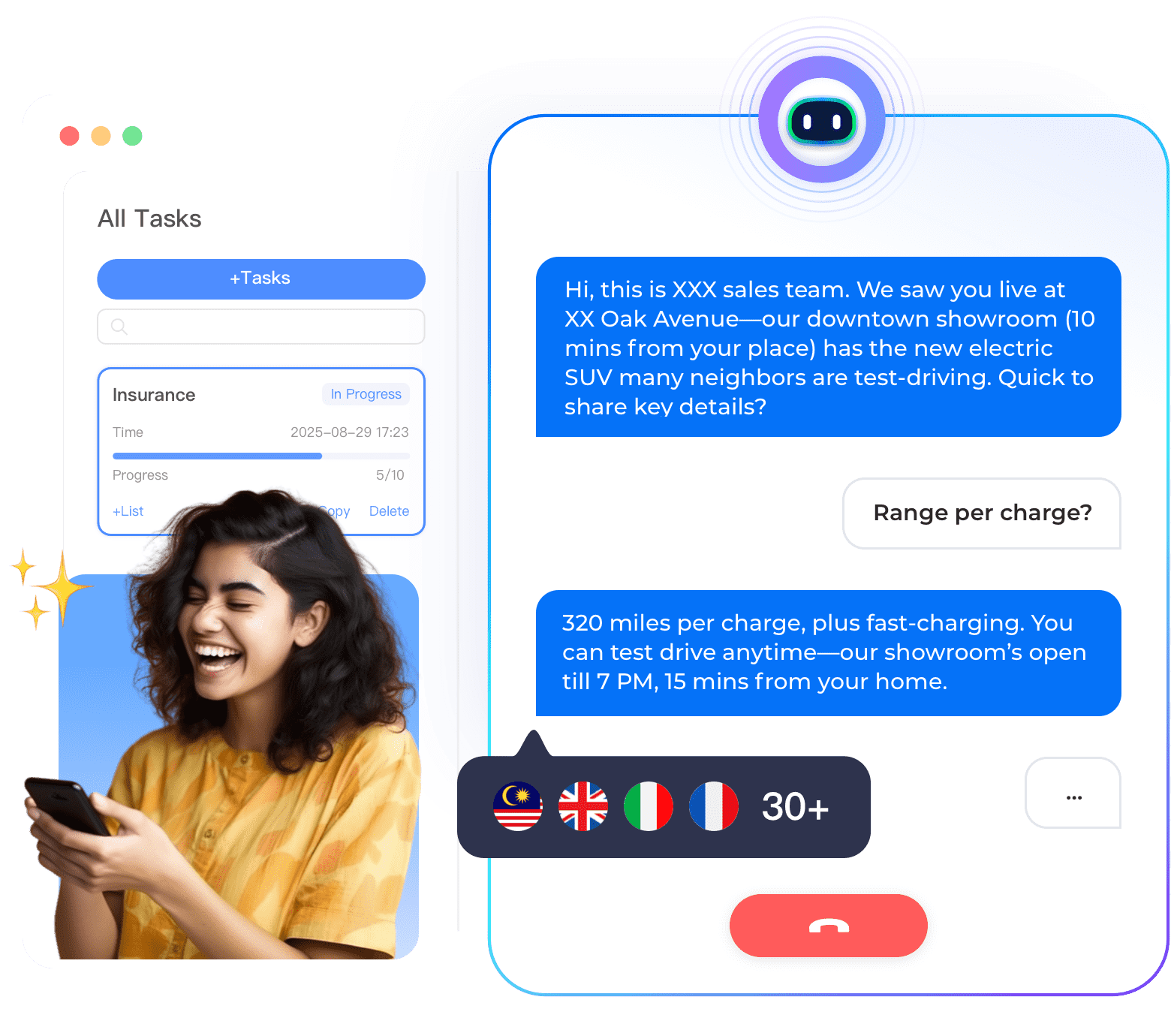
As Chinese enterprises embrace global expansion—spanning products, production capacity, and brands—cross-border logistics demand has exploded. International logistics, a cornerstone of global trade, faces major challenges.
Traditional marketing and service models can’t keep up. They struggle with low efficiency, high overseas labor costs, and poor adaptation to multilingual, multi-scenario needs.
In this landscape, large model voice robots (LLM-powered voice bots) are game-changers for logistics companies. They’re no longer optional—they’re essential for connecting global marketing and service workflows. This guide breaks down what they are, their core value for logistics, and how to implement them.

What Are Large Model Voice Robots?
Large model voice robots are intelligent voice systems built on Large Language Models (LLMs). They integrate Automatic Speech Recognition (ASR) and Text-to-Speech (TTS) technologies.
Unlike traditional script-based voice automation, they understand natural language. They can judge user intentions independently and adapt to complex logistics scenarios.
For cross-border logistics, this means handling diverse customer inquiries across regions and languages with human-like interaction.
Why Do Logistics Enterprises Need Them?
Global logistics companies face three core pain points—and large model voice robots solve all three.
1. Scalable Customer Acquisition
Traditional manual outbound teams only make hundreds of calls daily. They can’t keep up with cross-border lead generation needs.
Instadesk’s large model voice robots offer 24/7 service. They handle thousands of calls daily, boosting customer acquisition by over 200%.
2. Multilingual Service Adaptation
Cross-border logistics serves markets like North America, Europe, and Southeast Asia—each with unique languages.
Traditional robots lack real-time translation. Instadesk supports 10+ languages (including English, Spanish, and Southeast Asian languages), enabling seamless global interaction without large local teams.

3. Reduced Operational Costs
Overseas customer service teams can cost hundreds of thousands of dollars annually.
Instadesk’s robots replace 50–70% of basic customer service and outbound staff—cutting costs while maintaining quality.
Core Advantages Over Traditional Solutions
Traditional voice automation relies on fixed rules and keywords. Instadesk’s large model voice robots offer clear advantages, tailored specifically for logistics.
|
Aspect
|
Traditional Voice
Automation
|
Instadesk Large Model
Voice Robot
|
|
Response Flexibility
|
Fixed scripts;
no unstructured support
|
Dynamic RAG responses;
logistics intent
|
|
Language Support
|
Single language;
no real-time translation
|
10+ languages;
real-time translation
|
|
Scenario Adaptability
|
Simple tasks only
|
End-to-end logistics workflows
|
|
Iteration Capability
|
Static; no self-learning
|
Badcase closed-loop iteration
|
Instadesk’s key strength is its logistics-specific adaptation. It builds a customized cross-border logistics knowledge base—covering customs policies, overseas warehouse info, and freight standards.
The robot retrieves data in real time during conversations, ensuring accurate, professional responses.
How to Implement in Logistics Workflows
Implementing large model voice robots doesn’t require a full system overhaul. A phased approach works best for logistics teams.

Note: The workflow forms a closed loop, with continuous iteration based on pilot results
to optimize core scenarios and model performance.
Common Pitfalls to Avoid
Many logistics companies make avoidable mistakes when adopting large model voice robots.
1. Prioritizing Technology Over Scenarios
Focus on business needs, not technical specs. Choose solutions that solve your specific logistics pain points.
2. Ignoring Industry-Specific Knowledge Bases
Generic AI won’t understand logistics terms like FBA head transportation or overseas warehouse policies.
Instadesk’s logistics-specific knowledge is critical for accurate, professional responses.
3. Lack of Clear Human-Machine Collaboration
Define roles clearly: robots handle standardized tasks; humans manage complex, high-value scenarios.
This ensures efficiency and a smooth customer experience.
Conclusion
Large model voice robots are transforming global logistics. They enable efficient customer acquisition, cost reduction, and high-quality multilingual service.
Instadesk’s tailored solutions stand out for their logistics-specific adaptation, real-time knowledge retrieval, and closed-loop iteration.
For logistics enterprises expanding globally, adopting large model voice robots isn’t just a tech upgrade—it’s a strategic necessity. Follow the steps above, focus on core scenarios, and build a competitive edge in the global marketplace.