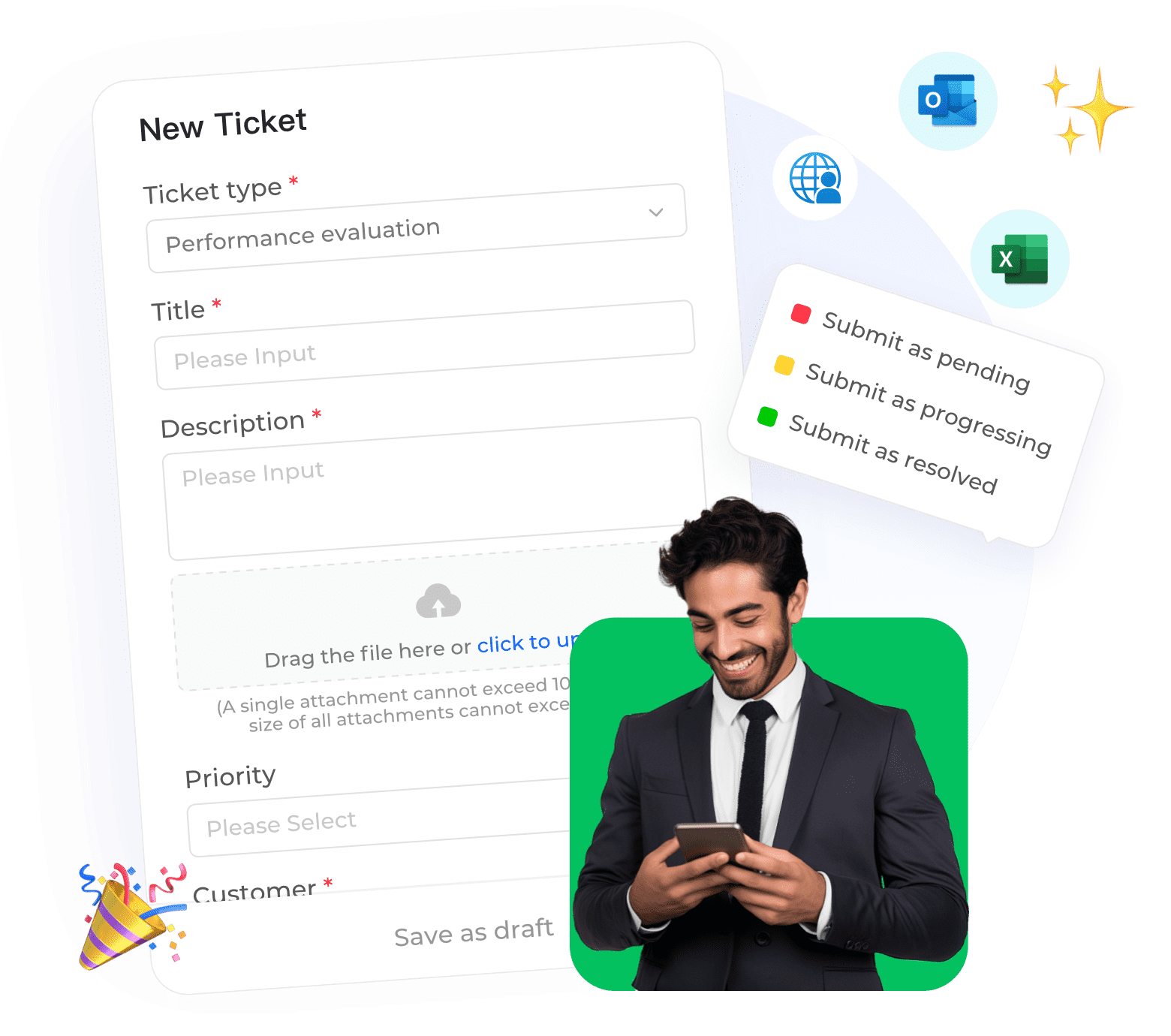

When a game goes global,player inquiries flood in from every direction—email,Discord,WhatsApp,in-app chat,Twitter DMs—each siloed in its own tool,each requiring agents to juggle screens and repeat context.Response times stretch to 12 hours or more,and during peak launches,38% of players churn from delayed replies.Instadesk Ticket System unifies every channel into one intelligent hub,automating routine requests and routing complex issues instantly.The result:average response time drops to under 8 minutes,and support teams stop managing tools and start keeping players in the game.
The Real Cost of Fragmented Player Support
Game studios face a unique set of challenges that traditional ticketing systems were never built to handle:
•Massive inquiry volume–A single game can have millions of players.During peak events like seasonal updates or new expansions,support inquiries can spike 300 percent overnight.Temporary agents take weeks to train.
•Fragmented channels–Players reach out everywhere:email for formal tickets,Discord for community questions,Twitter DMs for complaints,and in-app chat for technical issues.Each tool has its own interface,its own queues,and its own customer history—if it keeps history at all.Agents constantly switch between screens,and player information gets lost.
•Language barriers–A studio serving a global audience may need to support ten or more languages.Hiring native speakers for every language is expensive.Machine translation is often too slow or too inaccurate for real-time support.
•High operational costs–High‑volume customer inquiries,traditional hiring,training,and scaling pressure drive up overall operational costs.During peak seasons,support chaos is almost guaranteed.
•Player churn from slow responses–Data shows that during high-traffic periods,38% of players churn due to delayed responses.In gaming,where player retention is everything,slow support directly hits the bottom line.
How Instadesk Ticket System Rebuilds Player Support from the Ground Up
Instadesk Ticket System is purpose-built for the scale and complexity of modern gaming.It replaces fragmented tools with a single,intelligent platform:
1. Multi-channel ticket creation
Tickets flow in from anywhere—web forms,email,WhatsApp,LINE,WeChat,and API—and are automatically parsed into structured tickets.No more manual copy-paste.No more lost conversations.Every player inquiry,regardless of channel,lands in one unified dashboard.
2. Intelligent routing and assignment
AI-powered assignment,workflows,and triggers automatically route tickets by SLA,skill,or workload.Payment disputes go to payment specialists.Account recovery requests go to security experts.Technical glitches go to the right engineering-adjacent agents.No manual triage means faster complex issue resolution.
3. Email-to-ticket parsing
Customer emails are automatically parsed into structured tickets with reply and CC tracking.Everything stays in one place.Agents never lose track of a conversation thread.
4. Automated workflows and triggers
Routine inquiries—password resets,purchase verifications,gameplay questions—get resolved automatically through AI-powered workflows.Players get help in seconds,not hours.Agents get freed from repetitive tickets and can focus on complex issues that actually need human judgment.
5. Real-time translation
For global studios,multilingual support becomes automatic.The platform translates incoming messages in real time and lets agents respond in their native language.Players hear back in their own language.No specialized hiring required.
Where Smart Ticketing Delivers the Biggest Impact in Gaming
The platform addresses multiple scenarios that plague game studios daily:
•New game launches and major updates–Inquiries spike 300 percent overnight.Instadesk's automated workflows handle the surge without additional headcount.Routine questions get answered by AI.Complex issues get routed to the right specialists instantly.
•Payment and purchase disputes–A player's in-app purchase fails or a transaction is disputed.The ticket is automatically routed to the payment specialist team.Resolution time drops from days to hours.
•Account recovery and security–A player loses access to their account.The system automatically verifies identity using linked social accounts or purchase history,then guides them through password reset without agent involvement.The player is back in the game in minutes.
•Technical glitches and bug reports–Players report crashes or gameplay issues.Tickets are automatically categorized and routed to the right technical team.Agents have full context from previous interactions—no more asking "Can you tell me your ticket number again?"
•Multi-language player support–A player in Thailand submits a ticket in Thai.The agent responds in English.Real-time translation makes it seamless.Players feel heard in their own language.
Real Results from Global Enterprises
While these results come from other industries,the principles apply directly to gaming.A Southeast Asia fashion e-commerce leader deployed Instadesk's omnichannel platform and integrated eight channels including WhatsApp and Shopee into one dashboard.Their average response time dropped from 12 hours to under 8 minutes.They saved over $300K in first-year operational costs.
For game studios,the math is even more compelling.A 38% player churn rate due to delayed responses means millions in lost lifetime value.Cutting response time from 12 hours to 8 minutes isn't just an efficiency gain—it's a player retention strategy.
Conclusion
In gaming,player experience is everything.A slow support response doesn't just frustrate a player—it sends them to a competitor.Instadesk Ticket System equips game studios to respond faster,scale effortlessly,and keep players engaged.That is the new standard for player support.