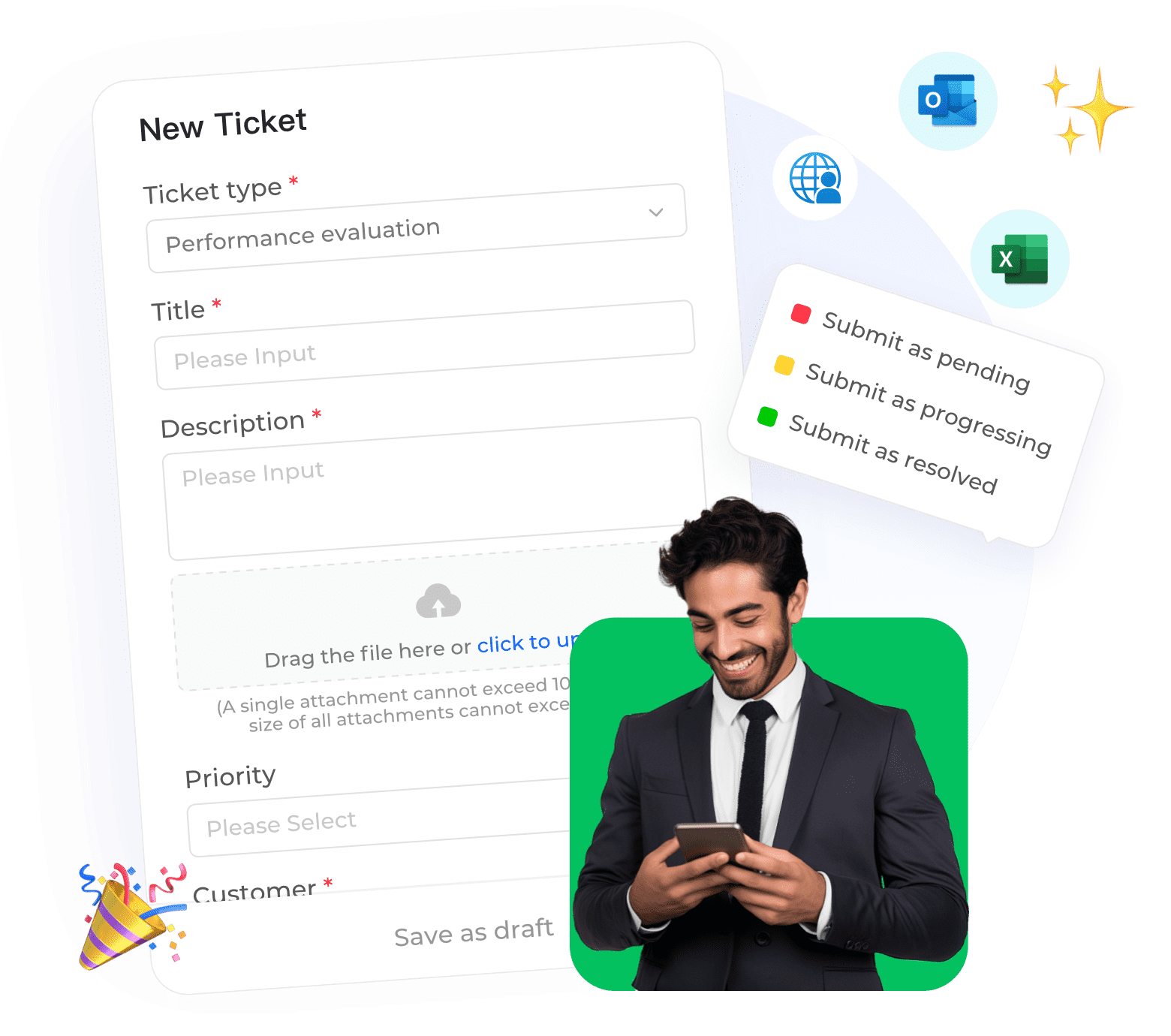

What Is Resolution-Based Support?
Traditional support models measure how many tickets get closed. Resolution-based support measures something different: how many problems get fully solved.
In a ticketing model, an issue might be marked “closed” after an agent sends a response. But if the customer still has the same problem, nothing has actually been fixed. From the customer’s perspective, that ticket was never really closed at all.
Resolution-based support changes this. Teams own each request through to a ed outcome, ensuring the issue is fully addressed across every channel. This approach doesn’t just move tickets forward. It moves customers toward a solution.
Why Ticketing Isn‘t Enough Anymore
Customers are tired of fragmented support. They reach out with a problem, get a reply, and then repeat the same details to someone new. Meanwhile, behind the scenes, it looks like progress. Tickets move forward, responses are sent, and metrics improve.
But the problem remains unresolved. And customers notice.
In 2025, 68 percent of consumers said they’ll pay more for brands that deliver excellent customer service, while 64 percent will switch after just one bad experience. Forty percent will stop doing business with a company after a single poor experience. That‘s not a retention problem. That’s a business continuity problem.
Ticket volumes are climbing. According to HDI‘s State of Tech Support 2025 report, 34 percent of teams report increasing volumes year over year, with spikes up to 42 percent during peak seasons. Yet support budgets remain constrained. The average service desk still spends 68.5 percent of its budget on staffing alone.
Traditional ticketing models were designed for a world where volume was predictable and customers only called during business hours. That world no longer exists.

From Ticket Metrics to Outcome Metrics
Shifting to resolution-based support starts with changing what you measure.
| Traditional Ticket Metrics | Outcome-Based Metrics |
| Tickets closed | Issues fully resolved |
| First response time | Mean time to resolution (MTTR) |
| Ticket backlog size | SLA compliance |
| Average handle time | Customer satisfaction (CSAT) |
First response time measures speed. It tells you how quickly a customer heard back. But it doesn‘t tell you whether they got help. MTTR measures resolution. One metric measures activity. The other measures value.
A team that closes 500 tickets a day might look productive. But if those tickets don’t lead to actual resolutions, customer satisfaction will still drop. Customers have zero patience for being bounced around.
How AI Workflow Automation Enables Resolution-Based Support
Shifting metrics is necessary, but not sufficient. To actually improve resolution rates, teams need tools that act on those metrics in real time.
AI and automation make resolution-based support possible at scale. Routine requests get handled instantly. Complex issues move faster with AI assistance. The result is faster, more consistent outcomes.
AI triages incoming requests, identifies intent and language, and routes them to the right team. For routine issues, it resolves requests through self-service — retrieving answers or completing simple actions like checking order status.
For complex issues, AI supports agents with suggested replies and relevant context. Issues are routed faster, responses are more consistent, and resolutions happen with fewer delays.
Many teams automate between 20 and 60 percent of interactions as they scale their use of AI. This reduces manual work and frees agents to focus on complex issues.
Integrating Front-End and Back-End Systems
A common trap is siloed systems. Your front-end tools might work fine, but if they can‘t talk to your back-end CRM, ERP, or order management systems, your team can’t actually resolve anything end to end.
If a customer calls to update their shipping address, your agent needs to reach into your order system and make that change. Without those integrations, nothing gets fully resolved.
Instadesk bridges this gap. It integrates seamlessly with CRM, ERP, and other business systems. Agents see customer information, order history, and previous interactions in one place. No toggling between screens. No asking customers to repeat themselves.
Real Results from Resolution-Based Support
Logistics provider reaches 85 percent autonomous resolution.
A global logistics provider faced high volumes of routine inquiries — shipment tracking, delivery estimates, address changes. These repetitive requests consumed agent time and pushed up costs.
Using Instadesk‘s AI workflow automation, the company built self-service flows for its highest-volume queries. The result? It reached 85 percent AI autonomous resolution for routine inquiries, freeing agents for complex cases.
E-commerce brand scales from 10 to 193 countries.
Little Warcraft Digital, a global eyewear brand, started with service coverage in just 10 countries. Support was manual. Language barriers required specialized hires. Nighttime service gaps meant delayed responses.
After implementing Instadesk’s platform, the company unified over 20 channels into one workspace and activated real-time translation across 15 languages. AI chatbots now handle routine order status and return requests 24/7.
Agent efficiency improved by over 50 percent. Night service gaps dropped by 80 percent. Ticket SLA reached 99.2 percent. Service coverage expanded to 193 countries — without proportionally growing headcount.
These aren‘t hypothetical projections. They’re real outcomes from companies that shifted from ticketing to resolution-based support.
The Bottom Line
Ticketing models track activity. Resolution-based models track outcomes. The difference changes everything.
When you stop measuring tickets closed and start measuring issues solved, you align your team around what customers actually care about. You automate the routine. You free agents for the complex.
AI workflow automation makes this shift possible. But the real change starts with rethinking what success looks like.
So ask yourself: Are you closing tickets? Or are you solving problems?