
Singapore's financial sector has reached an AI milestone. Every major bank is now either deploying or piloting AI solutions, according to Finastr's 2026 survey. Yet most banks have focused on inbound automation, leaving outbound communication—payment reminders, collections, frauds—still heavily dependent on manual calls. Agents spend hours dialing, leaving voicemails and repeating scripts. Operational costs climb.
83% of Singapore banks plan to invest in customer experience initiatives. In this context, AI voice outbound is not just a cost-saving measure. It is a strategic upgrade.

What is AI voice outbound?
AI voice outbound uses large language models to automate outbound calls. Unlike static IVR or basic text-to-speech bots, it holds natural, multi-round conversations, adapts to customer responses in real time, and takes actions such as updating payment records.
Key capabilities:
• Full-duplex with intelligent interruption. Customers can interrupt naturally; the system stops, processes the new input and adjusts within two seconds.
• Emotion-infused voice with voice cloning. Upload real voice samples to clone tone and intonation. Inject emotion—friendly for reminders, empathetic for collections.
• Massive parallel calling. One AI agent handles the workload of ten human representatives, 24/7. Intelligent call replay and unavailable number detection improve connection rates.
• Real-time personalization. Large models identify intent and emotional state, adjusting conversation content dynamically.
Why Singapore banks need it now
• Competitive pressure. Digital bank licenses and new entrants are shaking up the market. DBS, OCBC and UOB must defend share against agile challengers.
• Labour costs. Entry-level call centre agents earn SGD 2,600–4,000 monthly; specialized roles reach SGD 4,000–5,500. AI offers ten times the calling capacity without ten times the headcount.
• Customer expectations. 69% of Singapore banks rate their CX ahead of peers, yet 83% plan further investment. AI voice extends 24/7 personalization to outbound channels.
How AI voice outbound delivers value for Singapore banks
1. Multilingual capability
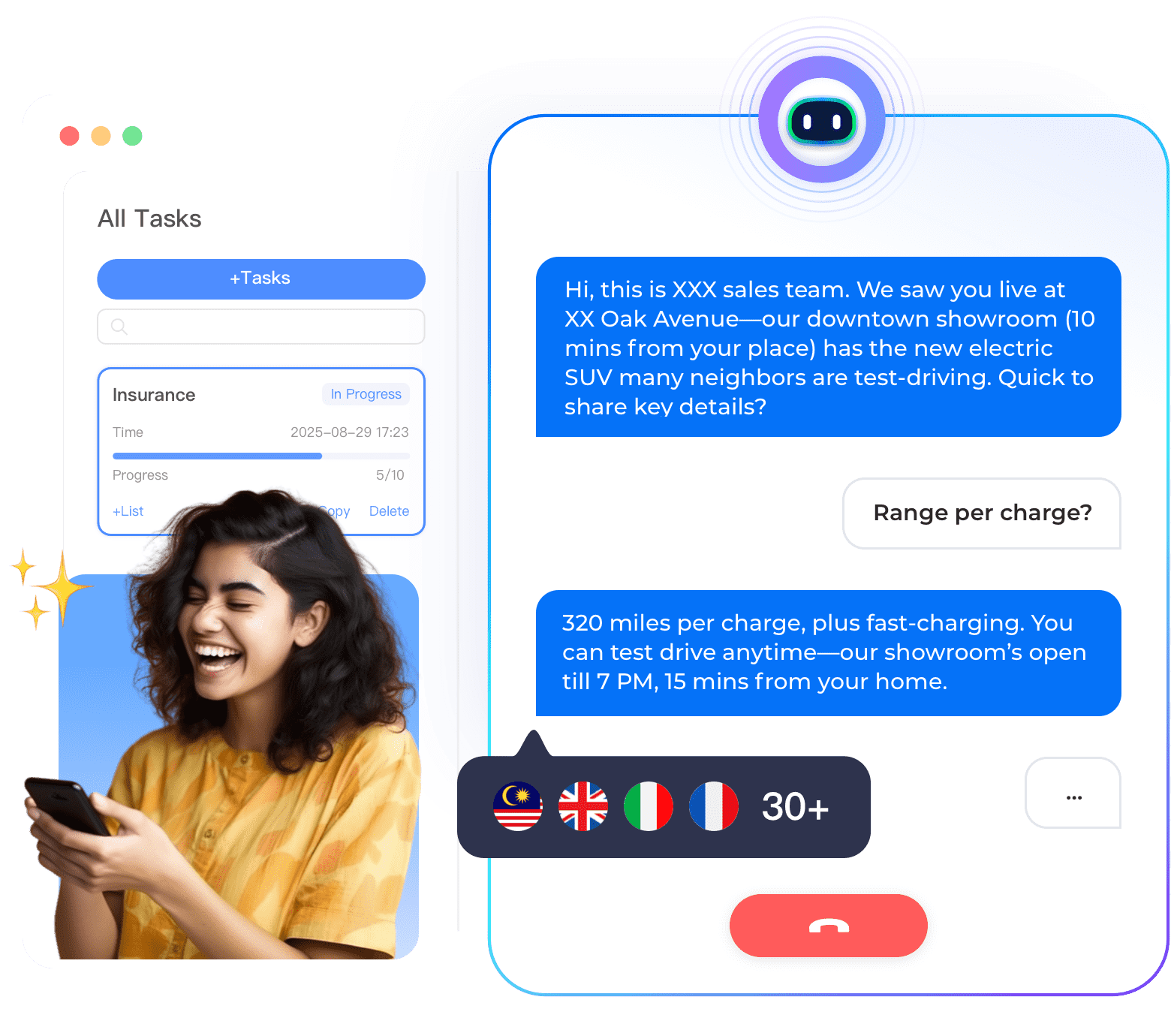
Singapore's population speaks Mandarin, Malay, Tamil and English. HSBC recently added dual English-Chinese support. OCBC’s upcoming in-app outbound call feature recognizes that effective communication must meet customers where their linguistic comfort lies. AI voice with natural code-switching gives banks a direct advantage.
2. Security and trust
Government-official impersonation scams surged to 1,762 cases in the first half of 2025, nearly triple the previous year. Customers are wary of unexpected calls. OCBC will extend in-app calling from inbound to outbound in early 2026, making calls harder to spoof. AI voice platforms with encrypted links, desensitized data and private deployment offer similar assurance.
3. Intelligent segmentation and lead management
Manual segmentation is slow and error-prone. AI voice outbound segments by age, gender, location and behaviour, directing the right message to the right customer. After each call, it tags content, extracts key information and syncs qualified leads directly to CRM. This reduces lead processing time by 50% and accelerates follow-up by 90%.
A practical guide to getting started
• Start with high-volume, low-complexity workflows. Payment reminders, collections follow-ups and fraud s are ideal.
• Use zero-code orchestration. Drag-and-drop interfaces let business teams build and iterate voice agents without engineering backlogs. Deployment takes days, not months.
• Integrate with existing CRM and security frameworks. Connect directly to bank systems. Encrypted links and private deployment meet regulatory requirements from day one.
For banks ready to upgrade
Singapore banks have already committed to AI. The next frontier is outbound communication with the same intelligence and personalization that chatbots brought to digital channels.
Instadesk VoiceBot delivers 30+ languages with native code-switching, full-duplex conversation under two seconds, emotion-infused voice, zero-code orchestration and enterprise-grade security. For banks moving beyond manual dialing, AI voice outbound is not just a tool. It is a new way to talk to customers.