What is interactive simulation?
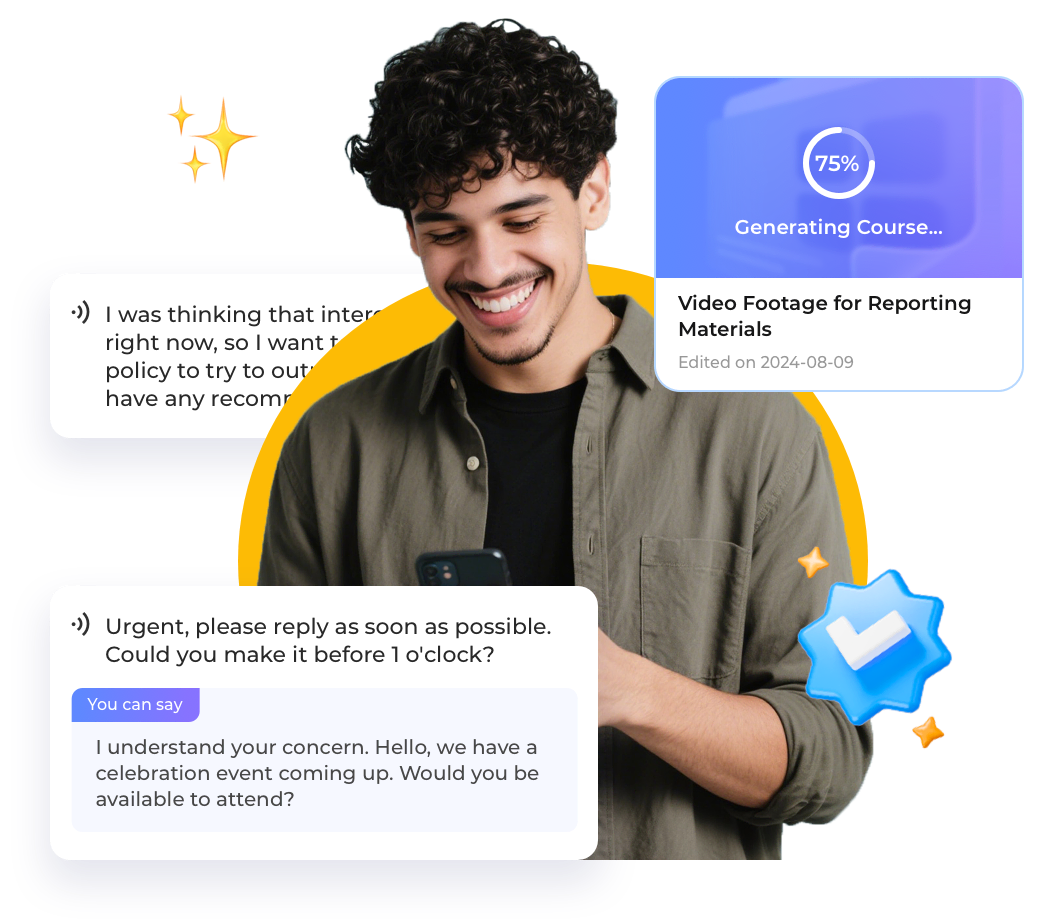
Interactive simulation is a training methodology that immerses learners in realistic,computer-generated scenarios where they make decisions and experience the consequences of those decisions in a safe environment.Unlike passive learning methods like lectures or reading,interactive simulation requires active participation,enabling learners to practice skills,apply knowledge,and build confidence before facing real-world situations.
In financial services,interactive simulation is used to train customer service agents,financial advisors,and compliance officers on handling complex client interactions,regulatory requirements,and sensitive situations.

Interactive simulation vs.Roleplay: What's the difference?
|
Aspect
|
Traditional Role-Play
|
Interactive Simulation
|
|
Scenario consistency
|
Varies by partner
|
Consistent every time
|
|
Feedback
|
After session, from partner
|
Real-time, objective, detailed
|
|
Scalability
|
One-on-one or small groups
|
Unlimited learners simultaneously
|
|
Repetition
|
Limited by time
|
Unlimited practice
|
|
Assessment
|
Subjective
|
Objective, data-driven
|
|
Cost
|
High (trainer time)
|
Scalable, lower per learner
|
Why interactive simulation matters for financial services
Financial services professionals face high-stakes interactions:
•Regulatory compliance: Agents must correctly disclose terms,avoid prohibited language,and follow strict procedures.
•Sensitive topics: Discussing finances,collections,and fraud requires both knowledge and emotional intelligence.
•Complex products: Understanding mortgages,investments,and insurance policies takes significant training.
•High pressure: Customers may be stressed,angry,or confused—agents need practice handling these emotions.
Interactive simulation delivers:
•Safe practice environment: Learners make mistakes without real-world consequences.
•Consistent training: Every learner experiences the same scenarios,ensuring baseline competency.
•Accelerated proficiency: Hands-on practice builds skills faster than passive learning.
•Objective assessment: Data-driven feedback identifies specific areas for improvement.
How to use interactive simulation in financial services
•Identify critical scenarios: What interactions are most challenging?Loan denials?Fraud reports?Collection calls?Upselling?
•Design realistic simulations: Create scenarios that mirror actual customer interactions with realistic dialogue,emotions,and objections.
•Integrate with training curriculum: Use simulations as part of onboarding and ongoing skill development.
•Provide immediate feedback: Learners need to know what they did well and where to improve right after each scenario.
•Track progress: Monitor completion rates,scores,and improvement over time.
How Instadesk Intelligent Training delivers interactive simulation for financial services
Instadesk’s Intelligent Training platform provides AI-powered interactive simulations tailored for financial services:
•Realistic AI customers: Virtual customers with unique personalities,emotions,and knowledge levels.They respond dynamically to the learner’s words and tone.
•Financial services scenarios: Prebuilt scenarios for loan applications,fraud reporting,collections calls,and cross-selling.Custom scenarios can be created for specific products or situations.
•Real-time feedback: After each simulation,learners receive detailed coaching on compliance,accuracy,tone,and empathy.
•Personalized learning paths: AI identifies skill gaps and recommends specific scenarios for each learner.
•Progress tracking: Managers see completion rates,scores,and improvement trends across their teams.
Frequently asked questions
Q:Can interactive simulation really teach soft skills like empathy?
A:Yes.Simulations with realistic AI customers and feedback on tone and word choice help learners practice and internalize empathetic responses.
Q:How does simulation compare to on-the-job training?
A:Simulation accelerates learning by allowing repeated practice in a safe environment.It complements,rather than replaces,supervised on-the-job training.
Q:What technical requirements are needed?
A:Instadesk’s platform is browser-based,requiring no special hardware.Learners access simulations from any computer or mobile device.
Conclusion
Interactive simulation transforms financial services training by providing safe,realistic practice at scale.It accelerates proficiency,ensures consistency,and delivers measurable improvements in compliance,customer satisfaction,and agent confidence.Instadesk Intelligent Training makes this powerful methodology accessible to financial institutions of all sizes.