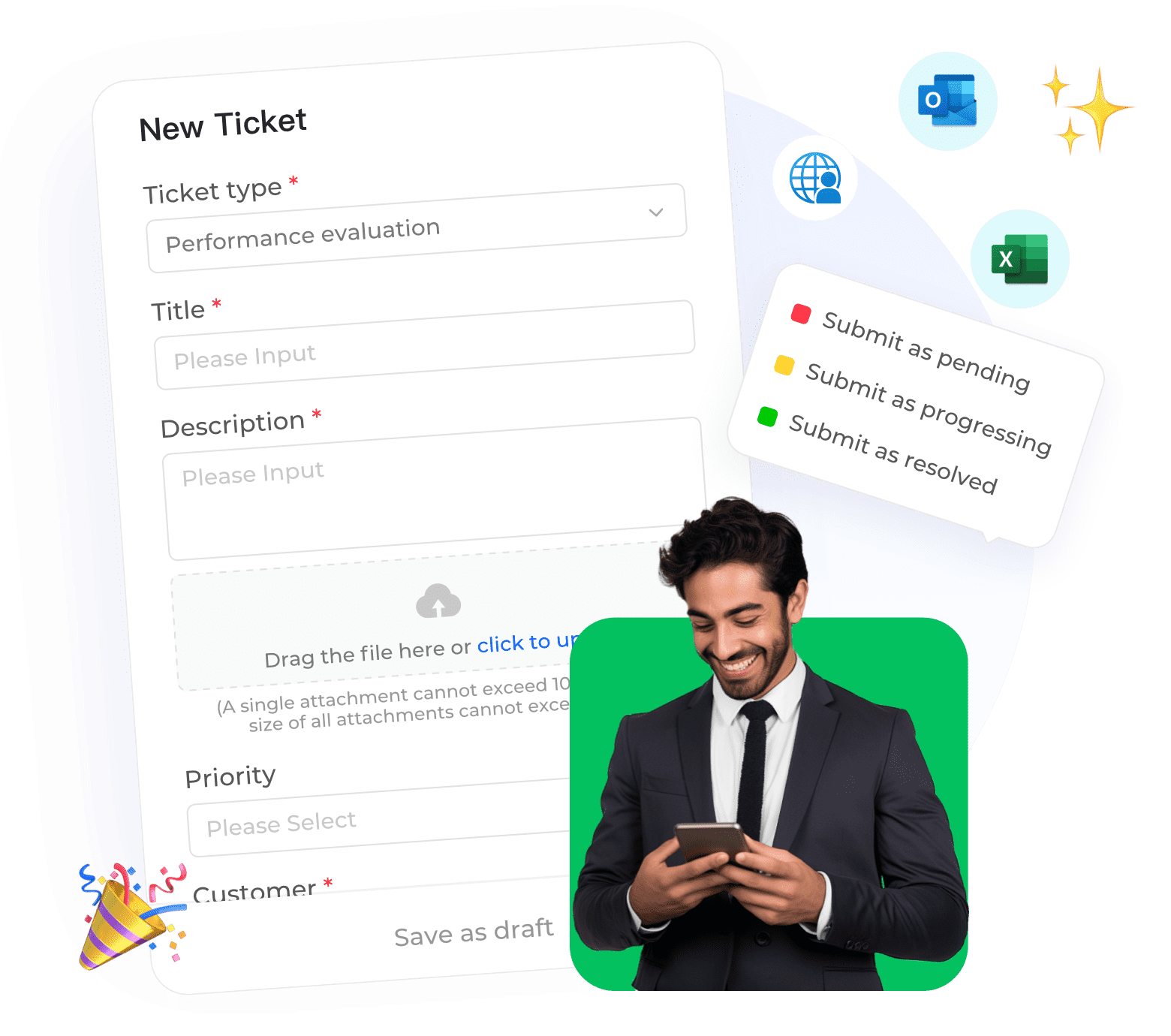
As businesses across Southeast Asia expand into new markets, customer service complexity increases faster than most teams expect. Must-Have Features in a Modern Ticketing System
: Beyond just tracking tickets is not just a product checklist; it reflects a structural shift in how companies operate at scale. When services stretch across Malaysia, Indonesia, Thailand, Vietnam, and Singapore, a ticketing system can no longer function as a passive record of issues. It must become the operational backbone that connects channels, languages, teams, and performance standards into one coordinated framework. This is where Instadesk’s ticketing capabilities demonstrate real impact.

When Channel Growth Becomes Operational Pressure
In one documented overseas deployment, a global smart home brand serving more than 100 countries encountered a growing service bottleneck . The company operated across over 20 overseas service channels, including social media, localized platforms, e-commerce internal messaging systems, email, and phone . Each channel required separate maintenance and monitoring. Internal resources were gradually consumed by platform switching rather than customer resolution.
As inquiries became scattered across disconnected systems, response processes became longer. Information transmission between teams slowed down. Customer waiting time increased.
Instadesk addressed this challenge by building a unified customer service workspace where all major overseas channels were integrated into a single platform . Instead of managing tickets across fragmented environments, every inquiry entered one structured ticket lifecycle. Agents no longer needed to switch between multiple backends. Operational visibility improved immediately.
A modern ticketing system must therefore be capable of consolidating diverse communication channels into one coordinated environment where tickets are standardized, traceable, and manageable at scale.

Intelligent Ticket Classification That Reduces Resolution Delays
Channel integration alone does not guarantee efficiency. Once tickets are centralized, the system must understand how to distribute them properly.
In the same deployment, service coverage spanned more than 10 major languages . Without structured classification, tickets risked being assigned to agents lacking the appropriate language capability or business expertise, which extended handling time and reduced first-response accuracy.
Instadesk implemented intelligent ticket classification and routing mechanisms designed to match tickets with the appropriate teams based on skill and responsibility . Instead of manual sorting, the system automatically directed inquiries to the most suitable service group.
This structured routing capability directly contributed to measurable service outcomes. Based on the intelligent ticket system and optimized routing process, the deployment achieved a 99.2% SLA compliance rate .
A modern ticketing system must therefore include embedded classification and routing intelligence that aligns ticket allocation with real operational logic, rather than relying on manual redistribution after delays have already occurred.
Multilingual Processing Embedded into Ticket Workflow
Serving customers across Southeast Asia requires more than multilingual hiring. It requires workflow-level multilingual integration.
The documented deployment involved service coverage across more than 10 languages . To maintain quality while controlling operational cost, Instadesk integrated an AI-powered real-time translation engine directly into the unified workspace .
As a result, the customer service team was able to support real-time communication in 15 languages . Language barriers were reduced without multiplying internal teams for every new region. Communication consistency improved across global service operations.
For companies expanding from Singapore into neighboring markets or from Malaysia into broader ASEAN regions, a ticketing system must allow agents to process multilingual tickets inside the same operational interface. This prevents workflow fragmentation and protects service quality across borders.
Time-Zone-Aware Ticket Allocation for Global Responsiveness
Customers expect responses during their working hours, not according to headquarters time. In the documented overseas case, Instadesk prioritized ticket assignment based on customers’ local time zones . Tickets were allocated to teams operating in the same or adjacent time zones to ensure faster response during local business hours .
This design improved cross-time-zone response timeliness and enhanced the overall customer experience .
A modern ticketing system must therefore incorporate time-zone logic into routing strategy, especially for companies operating across Indonesia, Thailand, Vietnam, and Singapore, where distributed service teams are increasingly common.
Deep Integration with Business Systems to Improve Accuracy
Tickets do not exist in isolation. They relate to orders, product information, and historical records.
In the IMOU deployment, Instadesk achieved data synchronization with the client’s OMS management system through standardized APIs . When handling inquiries, agents could automatically retrieve and view customer information within the same workspace. Integration with the enterprise knowledge base API ensured quick access to the latest product details and solutions .
This integration eliminated unnecessary repetition in customer communication and reduced handling errors caused by incomplete context.
A modern ticketing system must therefore function as a data-connected operational layer rather than a disconnected message queue. Only through structured integration can service teams maintain both speed and accuracy as ticket volume increases.
Global Service Standardization Through Structured Ticket Governance
As companies expand internationally, maintaining consistent service standards across regional teams becomes increasingly difficult.
In the documented deployment, the unified workbench enabled standardized global service practices across teams . Every ticket followed the same structured process. Performance metrics were measurable. SLA tracking was transparent.

The outcome was not just operational efficiency but service consistency across more than 100 countries .
For companies in Southeast Asia scaling rapidly across borders, governance cannot depend solely on management oversight. It must be embedded into the ticketing infrastructure itself.
Ticketing as Service Infrastructure
A modern ticketing system must evolve from a reactive tracking tool into a proactive operational framework capable of centralizing fragmented communication channels, intelligently analyzing and routing tickets based on language, responsibility, and time-zone alignment, integrating deeply with order and knowledge systems to eliminate contextual gaps, supporting real-time multilingual communication within the same workflow, and delivering measurable SLA performance across distributed service teams.
Instadesk’s documented overseas deployment demonstrates that when these capabilities are built into the ticket system architecture, service becomes predictable, scalable, and measurable .
For businesses expanding across Malaysia, Indonesia, Thailand, Vietnam, and Singapore, the real question is no longer whether tickets can be logged, but whether the ticketing system itself can support structured international growth.
That is what modern ticketing demands. And that is where Instadesk positions itself.