Banks invest heavily in training for customer service agents, compliance officers, and sales teams. But how do you know if the training is working? Traditional training evaluation relies on smile sheets and completion rates, which do not measure whether agents actually perform better on calls. A new trend is emerging: training effectiveness evaluation that links learning to business outcomes—compliance violation rates, first-call resolution, customer satisfaction, and sales conversion. This article explores why banks must adopt this approach, the key metrics to track, and how AI-powered training platforms like Instadesk enable data-driven evaluation.

The Current Training Evaluation Crisis in Banking
Most banks still use Level 1 (reaction) and Level 2 (learning) evaluations from the Kirkpatrick model: “Did participants like the training?” and “Did they pass a quiz?” These metrics do not predict real-world performance. Agents may ace a compliance quiz but still miss disclosures on live calls. As a result, banks waste millions on training that does not change behavior. The shift to Level 3 (behavior) and Level 4 (results) evaluation is not just a trend—it’s a necessity.
Why Banks Need to Measure Behavior and Results
Regulatory pressure: Regulators increasingly ask for evidence that training improves compliance, not just completion.
Cost justification: With training budgets under scrutiny, banks must demonstrate ROI.
Agent performance gap: Without behavior measurement, coaching is based on assumptions, not data.
Customer satisfaction: Poor agent behavior directly impacts CSAT and retention.
Key Metrics for Training Effectiveness Evaluation
Simulation performance scores: Objection handling, compliance adherence, empathy, closing rates.
Pre-vs-post training assessments: Improvement in scenario-based tests.
Time to proficiency: How many days from hire to consistent performance.
Compliance violation rates: Before and after training (measured by AI quality inspection).
Quality monitoring scores: Measured by AI or human reviewers.
Customer satisfaction (CSAT) scores: Correlated with training completion.
Sales conversion rates: For sales training.
Agent retention: Lower turnover after effective training.
How AI-Powered Training Platforms Enable This Shift
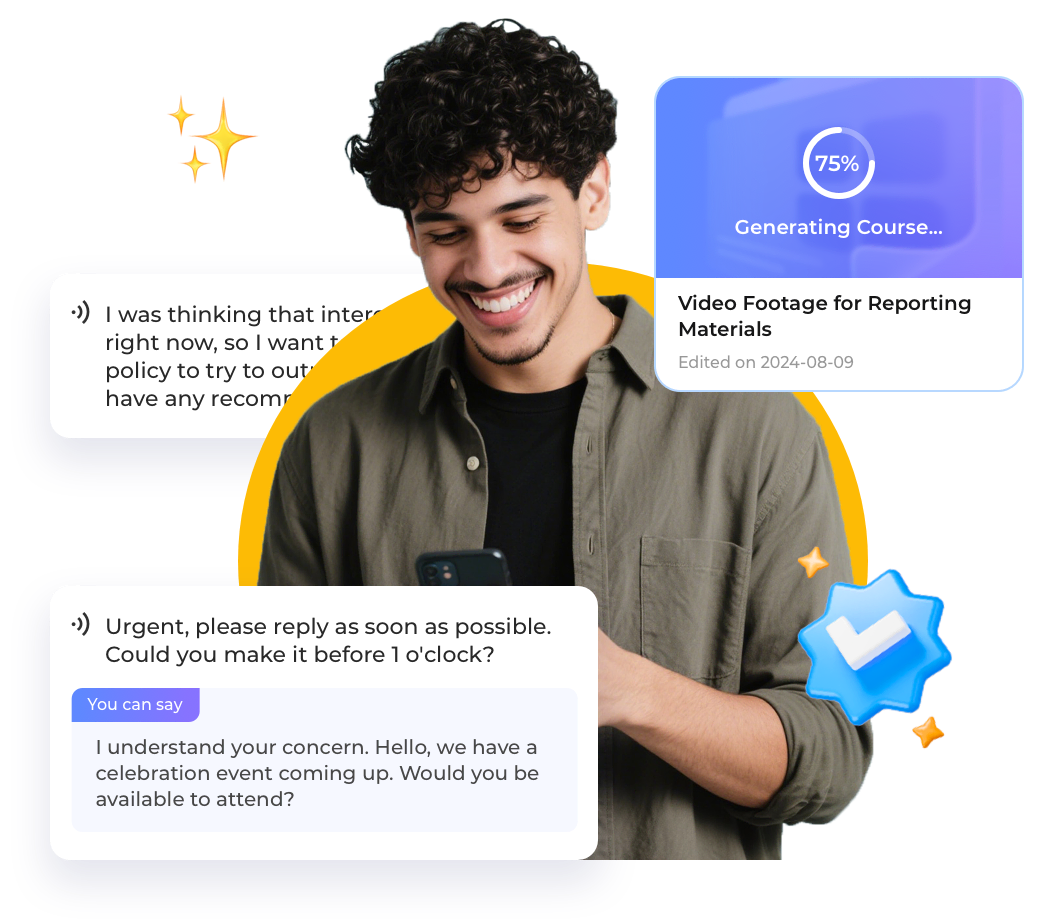
Traditional e-learning platforms cannot measure behavior change. AI-powered simulation platforms, however, capture every interaction during practice. They score agents on specific competencies and track improvement over time. When integrated with quality monitoring systems, they can correlate training completion with actual call performance. This closes the loop between learning and business outcomes.
How Instadesk’s Intelligent Training Supports Training Effectiveness Evaluation
Instadesk’s platform provides comprehensive analytics for training effectiveness. Key features include simulation scorecards with subscores for objection handling, compliance, empathy, and closing. Pre- and post-training competency dashboards to measure improvement. Time-to-proficiency tracking by agent cohort. Integration with quality monitoring to correlate training with call performance. Automated reporting for compliance training (audit-ready). A/B testing for training scenarios to identify the most effective content.
Case Study: Bank Reduces Compliance Violations by 60% After Simulation Training
A regional bank deployed Instadesk’s simulation-based training for 300 call center agents. They evaluated effectiveness using Level 3 and 4 metrics. Results: simulation scores improved by 40% from pre- to post-training; compliance violation rates (measured by AI quality inspection) dropped by 60% within 3 months; customer satisfaction scores increased by 15%; agents who completed training had 30% lower turnover than the control group. The bank calculated a 400% ROI on training investment.
What This Means for Banking Leaders
To stay competitive, banks must invest in training platforms that provide granular data on behavior change and business impact. The cost of not doing so includes higher compliance fines, lower customer satisfaction, and increased agent turnover. Start by piloting an AI-powered simulation platform with a small team, measure the impact on key metrics, then scale.
The future of training effectiveness evaluation is data-driven, behavioral, and linked to business outcomes. Instadesk’s Intelligent Training platform enables banks to measure ROI, reduce compliance risk, and improve agent performance. Embrace this trend to build a more skilled, compliant, and efficient workforce.